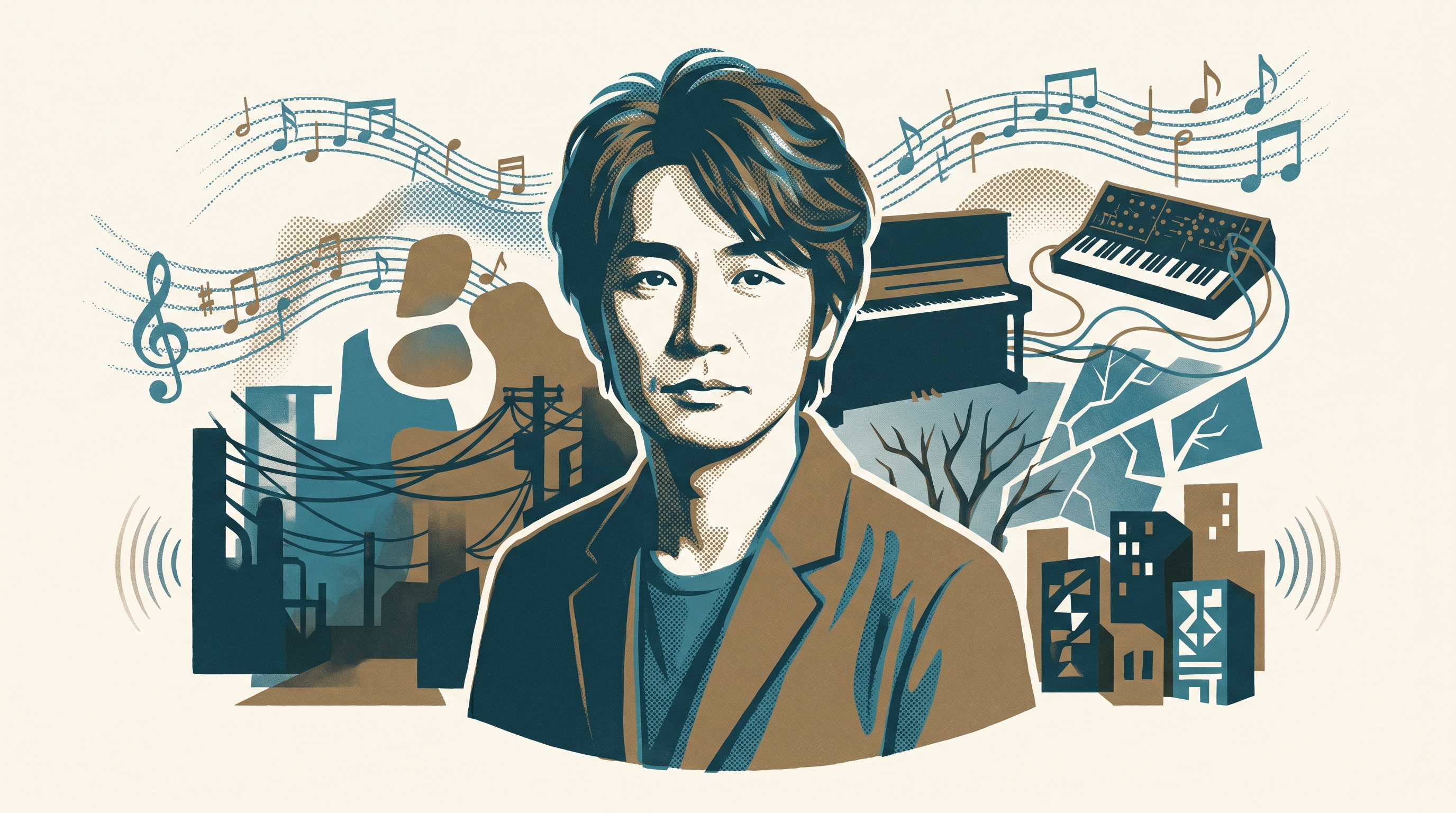
composer
Akira Yamaoka
山岡晃
He made silence louder than screams. Proof that what you don't hear shapes fear more than what you do.
About
Akira Yamaoka is a Japanese composer and sound designer, born February 6, 1968, in Niigata. He joined Konami in 1993 and volunteered to score the original Silent Hill (1999) because he believed only he could make the soundtrack. He composed and designed sound for nearly every Silent Hill entry, also producing several installments starting with Silent Hill 3. He left Konami in 2009 and joined Grasshopper Manufacture in 2010, working with Goichi Suda and Shinji Mikami on Shadows of the Damned.
History
Akira Yamaoka was born on February 6, 1968, in Niigata, Japan. He studied product design and interior design at Tokyo Art College, intending to become a designer. Music entered his life not as a plan but as a parallel track. He learned to play instruments, composed on the side, and thought of it as a private skill — something he did for himself, not for a career. By the time he graduated, he had decided to keep design as his profession. But when he applied to Konami in 1993, the company hired him as a sound engineer. He joined on September 21, 1993, and was immediately assigned to work on Contra: Hard Corps and the Sparkster titles. His career in music had begun, whether he had fully chosen it or not.
For the first few years at Konami, Yamaoka worked as a composer and sound designer on games that did not ask him to invent a new language. The work was competent, professional, and forgettable. Then, in the late 1990s, Konami began development on a survival horror game called Silent Hill. The project needed a composer. When the call went out, Yamaoka volunteered. According to his own account, he believed he was the only one at the company capable of making the kind of soundtrack the game required. That was not arrogance. It was a statement of fit. Silent Hill was not asking for orchestral grandeur or catchy melodies. It was asking for dread, ambiguity, and the sound of a world coming apart at the seams. Yamaoka understood that instinctively.
Silent Hill released in 1999. The soundtrack was not music in the traditional sense. It was texture — industrial noise, distant sirens, static, the hum of machinery heard through walls. Yamaoka layered these sounds with sparse piano, dissonant strings, and unsettling ambient drones. The result was a score that did not accompany the horror; it was the horror. The fog, the rust, the empty streets — these were visual. But the unease, the sense that something was wrong even when nothing was visibly threatening, came from the sound. Yamaoka had made silence louder than screams.
His approach was influenced by artists outside the gaming industry. He has cited Trent Reznor of Nine Inch Nails as his primary inspiration — both in performance style and in the way Reznor used noise as an emotional instrument. He also drew from Angelo Badalamenti's work with David Lynch, particularly the Twin Peaks soundtrack, which used beauty and dissonance in equal measure. The more atmospheric tracks by Depeche Mode and Metallica shaped his sense of mood. These were not game composers. They were musicians who understood that sound could carry psychological weight. Yamaoka brought that understanding into a medium that had rarely demanded it.
Silent Hill became a franchise, and Yamaoka became its sonic architect. He composed for Silent Hill 2 (2001), which he later named as his favorite of his own soundtracks, Silent Hill 3 (2003), and Silent Hill 4: The Room (2004). Starting with Silent Hill 3, he also took on the role of producer, overseeing not just sound but the overall direction of the series. His dual role meant that the soundscape and the game design were intertwined — the music was not added after the fact, it was built into the structure from the beginning. He worked on nearly every main entry in the series until his departure from Konami.
On December 2, 2009, Konami announced that Yamaoka was leaving the company. He had been there for sixteen years. On February 3, 2010, he joined Grasshopper Manufacture, a smaller, more experimental studio led by Goichi Suda. There, he worked with Suda and Shinji Mikami — the creator of Resident Evil — on an action game called Shadows of the Damned. The project was different in tone from Silent Hill, more pulp and less psychological, but Yamaoka's contribution remained rooted in atmosphere. He continued to compose for other projects, including contributions to later Silent Hill entries developed by external studios, though his direct involvement with the series had ended.
Yamaoka's career is a study in what happens when someone refuses to treat a medium as a limitation. He did not write game music. He wrote music that happened to be in games. The distinction mattered. Silent Hill's soundtracks were released as standalone albums and were played in concert halls. Players listened to them outside the game, in cars, on headphones, in quiet rooms. The music worked because it was not illustrative — it was expressive. It did not describe fear. It generated it. That is not a trick of clever sound design. It is the result of someone understanding that the absence of melody can be more powerful than its presence, and that silence, when shaped correctly, becomes a kind of sound all its own.
Timeline & Works
Career milestones and all 2 games in the museum they worked on — in the order they happened.
- 1968 02
Born in Niigata
Akira Yamaoka was born on February 6, 1968, in Niigata, Japan.
people - 1993 09
Joined Konami
Joined Konami as a sound engineer on September 21, 1993. Immediately assigned to Contra: Hard Corps and Sparkster titles.
people - 1999
Silent Hill released
Silent Hill released with Yamaoka's groundbreaking sound design and composition. He volunteered for the project, believing only he could create its soundtrack.
product - 1999
- 2001
Silent Hill 2
Composed Silent Hill 2, which he later named as his favorite of his own soundtracks.
product - 2001
- 2003
Silent Hill 3 — became producer
Composed and produced Silent Hill 3, taking on dual role as both sound designer and series producer.
leadership - 2009 12
Left Konami
Announced departure from Konami on December 2, 2009, after sixteen years with the company.
people - 2010 02
Joined Grasshopper Manufacture
Joined Grasshopper Manufacture on February 3, 2010. Began working with Goichi Suda and Shinji Mikami on Shadows of the Damned.
people
Connections
- employed konami (1993–2009)
Joined as sound engineer, became composer and producer of the Silent Hill series.
Also connected to
- Keiichiro Toyama co-created Silent Hill
Explore the work
Each title has its own page — history, trivia, and collector's notes.
Sources
- Akira Yamaoka — Wikipedia — accessed 2026-06-23
- Interview: Silent Hill Composer Akira Yamaoka — Anime News Network — accessed 2026-06-23
- Creating Fear: Interview with Akira Yamaoka (Konami) — Silent Hill Memories — accessed 2026-06-23
- Akira Yamaoka | Silent Hill Wiki | Fandom — accessed 2026-06-23