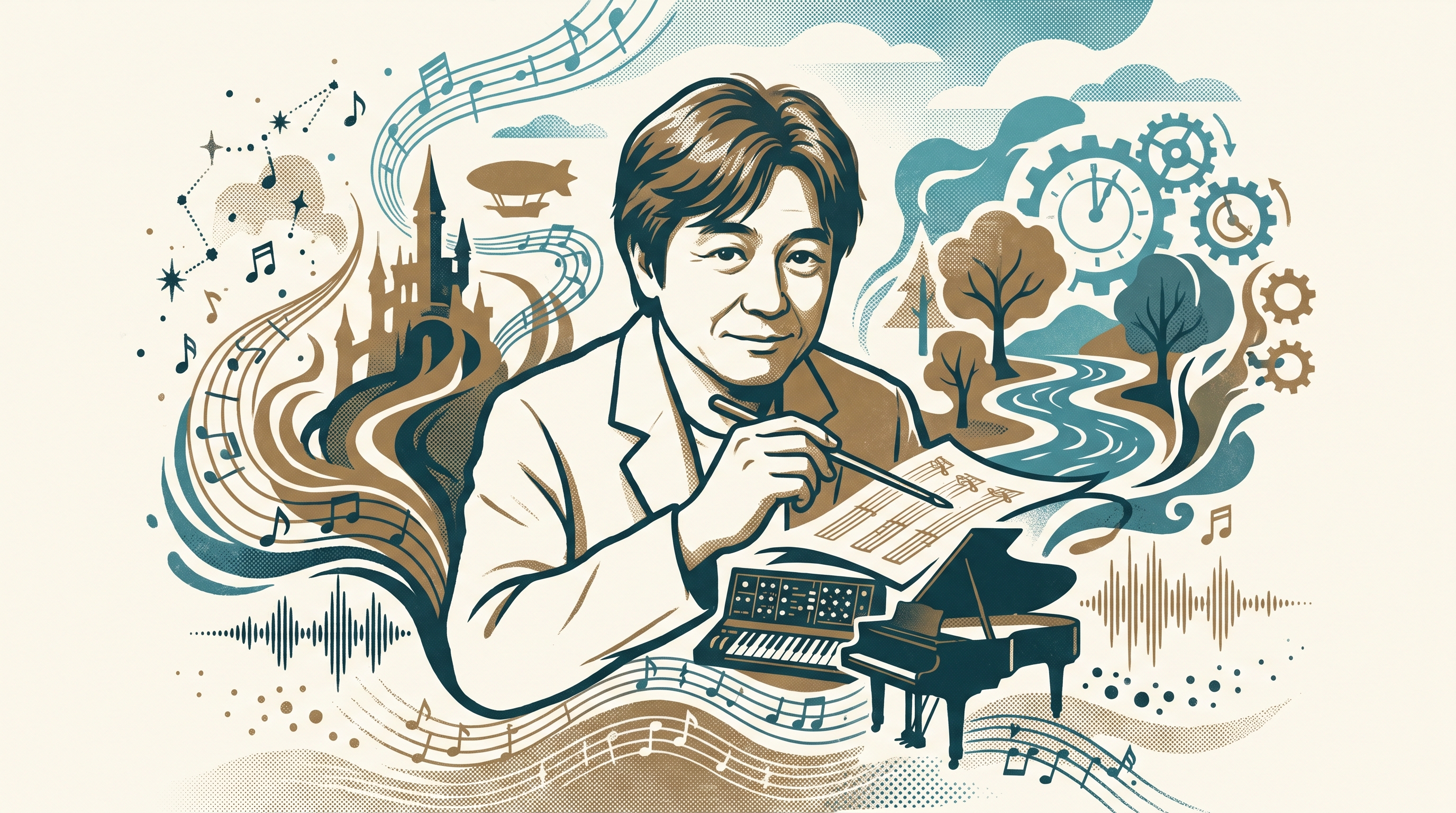
composer
Hitoshi Sakimoto
崎元仁
He programmed music before he composed it — and the gap between those two things turned out to be smaller than anyone expected.
About
Hitoshi Sakimoto is a Japanese composer and arranger who taught himself music programming as a teenager and built a career on the intersection of technical precision and orchestral scale. He is best known for his work on Final Fantasy Tactics (1997), Vagrant Story (2000), and Final Fantasy XII (2006). He founded the music production company Basiscape in 2002. His music is characterized by a brass-forward orchestral sound, disciplined counterpoint, and a sense of formal grandeur that suits large-scale strategy and role-playing games.
History
Hitoshi Sakimoto was born on February 26, 1969, in Tokyo, Japan. His introduction to music composition was, by the standards of the music world, irregular: he taught himself to write music using MML (Music Macro Language), a text-based programming format used to sequence music for early home computers and game hardware. He was in middle school. The fact that his compositional education came through programming rather than formal music theory gave him a facility with the technical machinery of game audio that a conservatory-trained composer might not have — and it also meant that his musical thinking developed alongside, rather than in opposition to, the constraints of the medium.
His professional career began when he was hired by Quest Corporation in the late 1980s. Quest was the developer of the Ogre Battle series — large-scale tactical RPGs with a political complexity unusual for the era — and Sakimoto's music for those games established the aesthetic that would define his best-known work: brass-heavy orchestral writing, counterpoint-driven arrangements, and a formal grandeur that communicated the weight of armies and the cost of kingdoms. The Ogre Battle 64 (1999) and Tactics Ogre (1995) soundtracks are among the defining examples of tactical RPG music from the era.
When Quest was absorbed into Square's network of associated studios in the mid-1990s, Sakimoto's relationship with Square deepened, and the result was Final Fantasy Tactics (1997) — one of the most ambitious soundtracks on the PlayStation and, many fans argue, in JRPG history. The game's medieval political intrigue demanded music that felt genuinely historical without being pastiche, and Sakimoto delivered a score structured around brass fanfares, contrapuntal vocal writing, and battle music of real rhythmic drive. 'Trisection,' the main battle theme, is one of the most technically sophisticated short pieces written for a 16-bit successor console. The game was a commercial disappointment on initial release in Japan but developed one of the most intensely loyal fan bases in the medium, in part because the music rewarded close listening.
Vagrant Story (2000) represented a different challenge: not the broad orchestral canvas of a strategy game but the claustrophobic atmosphere of a single dungeon, a single protagonist, a psychological narrative. Sakimoto's score for the game moved between industrial percussion, spare string writing, and orchestral passages of genuine unease, creating a tonal vocabulary that matched the game's aesthetic ambition. Vagrant Story won the BAFTA Interactive Entertainment Award for Best Artistic Achievement in the year of its release and is frequently cited by critics as a landmark moment in the intersection of game design and composition.
Final Fantasy XII (2006) brought Sakimoto to the largest stage of his career. The game's Ivalice setting — a politically complex world with a deliberately Mediterranean-influenced visual design — gave him the space to write a full orchestral score of enormous scope, one that needed to hold together across dozens of hours of gameplay and support a narrative considerably more adult in its political ambitions than the mainline Final Fantasy series had previously attempted. The soundtrack, recorded with the Warsaw Philharmonic Orchestra among others, represents the fullest realization of the orchestral sound he had been developing since the Ogre Battle days. It is one of the most formally ambitious scores in the series and one of the most frequently cited by composers working in the medium today.
In 2002, Sakimoto founded Basiscape, a music production company staffed by composers and arrangers, which allowed him to take on projects at a scale that required more than a single composer. The studio has worked on dozens of projects across multiple genres, maintaining the orchestral-formal sensibility that Sakimoto established while extending it into new contexts. His career from MML programmer in middle school to the conductor-ready scores of Final Fantasy XII describes a sustained argument that musical training comes in many forms — and that the kind of precision that grows out of programming discipline is not so different, in its outcomes, from the kind that grows out of conservatory training.
Timeline & Works
Career milestones and all 6 games in the museum they worked on — in the order they happened.
- 1969 02
Born in Tokyo, Japan
Hitoshi Sakimoto was born on February 26, 1969, in Tokyo.
people - 1991
- 1995
Tactics Ogre — tactical RPG orchestral language
His work on Tactics Ogre established the brass-forward, counterpoint-driven orchestral style that defined his best-known work.
product - 1995
- 1997
Final Fantasy Tactics — landmark JRPG score
The soundtrack for Final Fantasy Tactics is considered one of the most sophisticated scores in JRPG history, combining brass fanfares, contrapuntal writing, and rhythmically driven battle music.
milestone - 1997
- 1997
- 1998
- 2000
Vagrant Story — BAFTA award
Vagrant Story won the BAFTA Interactive Entertainment Award for Best Artistic Achievement, in part due to Sakimoto's score, which matched the game's psychological and atmospheric ambitions.
milestone - 2000
- 2002
Founded Basiscape
Sakimoto founded Basiscape, a music production company staffed by composers and arrangers, to handle large-scale scoring projects.
career - 2006
Final Fantasy XII — full orchestral recording with Warsaw Philharmonic
The score for Final Fantasy XII, recorded partly with the Warsaw Philharmonic Orchestra, represents the fullest realization of the orchestral sound he had been developing since the Ogre Battle era.
milestone
Also connected to
- Masaharu Iwata co-created Final Fantasy Tactics / co-created Magical Chase / co-created Tactics Ogre: Let Us Cling Together
- Hiroshi Minagawa co-created Final Fantasy Tactics / co-created Tactics Ogre: Let Us Cling Together
- Hironobu Sakaguchi co-created Final Fantasy Tactics
Explore the work
Each title has its own page — history, trivia, and collector's notes.
PlayStation · 2000
Vagrant Story
No towns. No shops. No party. One man and one sword moving through a city that n…
Sega Saturn · 1998
Radiant Silvergun
A shooter where you started strong and grew stronger. Treasure built seven weapo…
PlayStation · 1997
Final Fantasy Tactics
History remembered the one who won. It forgot the one who was simply right.…
Sega Saturn · 1997
Terra Diver
N.A.L.S. was built to have no blind spot. The company that built it disappeared …
Super Famicom / SNES · 1995
Tactics Ogre: Let Us Cling Together
Matsuno's war game that made the player choose sides. Every faction thought it w…
PC Engine / TurboGrafx-16 · 1991
Magical Chase
A PC Engine shooter by Quest. One of the rarest cartridges on the platform. The …
Rooms their games live in
Sources
- Basiscape official profile
- BAFTA Interactive Entertainment Awards 2001