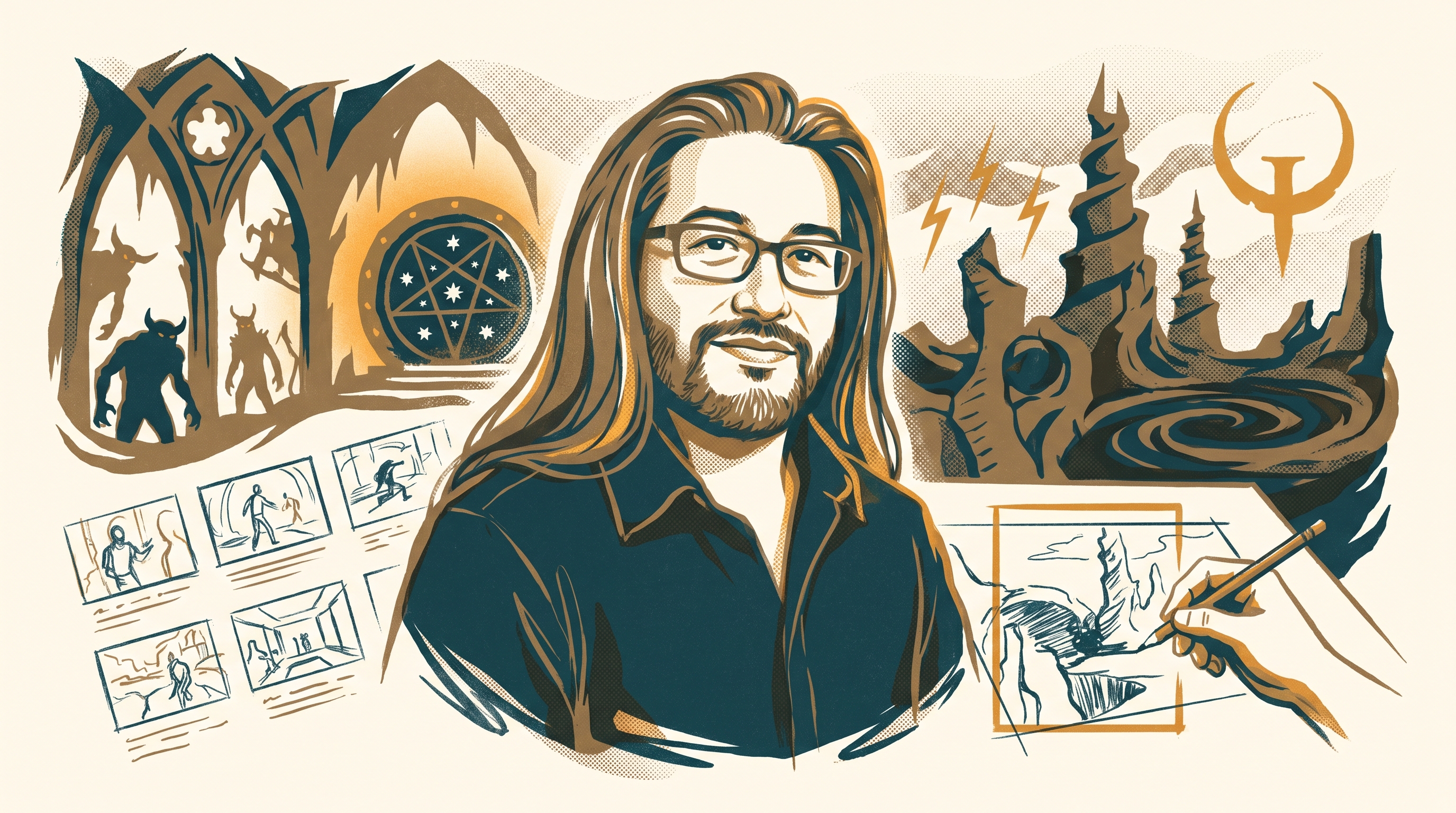
director
John Romero
Two characters stood facing each other on two PCs, and there was no word yet for what he was looking at. So he said one out loud.
About
John Romero co-founded id Software and designed most of the first episode of Doom. The word he came up with in John Carmack's office in November 1993, about a month before Doom shipped, was deathmatch.
History
Before he had a computer of his own, John Romero was copying assembly language out of magazine listings and typing it back in to see what it did. He was born on October 28, 1967, in Colorado Springs, Colorado, of Mexican, Yaqui, and Cherokee descent, and he did this on an Apple II through most of his childhood. By his teens he had finished dozens of small games. Nobody played them. There was no store to sell them in and no one to show them to, so the only thing a finished game gave him was the next one.
In 1990, Romero met John Carmack, Tom Hall, and Adrian Carmack at Softdisk, a software publishing company in Louisiana. The four worked on assigned projects during business hours and developed their own games at night. They built a smooth-scrolling PC game engine and used it to create a demo clone of Super Mario Bros. 3. Nintendo declined to publish it. In February 1991, the four founded id Software. Their first major release was Commander Keen, a side-scrolling platformer series designed by Hall and co-developed by Romero.
In May 1992, id Software released Wolfenstein 3D. It was fast, violent, and immersive in a way PC games had not been before. Romero designed half the levels. The game sold over 250,000 copies in its first year and established the first-person shooter as a commercial genre. What it did not have was other people. You walked the corridors alone, and every single thing that moved was a machine deciding when to shoot you.
Doom was scheduled for December 1993. With roughly a month left, John Carmack was still building the multiplayer, and he went with peer-to-peer networking because — as Romero puts it — it was the quick and dirty solution instead of a client-server model. When it ran, Carmack called Romero into his office. Romero wrote later: “Both PCs in his office had the game open, and they were syncing up with two characters facing one another.” Two people, in one room, aiming at each other instead of at monsters. There was no word for that yet. Romero went looking for one: “I thought of boxing or an extreme wrestling match, where you go in a cage to fight. This was much more violent, more deadly… I searched for a way to describe it. ‘This is deathmatch,’ I said.” The team latched onto the name, and it has never been replaced.
The idea did not arrive from nowhere. At id Software the breaks were spent on Street Fighter II, Fatal Fury and Art of Fighting, with house rules, trash talk, and furniture that occasionally did not survive. Romero has said where the impulse came from: “Japanese fighting games fueled the creative impulse to create deathmatch in our shooters.” A kill needed a word too. Romero took the question into the art room and told Kevin Cloud and Adrian Carmack that each kill in a deathmatch needed a name that was not ‘kill’. Cloud offered ‘frag’ — the word American soldiers in Vietnam had used for turning a fragmentation grenade on an officer who gave a dangerous order. “So, in a deathmatch we’re all fragging each other!” Romero said. Cloud agreed, and that word stuck as well.
Doom shipped on December 10, 1993. It went out over the early internet and onto millions of machines, and by 1995 it was estimated to be installed on more computers than Microsoft's Windows 95. The part of it people are still playing three decades later was the quick and dirty part, added in the last month. It was built by a team that spent that year losing to each other at Japanese fighting games.
Quake followed in 1996. Romero designed a quarter of its levels and wrote the tools the rest of the team worked in, including QuakeEd, the level editor. What he wanted the game to be was something else — a medieval fantasy with melee weapons and a story. Most of the team wanted a shooter with Doom's guns. They put it to a vote, and Romero lost. He has said he knew at that moment that he would leave when the game was done. Then he stayed and finished it. He was fired later that year, after five years, following disputes with Carmack over scope and direction.
In November 1996, Romero co-founded Ion Storm in Dallas with the designer Tom Hall, the investor Todd Porter, and Mike Wilson. The pitch was that designers would decide what the games were and no publisher would tell them otherwise. Romero announced Daikatana, a first-person shooter he would direct himself, for Christmas 1997. Then a full-page ad ran in the gaming magazines with his name in it: 'John Romero's about to make you his bitch.' He has said since that it was a mistake, and that it changed his relationship with the people who played his games.
Six months into Daikatana they switched from the Quake engine to Quake II, and much of the work started over. People left — more than fifty of them across the project, and by 1999 almost the whole Daikatana team had resigned together to join another studio. Two people stayed on the game from beginning to end. It shipped in May 2000, more than two years late, to reviews that called it dated, and it sold about forty thousand copies. The Dallas office closed.
He kept making levels. He left Ion Storm in 2001, and in July of that year he and Tom Hall started Monkeystone Games to build games for phones. On January 15, 2016 he put out a new level for the original Doom — his first in more than twenty-one years — and gave it away. On Doom's twenty-fifth anniversary he announced a whole new episode, SIGIL, and gave that away too. People are still downloading both. He gets asked about Daikatana in interviews and answers without putting it on anyone else: he wanted more than he had built the discipline to finish. What are you still finishing that nobody has asked you for?
Timeline & Works
Career milestones and all 2 games in the museum they worked on — in the order they happened.
- 1967 10
Born in Colorado Springs
Alfonso John Romero was born on October 28, 1967, in Colorado Springs, Colorado. Of Mexican, Yaqui, and Cherokee heritage.
people - 1991 02
Founded id Software
Romero co-founded id Software with John Carmack, Tom Hall, and Adrian Carmack. Their first major release was Commander Keen.
founding - 1992 05
Wolfenstein 3D Released
id Software released Wolfenstein 3D. Romero designed half the levels. The game sold over 250,000 copies in its first year and established the first-person shooter as a commercial genre.
product - 1993 11
Names it deathmatch
About a month before release, Carmack's peer-to-peer multiplayer ran for the first time. Standing in that office, Romero named it. In the art room, Kevin Cloud named a kill a “frag.”
people - 1993 12
Doom Released
Doom shipped on December 10, 1993. Romero designed most of the first episode. The game was distributed over the early internet and played by millions.
product - 1994
- 1996
Departed id Software
Following disputes with John Carmack over project scope and direction, Romero was fired from id Software after five years.
people - 1996 06
Quake Released
Romero designed a quarter of Quake's levels and contributed development tools, including QuakeEd. The project saw internal conflict over design direction.
product - 1996 11
Co-founded Ion Storm
Romero co-founded Ion Storm in Dallas with Tom Hall, Todd Porter, and Mike Wilson. The studio was positioned as a designer-led company without publisher constraints.
founding - 1997
Daikatana Announced
Romero announced Daikatana with a planned Christmas 1997 release. The infamous print ad 'John Romero's about to make you his bitch' appeared in gaming magazines.
product - 1998
- 2000 05
Daikatana Released
Daikatana was released more than two years late. It received negative reviews and sold approximately 40,000 copies, becoming a major commercial failure.
product - 2001
Departed Ion Storm
Romero departed Ion Storm following Daikatana's failure. The studio's Dallas office closed shortly after.
people - 2001 07
Founded Monkeystone Games
Romero and Tom Hall founded Monkeystone Games to develop games for mobile devices.
founding - 2016
Back to Doom: “Tech Gone Bad”
On January 15, 2016 Romero released “Tech Gone Bad”, a free level for the original Doom — his first Doom level in more than 21 years.
product
Connections
- collaborated with tom-hall (1990–present)
Romero and Tom Hall co-founded id Software in 1991 and later Ion Storm in 1996.
Explore the work
Each title has its own page — history, trivia, and collector's notes.
Rooms their games live in
Sources
- John Romero, Doom Guy: Life in First Person (Abrams Press, 2023) — excerpt: the moment deathmatch was named — accessed 2026-08-30
- Mia Consalvo, Atari to Zelda: Japan's Videogames in Global Contexts (MIT Press, 2016), pp. 201-203 — Romero on Japanese fighting games and deathmatch (cited via Wikipedia; the printed page has not been read directly) — accessed 2026-08-30
- David Kushner, Masters of Doom (Random House, 2004), p. 149 — accessed 2026-08-30
- John Romero - Wikipedia — accessed 2026-06-23
- Daikatana - Wikipedia — accessed 2026-06-23
- Ion Storm - Wikipedia — accessed 2026-06-23
- Doom Legend John Romero — The Path to Prolific Innovation and Making 130+ Games - Tim Ferriss Show — accessed 2026-06-23
- Quake turns 25: John Romero looks back on the legendary FPS that almost tore id Software apart - GamesRadar+ — accessed 2026-06-23