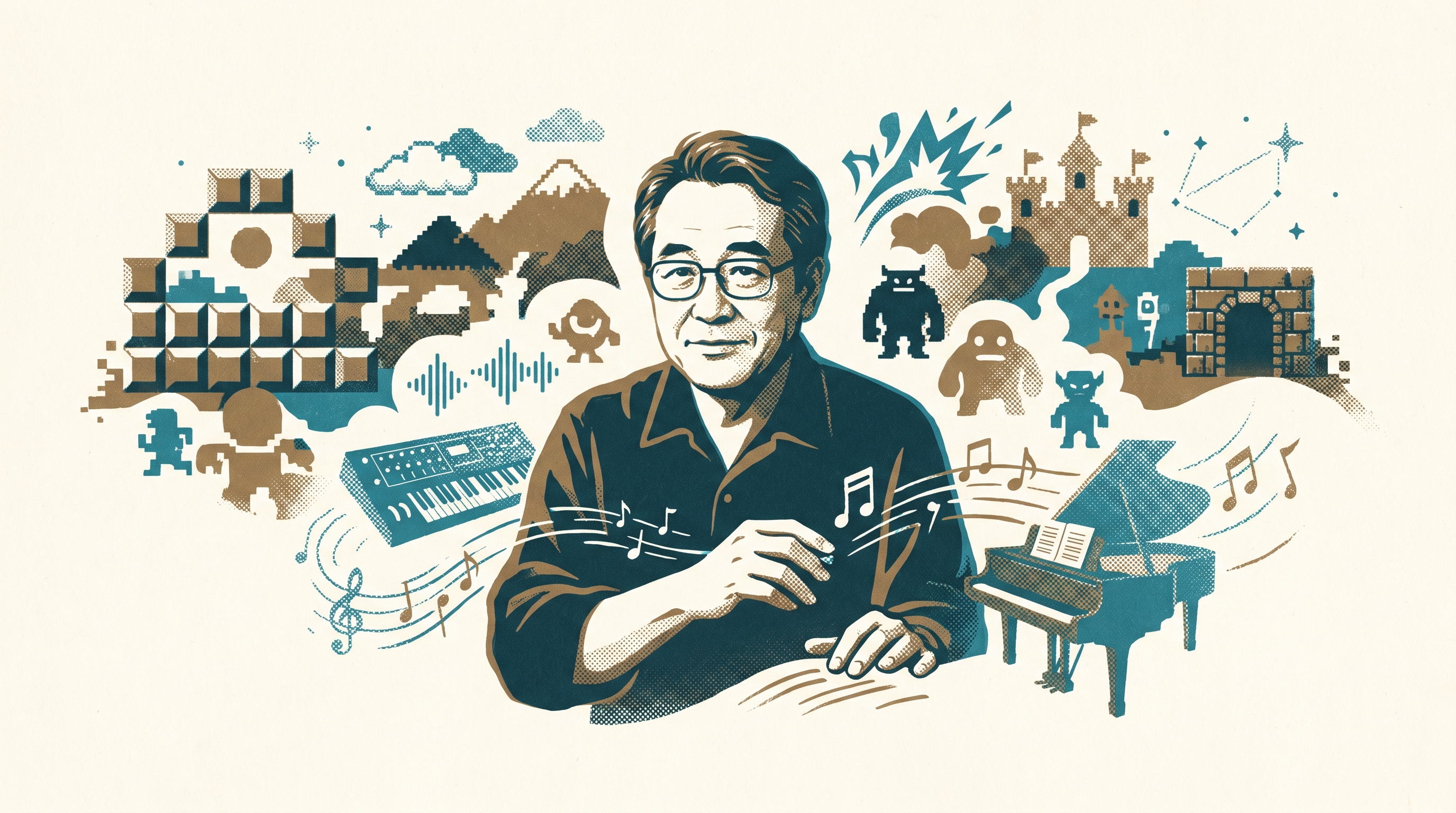
composer
Kazuo Sawa
澤和雄
Don't abandon your first language. What you played before games can become the music inside them.
About
The composer who brought rock guitar energy to the Kunio-kun series.
History
Kazuo Sawa was born in 1951. By the time he entered Tokai University, he was already a guitarist in a local band. Music was not a side interest. It was the primary language he spoke. He played in clubs and rehearsal rooms, learning how to layer sound, how to hold a melody over rhythm, how a guitar could carry emotion without words.
After graduating, he joined Technos Japan Corp, a small game company known for belt-scrolling action games. He was not hired as a musician. The role was broader — composer, sound designer, programmer. In the early days of game audio, those jobs were not separate. If you wanted sound, you wrote the code that generated it. Sawa wrote music in assembly language, using a sound driver programmed by Hiroshi Yamazaki. The tools were minimal. The results were not.
His most recognizable work came through the Kunio-kun series — a string of sports and fighting games built around a high school delinquent with a sense of justice. The music did not try to sound like a symphony. It sounded like a garage band. Fast, direct, with rough edges that made it memorable. That was not a compromise. That was Sawa bringing what he already knew — the energy of a live band — into a space that had no microphones or amplifiers.
He also composed for the Double Dragon series, working alongside Kazunaka Yamane. Together, they shaped the sound identity of Technos Japan through the late 1980s and early 1990s. Sawa's music appeared in games released by other companies as well — Battle of Olympus for Infinity, Totally Rad for Jaleco, and work for HAL Laboratory. He was a freelance composer before the term became common in the game industry.
Around 1993, Sawa left Technos Japan and founded his own company, DSP Co., Ltd. The work shifted from composing individual game soundtracks to producing music for multiple developers. It was a different kind of creativity — managing projects, coordinating with clients, building a business around sound. He had moved from playing in a band to leading one.
In 2001, he helped establish the Tokai University JAZZ Research Club Alumni Association, reconnecting with musicians from his college years. A decade later, in 2011, he returned to game composition with Kunio-kun Supesharu, released by Arc System Works. It was not a comeback. It was a continuation. The music he had written decades earlier was still being played, still being remembered. He had not stopped being a musician. The work had simply taken different forms.
Kazuo Sawa passed away in 2024. The details of his final years are not widely documented. What remains is a catalog of music that refused to sound like background noise. His work proved that a guitarist who played in college bands could write music that defined entire game series. The transition from stage to code was not a abandonment of the first skill. It was an expansion of where that skill could live.
Timeline & Works
Career milestones and all 3 games in the museum they worked on — in the order they happened.
- 1951
Born in Japan
Kazuo Sawa was born. He would grow up to become a guitarist before entering the game industry.
people - 1970
Entered Tokai University
Enrolled at Tokai University. During his college years, he played guitar in a local band.
people - 1974
Joined Technos Japan Corp
After graduating, joined Technos Japan Corp as a composer, sound designer, and programmer.
people - 1986
Renegade (Nekketsu Koha Kunio-kun)
Composed music for the first game in the Kunio-kun series, establishing the energetic sound that would define the franchise.
product - 1987
Double Dragon
Composed music for Double Dragon alongside Kazunaka Yamane, shaping the sound identity of Technos Japan.
product - 1988
Battle of Olympus
Composed music for Battle of Olympus, published by Infinity. Worked as a freelance composer for multiple companies.
product - 1988
- 1989
- 1990
Totally Rad (Magic John)
Composed music for Totally Rad, published by Jaleco. Continued freelance work alongside Technos projects.
product - 1990
- 1993
Founded DSP Co., Ltd.
Left Technos Japan and established his own music production company, DSP Co., Ltd., focusing on producing music for various game developers.
people - 2001
Established Tokai University JAZZ Research Club Alumni Association
Helped establish the Tokai University JAZZ Research Club Alumni Association, reconnecting with musicians from his college years.
people - 2011
Kunio-kun Supesharu
Returned to game composition with Kunio-kun Supesharu, released by Arc System Works. A continuation, not a comeback.
product - 2024
Passed away
Kazuo Sawa passed away. The details of his final years are not widely documented, but his music catalog remains.
people
Connections
- employed technos-japan (1974–1993)
Worked as composer, sound designer, and programmer. Shaped the sound identity of Kunio-kun and Double Dragon series.
- founded dsp-co-ltd (1993–present)
Established his own music production company after leaving Technos Japan.
Explore the work
Each title has its own page — history, trivia, and collector's notes.
Family Computer (Famicom) / NES · 1990
Nintendo World Cup
In Japan, the players were delinquents from a tough high school. Overseas, the s…
Family Computer (Famicom) / NES · 1989
River City Ransom
Technos Japan's brawler RPG on Famicom. Buy techniques, upgrade stats, and rescu…
Family Computer (Famicom) / NES · 1988
Super Dodge Ball
Technos Japan's dodgeball game on Famicom. Teams of five, special throws, and in…
Rooms their games live in
Sources
- 澤和雄 - Wikipedia — accessed 2026-06-21
- Kazuo Sawa - Video Game Music Preservation Foundation Wiki — accessed 2026-06-21
- Kazuo Sawa - MobyGames — accessed 2026-06-21
- 澤和雄とは - わかりやすく解説 Weblio辞書 — accessed 2026-06-21