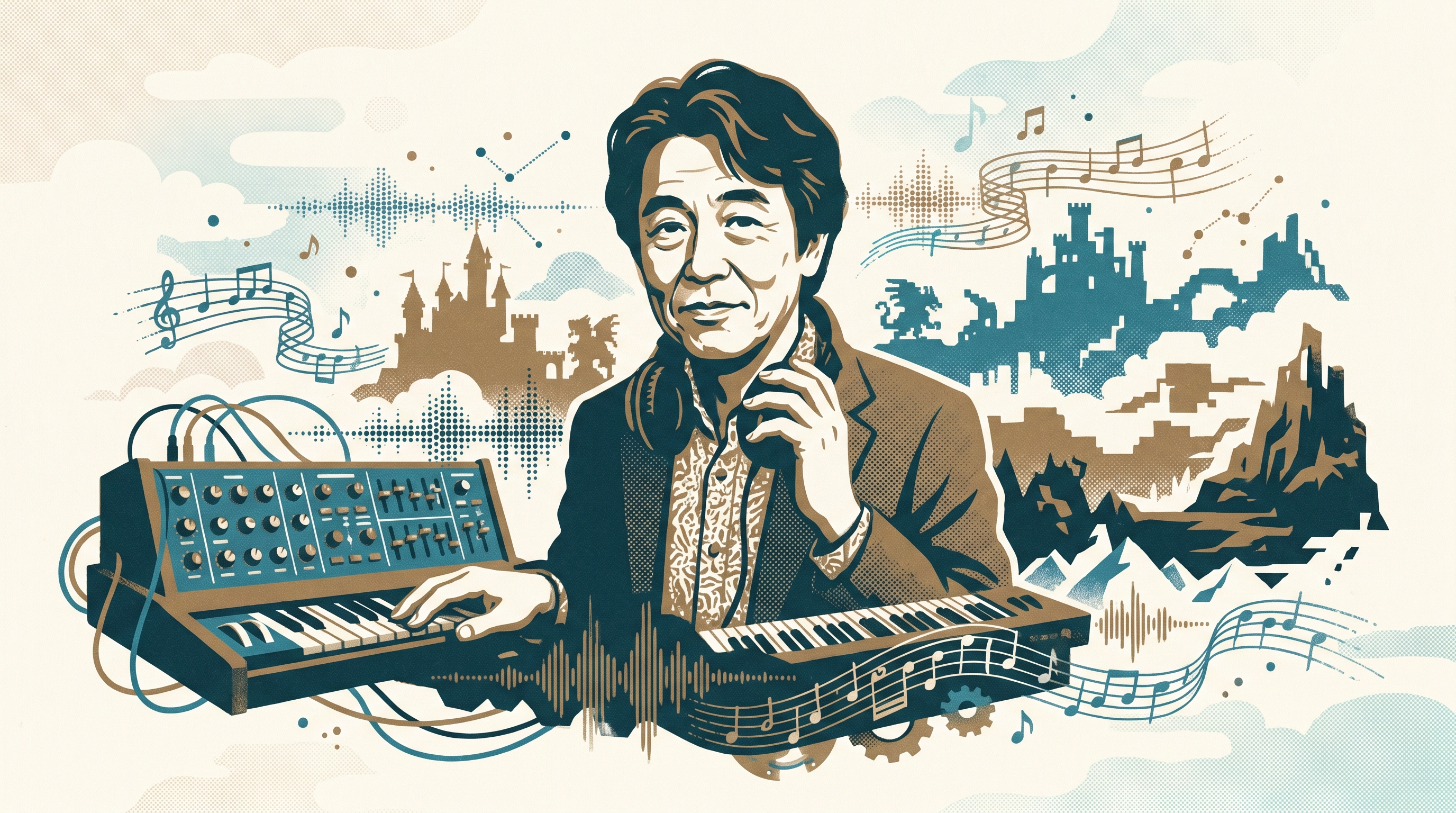
composer
Toshiaki Sakoda
迫田崇昭
He brought heavy metal to the chip — not to prove it could be done, but because the sound in his head demanded it.
History
Toshiaki Sakoda was born April 7, 1964, in Hiroshima City, Hiroshima Prefecture, Japan. At eight years old, he picked up the classical guitar. From that moment, the idea of composing music was not a distant dream but something immediate and necessary. He was not drawn to games as a child — he was drawn to sound, to the structure of melody, to the question of how music could carry weight.
He joined Compile in 1988, during the late years of the Famicom and the early rise of new hardware. Compile was a small studio known for vertically scrolling shooters, games built on speed and reflex, not narrative. Sakoda's role was to compose soundtracks that would run on hardware with no room for error. The MSX, the NES, and later the Sega Genesis gave him three or four simultaneous audio channels, a handful of kilobytes, and the challenge of making something memorable inside those constraints. He wrote music in assembly macros on an MSX computer. The code was compiled to the target console with sound drivers written by Takayuki Hirono. It was meticulous, technical work. Every note had a cost.
His notable works for Compile included Aleste 2, the Madou Monogatari series, Xevious: Fardraut Saga, Gun*Nac, GG Aleste, and Spriggan. He also composed for Naxat projects including Alien Crush, Devil Crush, and Cyber Knight. But the work that defined his approach came in 1990 with MUSHA: Metallic Uniframe Super Hybrid Armor for the Sega Genesis. Sakoda composed the score as a heavy metal suite — a deliberate, genre-specific choice that had never been attempted in a video game before. His influences were VowWow, Van Halen, Michael Schenker, along with flamenco, fusion, rock, and Beethoven. He later said he made MUSHA's music to overturn the industry, to show that game soundtracks could carry the weight and structure of a concert suite. The result was a game soundtrack that sounded like it belonged in a live venue, not a living room.
By the early 1990s, Sakoda had transitioned from assembly macros to MIDI, and his role expanded to sound director on several projects. He was composing prolifically — across genres, across consoles, for Konami, Hudson, Namco, and later Square Enix and Microsoft. Much of his work was ghostwritten, credited to others or uncredited entirely. The industry at the time did not always recognize composers by name, and Sakoda's output — already in the thousands of pieces — remained largely invisible to the public even as his music shaped the atmosphere of dozens of games.
When Sakoda saw that Compile was heading toward financial collapse, he left. He joined Sting, a studio known for experimental RPGs, and took on the role of director and producer in addition to composer. At Sting he worked on Treasure Hunter G, Baroque, and the Evolution series. The shift from Compile to Sting marked a transition from high-speed action soundtracks to more atmospheric, story-driven compositions, but the underlying principle remained the same: music was architecture, not decoration.
Over the course of his career, Sakoda composed more than 30,000 pieces of music. He continued uploading compositions to YouTube, working on independent projects, and contributing to game soundtracks well into the 2020s. His favorite soundtracks among his own work were Seirei Senshi Spriggan and Treasure Hunter G — both games where the music carried the emotional weight of the experience, not just the pacing.
What Sakoda demonstrated, quietly and without fanfare, is that technical constraints do not dictate artistic ambition. He brought heavy metal to the chip not because the hardware was ready for it, but because the sound in his head demanded it. That insistence — the refusal to wait for permission or for better tools — is what separates work that fills space from work that claims it.
Timeline & Works
Career milestones and all 3 games in the museum they worked on — in the order they happened.
- 1964 04
Born in Hiroshima
Toshiaki Sakoda was born April 7, 1964, in Hiroshima City, Hiroshima Prefecture, Japan.
people - 1972
Began classical guitar
At age eight, Sakoda began playing classical guitar and decided he wanted to compose music.
people - 1988
Joined Compile
Sakoda joined Compile as a composer during the late Famicom era, composing soundtracks in assembly macros on MSX hardware.
people - 1989
Aleste 2 released
Sakoda composed the music for Aleste 2 on MSX, one of his early notable works for Compile.
product - 1990
MUSHA released — first heavy metal game suite
Sakoda composed MUSHA: Metallic Uniframe Super Hybrid Armor for the Sega Genesis as a heavy metal suite — the first of its kind in video game history.
product - 1990
- 1990
- 1992
Alien Crush and Devil Crush
Sakoda composed the soundtracks for pinball games Alien Crush and Devil Crush for Naxat.
product - 1992
- 1996
Left Compile, joined Sting
Anticipating Compile's financial collapse, Sakoda left the company and joined Sting as composer, director, and producer.
people - 1996
Treasure Hunter G released
Sakoda composed the music for Treasure Hunter G at Sting — one of his personal favorite soundtracks.
product - 1998
Baroque released
Sakoda worked on the atmospheric RPG Baroque at Sting, marking his shift toward story-driven compositions.
product - 2020
Continued independent composition
Sakoda continued uploading compositions to YouTube and working on independent music projects, having composed over 30,000 pieces across his career.
milestone
Connections
- employed compile (1988–1996)
Composed soundtracks for Compile's shooter games and RPG projects, including MUSHA, Aleste 2, and the Madou Monogatari series.
Also connected to
- Masanobu Tsukamoto co-created Devil's Crush / co-created Puyo Puyo
Explore the work
Each title has its own page — history, trivia, and collector's notes.
Sega Mega Drive / Genesis · 1992
Puyo Puyo
Compile's falling block puzzle. Chains of four same-color blobs. Japan's answer …
PC Engine / TurboGrafx-16 · 1990
Devil's Crush
A pinball table built around a demonic pentagram. Compile made it — nobody else …
Sega Mega Drive / Genesis · 1990
MUSHA Aleste
Compile's fastest and hardest shooter, set in feudal Japan. The Mega Drive ran i…
Rooms their games live in
Sources
- Toshiaki Sakoda - Video Game Music Preservation Foundation Wiki — accessed 2026-06-18
- Hardcore Gaming 101 - Interview with Toshiaki Sakoda — accessed 2026-06-18
- Toshiaki Sakoda - VGMdb — accessed 2026-06-18