Buying a Nintendo GameCube — A Practical Guide
What to think about before you click. Questions worth asking — and what the answers tell you.
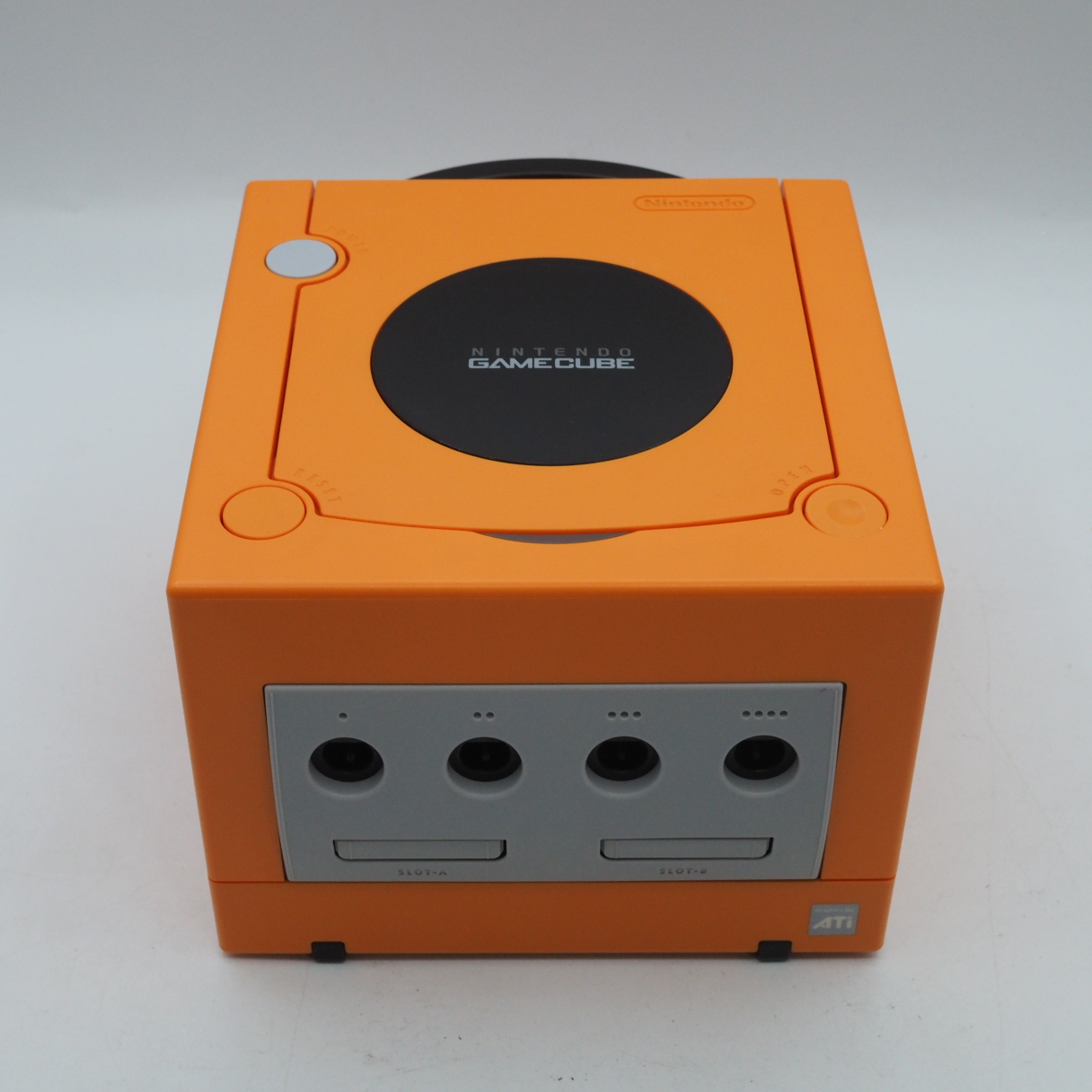
Things to watch out for when buying
The GameCube is old enough that its failure points are well-documented. The single most important thing to know before you buy: which model. DOL-001 and DOL-101 look almost identical from the outside, but differ in ways that matter for connecting to a modern display. After model, the laser lens is the most common failure — and the one worth confirming before money changes hands.
The variations of the Nintendo GameCube
Nintendo GameCube (original)
The original GameCube model, produced until around 2004. Features a Digital AV Out port under a flap on the bottom, enabling component video (480p progressive scan) output and compatibility with HDMI adapters such as the Carby and GCVideo. Also carries the expansion port for the Game Boy Player accessory.
- Digital AV Out port (480p capable)
- Game Boy Player expansion port
- Component/HDMI adapter compatible
- 46W power supply
Identifiable by 'DOL-001' on the rear serial sticker. The recommended choice if display output quality matters.
Nintendo GameCube (late model)
A cost-reduced model introduced from 2004 onward. The Digital AV Out port and Game Boy Player expansion port were removed. Without modification, the best video output is S-Video (NTSC) or composite.
- No Digital AV Out port
- No Game Boy Player port
- S-Video / composite output only (unmodified)
- 48W power supply
More common on the used market and typically priced lower. Internal HDMI mods (GCDual) can be fitted by a specialist.
Panasonic Q
A Japan-only collaboration between Nintendo and Panasonic, released in December 2001. Combines full GameCube functionality with DVD, CD, and MP3 playback in a stainless steel enclosure. Carries the Digital AV Out port of DOL-001.
- DVD / CD / MP3 playback
- Digital AV Out port
- Stainless steel housing
- Japan domestic release only
Sold at approximately four times the GameCube's retail price. A sought-after collector item, particularly outside Japan.
Shipping, customs, and what to expect
Buying a GameCube from Japan means an international shipment. A few things are worth knowing before you commit:
- Small, light, and easy to send: The GameCube is one of the more forgiving consoles to import. It is compact and light, with a carrying handle, so shipping cost and packaging are usually modest compared with larger machines. A complete-in-box unit still ships heavier, but a loose console travels well.
- Region locking: The GameCube is region-locked. A Japanese (NTSC-J) console plays the Japanese library; North American and PAL discs are locked out without modification. If you want the Japanese games, Japanese hardware is the natural match — confirm the region of both console and discs.
- Mini-DVD discs and the drive: The GameCube uses small proprietary mini-DVD discs read by an optical drive. As with any disc system, the laser ages; a console that loads several different games reliably has a healthy drive. Ask whether the seller tested with more than one disc.
- The separate power brick: The GameCube uses an external AC adapter (power brick). A Japanese unit ships with a 100V Japanese adapter, so in 120V or 230–240V countries you will need a step-down converter or a correctly-rated replacement brick. Confirm the adapter is included.
- Import duties and tax: Whether — and how much — your country charges on used electronics from Japan changes often, and several thresholds shifted during 2026. Rather than trust a figure that may already be out of date, check your own country's current import rules before you order, and budget for the result.
- Declared value and transit: A responsible seller declares the actual sale price; under-declaring shifts risk to you. EMS typically takes one to two weeks from Japan, with air parcel a reasonable middle ground.
Before you buy — a summary checklist
- Region confirmed (NTSC-J console pairs with the Japanese library)
- Powers on and outputs clean video — tested and stated by the seller
- Loads multiple mini-DVD discs reliably (a sign of a healthy laser)
- Disc lid latches and closes securely; the drive spins up cleanly
- Separate 100V power brick included, or a correctly-rated replacement planned
- Controller tested — every direction, button, trigger, and C-stick registers
- Memory Card included or noted if you need to save progress
- Any extras (Game Boy Player, etc.) confirmed if you are paying for them
- Shipping cost, import duty, and declared-value policy confirmed with seller
- Original box and documentation status is what you want and priced accordingly
Want to know the going rate?
Prices for original Nintendo GameCube hardware vary — condition, revision, and servicing history all affect the figure. Our shop lists hand-tested units with pricing that reflects what each machine is actually worth.
Check current Nintendo GameCube prices and stock at our shop →
Already own one? How to care for a Nintendo GameCube →
Now in the shop
These are the individual pages for units we currently have in stock.
- Animal Crossing: Doubutsu no Mori e+ (Dōbutsu no Mori e+)
- Konjiki no Gash Bell!! Yūjō Tag Battle Full Power
- Luigi's Mansion
- Mario Kart: Double Dash!!
- Mario Party 4
- Mario Party 5
- Mario Party 6
- Mario Power Tennis
- Pikmin
- Pikmin 2
- Sonic Mega Collection
- Star Fox: Assault
- Super Mario Strikers
- Super Monkey Ball 2
- Virtua Striker 3 ver. 2002