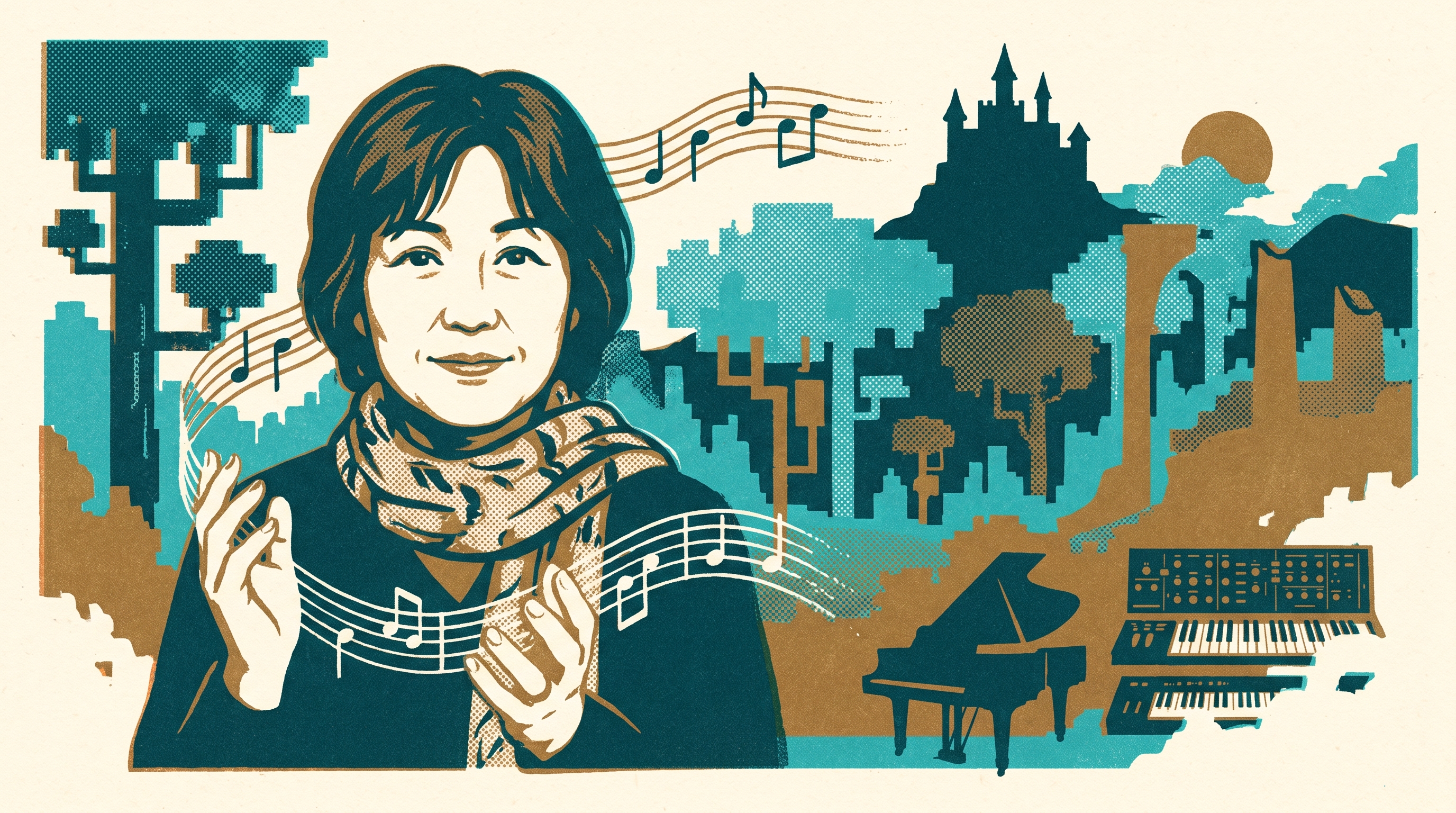
composer
Mari Yamaguchi
山口真理
She composed for some of Capcom's brightest games in the SNES era — then walked away while the sound was still ringing.
About
Mari Yamaguchi is a Japanese video game composer, born August 19 in Nara, Japan. She graduated from the Osaka School of Music and joined Capcom as a sound designer in the early 1990s, becoming a member of Alph Lyla, Capcom's in-house sound team. She composed the music for Mega Man 5, Super Ghouls 'n Ghosts, Breath of Fire, and U.N. Squadron during the SNES era. In 1993, she became a freelance composer and moved to Tokyo. She returned to the Mega Man series in 2010 to compose one Robot Master theme for Mega Man 10.
History
Mari Yamaguchi was born on August 19 in Nara, Japan. She studied music formally at the Osaka School of Music, building a foundation in composition and arrangement that would later define her approach to video game soundtracks. In the early 1990s, she joined Capcom as a sound designer — entering the industry during the transition from the NES to the Super Nintendo, when game music was gaining polyphonic depth and composers were learning what could be done with hardware that had just begun to breathe.
At Capcom, she became a member of Alph Lyla, the company's in-house sound team. The name came from the Arabic title of One Thousand and One Nights, and the group represented a generation of Capcom composers who worked across genres — platformers, fighting games, RPGs, shooters. Yamaguchi contributed to some of the most recognized titles of the SNES era. She composed the soundtrack for Mega Man 5, released in December 1992, continuing the melodic and energetic tradition of the series while introducing her own harmonic voice. She worked on Super Ghouls 'n Ghosts, U.N. Squadron, and Breath of Fire, each requiring a different emotional palette — from gothic danger to military tension to fantasy adventure.
Her work on Breath of Fire, Capcom's first original RPG released in April 1993, stood out for its use of atmospheric progression. The soundtrack moved between town themes that felt like rest stops and battle music that conveyed urgency without overwhelming the player. It was music that understood pacing — when to push and when to let the player sit with the world. Yamaguchi's compositions during this period were not flashy, but they were reliable and emotionally precise, qualities that mattered in an era when game soundtracks were expected to carry entire atmospheres on three or four melodic channels.
In 1993, Yamaguchi left Capcom and became a freelance composer, relocating to Tokyo. The decision to go independent while still in her twenties was not common in the Japanese game industry, where studio employment offered stability and structure. The reasons she left are not publicly documented, but the timing suggests she wanted control over what she worked on and how she worked. Freelance life meant fewer credits and less visibility — there is no comprehensive discography of her post-Capcom career, and she does not have a Wikipedia page despite her contributions to some of the most-played games of the 1990s.
She returned to the Mega Man series in 2010 when Capcom invited former composers to contribute individual Robot Master themes for Mega Man 10, a retro-styled downloadable title. Yamaguchi composed one stage theme, briefly reconnecting with the series she had helped define nearly two decades earlier. It was a small contribution, but it confirmed that her voice was still recognizable — melodic, structured, and built on the idea that game music should support the player's emotional journey without demanding attention for its own sake.
Mari Yamaguchi's career is a quiet argument that some of the best work is done by people who do not stay in the spotlight. She composed for major franchises at a formative moment in game music history, then chose a path that valued creative autonomy over visibility. Her music from the SNES era — especially Mega Man 5 and Breath of Fire — remains in circulation, played and remixed by communities who may not know her name but who recognize the feeling her compositions left behind. That distance between the work and the person is not a failure of recognition. It is the result of a choice she made, and the work speaks clearly enough on its own.
Timeline & Works
Career milestones and all 2 games in the museum they worked on — in the order they happened.
- 1990
Joined Capcom
Yamaguchi joined Capcom as a sound designer in the early 1990s and became a member of Alph Lyla, the in-house sound team.
people - 1991
U.N. Squadron released
Yamaguchi composed the music for U.N. Squadron, a side-scrolling shooter for the SNES.
product - 1993
Became freelance composer
Yamaguchi left Capcom and became a freelance composer, relocating to Tokyo.
people - 1993 04
Breath of Fire released
Yamaguchi composed the music for Breath of Fire, Capcom's first original RPG for the SNES.
product - 08
Born in Nara, Japan
Mari Yamaguchi was born on August 19 in Nara, Japan. She would later study music at the Osaka School of Music.
people - 1991 10
Super Ghouls 'n Ghosts released
Yamaguchi contributed to the soundtrack of Super Ghouls 'n Ghosts, the third entry in the Ghosts 'n Goblins series.
product - 1991
- 1992 12
Mega Man 5 released
Yamaguchi composed the full soundtrack for Mega Man 5, one of the most recognized entries in the series.
product - 1992
- 2010 03
Contributed to Mega Man 10
Yamaguchi returned to compose one Robot Master theme for Mega Man 10, nearly two decades after her work on Mega Man 5.
product
Connections
- employed capcom (1990–1993)
Yamaguchi worked at Capcom as a sound designer in the early 1990s, contributing to major SNES titles.
Explore the work
Each title has its own page — history, trivia, and collector's notes.
Rooms their games live in
Sources
- Mari Yamaguchi — Video Game Music Preservation Foundation Wiki — accessed 2026-06-20
- Mari Yamaguchi — Capcom Database | Fandom — accessed 2026-06-20
- Mari Yamaguchi biography — Last.fm — accessed 2026-06-20
- The composers that Wikipedia ignores: Mari Yamaguchi — GoNintendo — accessed 2026-06-20
- Alph Lyla — Wikipedia — accessed 2026-06-20