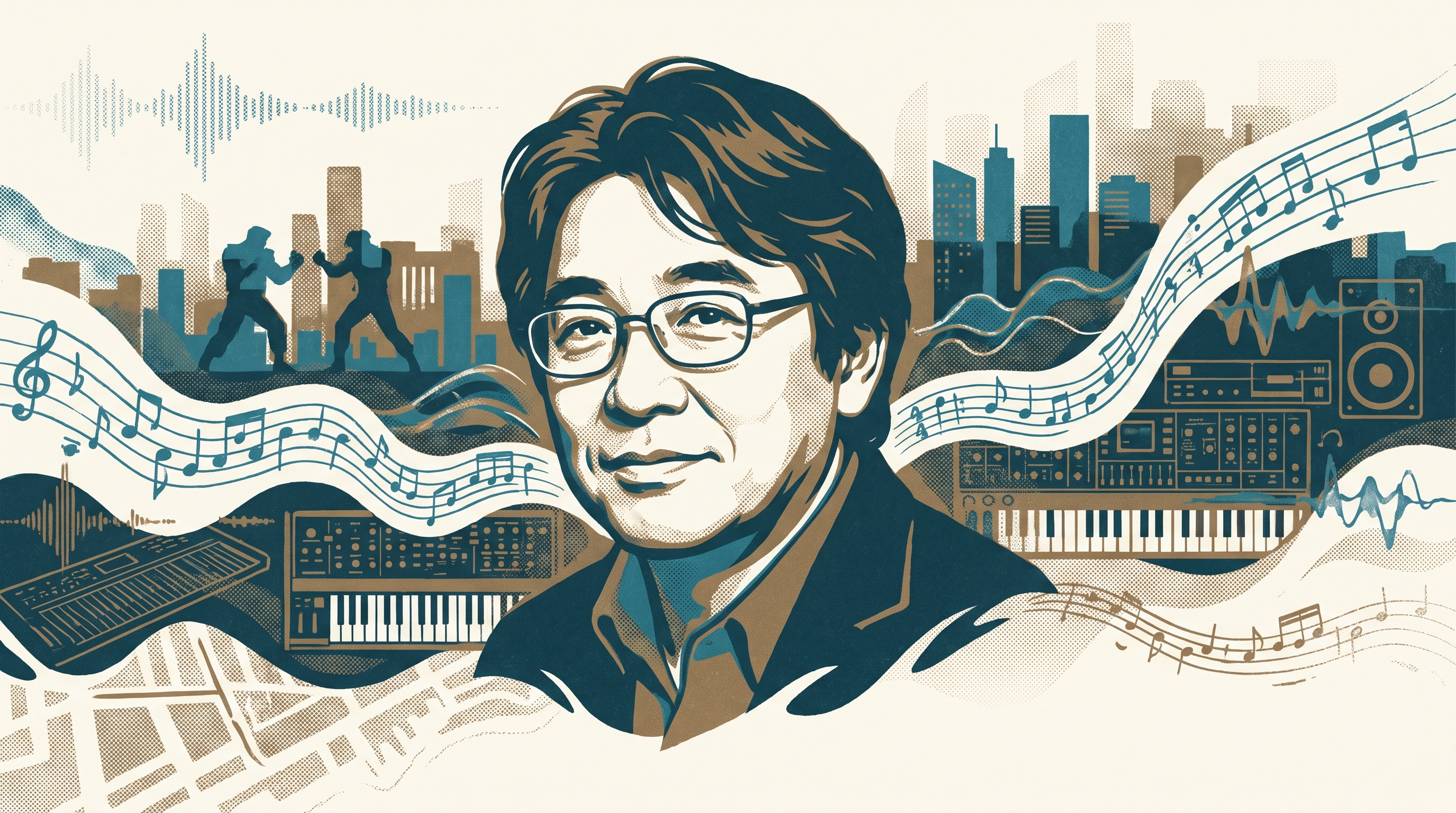
composer
Motohiro Kawashima
河島求広
He studied why each sound exists before placing it. Constraints don't limit music — they reveal what it can become.
History
Motohiro Kawashima was born in Nagoya City, Aichi Prefecture. He studied twentieth-century classical music at Kunitachi College of Music, immersing himself in composers who asked listeners to contemplate why a sound exists before accepting it as music. His education was formal and intellectual — far removed from the world of video games. During his college years he began producing techno music on the side, renting CDs from a shop called 33 in Kichijoji and absorbing the bass-heavy currents of house and Detroit techno that were flooding into Tokyo. It was a different kind of study, driven by rhythm rather than theory.
In 1992, Yuzo Koshiro's mother, a piano teacher at Kunitachi, passed along a techno demo Kawashima had made. Koshiro listened and invited him to join Ancient, the small development company he had founded to produce music and games for Sega. Kawashima became employee number one. His first assignments were for the Game Gear — Shinobi II: The Silent Fury and Batman Returns, both portable adaptations of bigger franchises, both constrained by the handheld's limited sound hardware. He found the constraints clarifying. Years later he said there were possibilities within limitations, ways to make music effective even when the technology was not.
His early collaboration with Koshiro came on Streets of Rage 2, released in 1992. Kawashima contributed several tracks, including one called 'Expander' that marked a turning point in his approach to game composition. The project introduced him to Music Macro Language, the text-based system used to program sound on the Sega Genesis FM chip. At first he questioned whether real music could be written this way. Koshiro taught him programming tricks to push the chip further — techniques for layering sounds, manipulating timbre, drawing out textures the hardware was not designed to produce.
Streets of Rage 3, released in 1994, split composition duties equally between the two. By then Kawashima had attended live performances by Underground Resistance, the Detroit techno collective whose uncompromising sound had influenced him deeply. He and Koshiro decided to incorporate elements of Rotterdam techno — harder-edged, faster, more abrasive than the house-influenced grooves of the earlier games. Koshiro built an automatic composition apparatus that randomized instrument timbres across the FM channels, giving each playthrough a subtly different sonic texture. The result was a soundtrack that polarized listeners. Some found it too experimental, too far from melody. Kawashima hoped it would show other composers that game music did not need to compromise.
After the Streets of Rage series, Kawashima continued working in game audio but stepped back from high-profile projects. He composed for smaller titles, worked under the pen name Kashii for a time, and in 2020 returned to contribute tracks to Streets of Rage 4 alongside Koshiro and a roster of other composers. Outside of games he released solo albums — Prepared Wave in 2019, Acrobatizm in 2023 — that carried forward his interest in the intersection of techno and experimental composition. He became a lecturer in computer music at Kunitachi College of Music, the institution where he had first studied the classical avant-garde decades earlier.
Koshiro once said that Kawashima had a talent for creating music that stirs something in the listener. Kawashima's own reflection was quieter: that modern classical music taught him to ask why a sound is placed where it is, and that working within the constraints of game hardware forced him to answer that question with clarity. His career is a reminder that limitations are not the enemy of expression. They are the frame that makes expression visible.
Timeline & Works
Career milestones and all 2 games in the museum they worked on — in the order they happened.
- 1992
Joins Ancient as employee number one
Yuzo Koshiro invites Kawashima to join Ancient after hearing his techno demo; first assignments are Game Gear titles Shinobi II and Batman Returns.
people - 1992
Streets of Rage 2 released
Contributes several tracks including "Expander"; begins learning Music Macro Language and FM synthesis techniques from Koshiro.
product - 1992
- 1994
Streets of Rage 3 — equal composition partnership
Splits composition duties equally with Koshiro; incorporates Rotterdam techno and harder-edged sound influenced by Underground Resistance.
product - 1994
- 2019
Solo album Prepared Wave released
Releases first solo album exploring the intersection of techno and experimental composition outside of game contexts.
milestone - 2020
Returns for Streets of Rage 4
Contributes tracks to Streets of Rage 4 alongside Koshiro and other composers, marking his return to the series after 26 years.
product - 2023
Solo album Acrobatizm released
Releases second solo album continuing exploration of techno and experimental music.
milestone
Connections
- collaborated with yuzo-koshiro (1992–present)
Longtime collaborator; Koshiro invited Kawashima to join Ancient in 1992 and the two composed Streets of Rage 2 and 3 together, frequently visiting nightclubs for musical inspiration.
Explore the work
Each title has its own page — history, trivia, and collector's notes.
Rooms their games live in
Sources
- Motohiro Kawashima — Wikipedia — accessed 2026-06-22
- Interview: Motohiro Kawashima | Red Bull Music Academy Daily — accessed 2026-06-22
- Streets of Rage – Composer Interview Collection - shmuplations.com — accessed 2026-06-22