composer
Takenobu Mitsuyoshi
光吉猛修
He sang because there was no one else in the room — and that voice became the sound of an era.
About
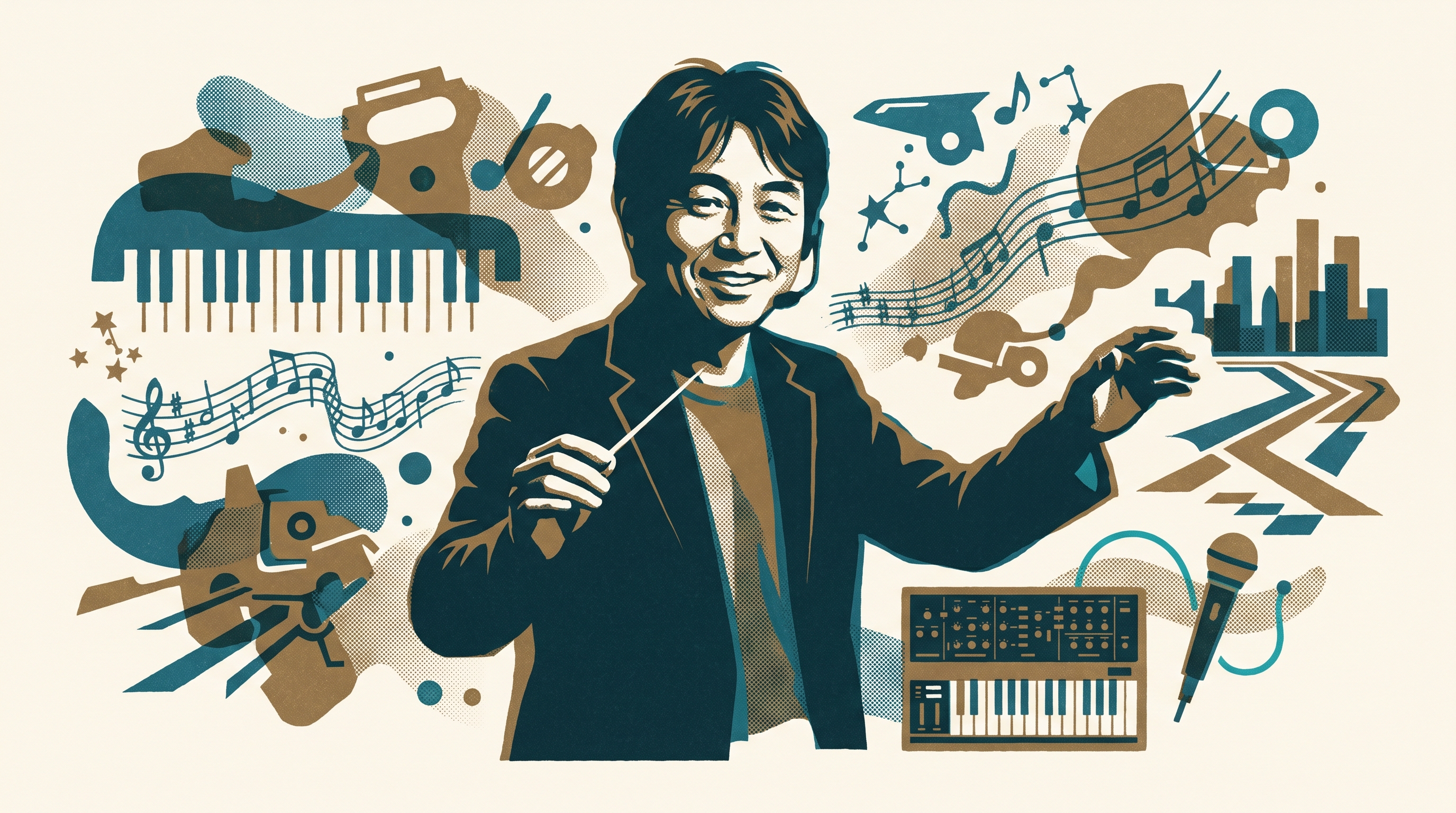
Takenobu Mitsuyoshi is a Japanese video game composer, singer, and voice actor. Born December 25, 1967, in Fukuoka, he joined Sega Enterprises in April 1990 and composed music for Daytona USA, Virtua Fighter 2, Virtua Fighter 3, and Shenmue. He is also known for singing the iconic vocal tracks in Daytona USA and voicing Kage-Maru in the Virtua Fighter series. As of 2017, he works at Sega Interactive's Third R&D Division Sound Section.
History
Takenobu Mitsuyoshi was born on December 25, 1967, in Fukuoka, a port city on the southern island of Kyushu. He grew up during the early years of arcade culture in Japan, when game centers were small, loud, and lit by the glow of CRT screens. In April 1990, at the age of twenty-two, he joined Sega Enterprises as a composer, keyboardist, and bassist, assigned to the company's AM2 division — the internal team responsible for Sega's most technically ambitious arcade games. His first years were spent writing background music for games that few would remember by name, learning the technical constraints of arcade sound hardware and the unforgiving schedule of a division expected to ship multiple titles a year.
In 1993, Sega began development on an arcade racing game that would become Daytona USA. The project was led by Yu Suzuki, the AM2 division head who had already built Virtua Racing and was now aiming to push polygonal graphics and synchronized cabinet link-play even further. Mitsuyoshi was assigned to compose the music. He wrote three songs for the game's three courses: 'Let's Go Away,' 'Pounding Pavement,' and the opening theme 'Sky High.' Each track needed vocals, but the production schedule was tight and the budget did not include hiring a professional singer. According to Mitsuyoshi's own account in interviews years later, he recorded temporary scratch vocals as a placeholder — rough takes meant to be replaced once a real vocalist was brought in. But no one ever brought in another singer. The scratch tracks stayed. When Daytona USA shipped to arcades in March 1994, the voice belting 'Daytonaaaaa! Let's go away!' at the start screen was Mitsuyoshi's own.
The game was a commercial phenomenon. Players lined up for the eight-cabinet link setups, and the music — especially the opening vocal hook — became inseparable from the experience of the game itself. Mitsuyoshi had not trained as a singer. He had not intended to become one. But the decision to leave his voice in the final build turned out to be the thing people remembered most. In Japan and overseas, 'Daytona USA' became shorthand not just for a racing game but for a specific feeling: the sound of speed, momentum, and unpolished enthusiasm broadcast at high volume across a packed game center. A soundtrack CD was released. Mitsuyoshi's voice was now a commercial product.
His work at Sega continued across multiple high-profile projects. He composed music for Virtua Fighter 2 (1994), where he chose a rock foundation after listening extensively to the genre to match the game's kinetic, competitive tone. He also took on voice acting roles: he had voiced Akira Yuki in the first Virtua Fighter (1993), and from Virtua Fighter 3 (1996) onward he became the long-term voice of Kage-Maru, a role he would hold across nearly every subsequent entry in the series. For Virtua Fighter Kids (1996), he handled both music and Kage-Maru's voice. In 1999, he composed for Shenmue, Yu Suzuki's story-driven open-world epic that cost Sega an estimated $47 million and redefined the ambition ceiling for console game production. Mitsuyoshi also contributed music to Sega Rally Championship and other AM2 titles throughout the 1990s.
When Sega restructured in April 2015, Mitsuyoshi transferred to the newly formed Sega Interactive, the subsidiary responsible for arcade game development. As of 2017, he works in the Third R&D Division Sound Section, continuing to compose for Sega's arcade output. He remains active in the game music scene, occasionally appearing at fan events and giving interviews in which he reflects on the strange accident that made him a voice as well as a composer. In one interview published by Time Extension, he remarked: 'It never crossed my mind to bring in another singer.' The placeholder became permanent not by design but by oversight, deadline pressure, and the absence of anyone in the room saying no.
Mitsuyoshi's career is a reminder that the thing you make while waiting for the 'real' version can become the version people remember. A scratch vocal recorded in haste, never replaced, became the signature sound of one of Sega's most iconic games. He did not set out to be the voice of Daytona USA. He sang because there was no budget, no time, and no one else available. That pragmatic choice — or non-choice — became his legacy. What matters in the end is not whether you meant to leave your voice in the room. What matters is whether it was worth hearing.
In Takenobu's Own Words
Real interview footage, not paraphrase. Each line links back to the exact moment in the video so you can hear it for yourself.
“After I started, I was assigned to the 8th R&D Division. It was focused on arcade games, such as After Burner, Hang-On or Space Harrier.”
“After ten, fifteen years, I didn't know what was my identity. I figured there was something in my melodies, or the style I took in rhythm, it was all very blurry.”
“I've been at SEGA for 30 years, I'm now 52 years old. Doing this job, I got to know players, sound composers and designers, meeting these people feels like a treasure to me.”
Timeline & Works
Career milestones and all 2 games in the museum they worked on — in the order they happened.
- 1967 12
Born in Fukuoka
Takenobu Mitsuyoshi is born on December 25, 1967, in Fukuoka, Kyushu.
people - 1990 04
Joins Sega Enterprises
Joins Sega Enterprises in April 1990 as a composer, keyboardist, and bassist, assigned to the AM2 division.
people - 1993
Voices Akira Yuki in Virtua Fighter
Provides the voice for Akira Yuki in the original Virtua Fighter arcade game.
product - 1994
Composes Virtua Fighter 2
Composes the soundtrack for Virtua Fighter 2, choosing a rock foundation after extensive listening research.
product - 1994 03
Daytona USA released
Daytona USA launches in arcades with Mitsuyoshi's scratch vocals left in the final build, including the iconic 'Daytonaaaaa!' opening. The game becomes a commercial phenomenon.
product - 1995
- 1996
Becomes voice of Kage-Maru
From Virtua Fighter 3 onward, becomes the long-term voice actor for Kage-Maru across nearly every subsequent series entry.
product - 1999
Shenmue
Composes music for Shenmue, Yu Suzuki's ambitious open-world epic.
product - 1999
- 2015 04
Transfers to Sega Interactive
Transfers to the newly formed Sega Interactive, the arcade game development subsidiary, during Sega group restructuring.
people
Connections
Also connected to
- Ryuji Iuchi co-created Shenmue
Explore the work
Each title has its own page — history, trivia, and collector's notes.
Rooms their games live in
Sources
- Takenobu Mitsuyoshi — Wikipedia (English) — accessed 2026-06-20
- 光吉猛修 — Wikipedia(日本語) — accessed 2026-06-20
- "It Never Crossed My Mind To Bring In Another Singer" - How Takenobu Mitsuyoshi Became A Game Music Legend Almost By Accident — Time Extension — accessed 2026-06-20
- Takenobu Mitsuyoshi | Virtua Fighter Wiki — Fandom — accessed 2026-06-20