designer
Yu Suzuki
鈴木裕
Build the whole world — even the corners no one will ever walk into.
About
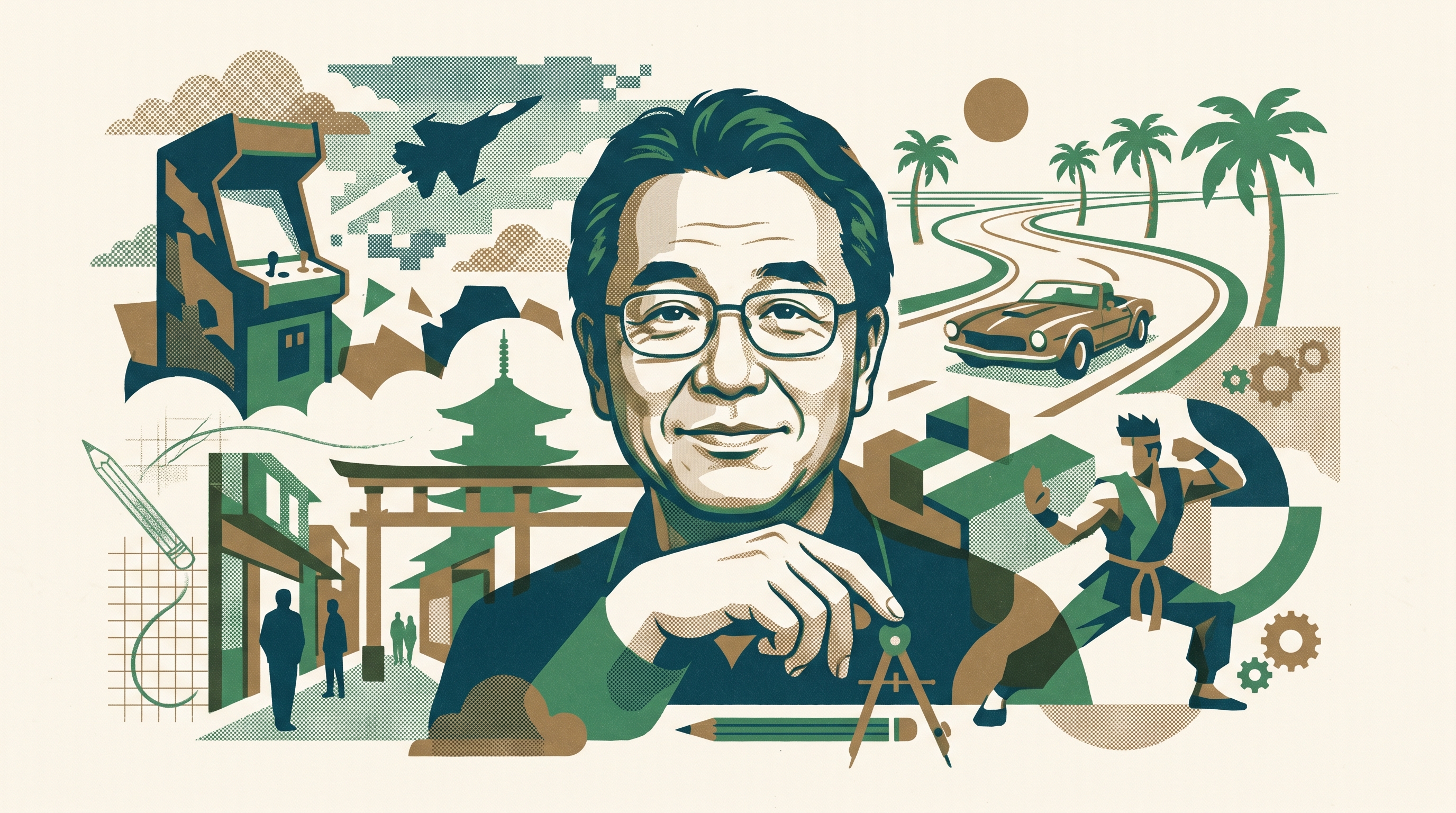
Yu Suzuki is a Japanese game designer, producer, and arcade hardware engineer at Sega. He created Space Harrier (1985), Out Run (1986), After Burner (1987), Virtua Fighter (1993), and Shenmue (1999). As an arcade hardware engineer, he led development of the Sega System 16, Model 1, Model 2, and Model 3 boards, and was involved in the development of the Dreamcast and its NAOMI arcade hardware. Shenmue — his most ambitious project, with a budget Suzuki himself cited in a 2011 interview as approximately $47 million (other sources estimate as high as $70 million) — created the open-world life simulation genre, introducing fully explorable 3D environments, a real-time day–night cycle, and interactive NPCs with daily routines. Suzuki coined the term FREE (Full Reactive Eyes Entertainment) for this design philosophy.
History
Yu Suzuki was born on June 10, 1958, in Iwate Prefecture, in the northeast of Japan. He studied electronic science at the Okayama University of Science, where — in a detail that reads almost like prophecy — he wrote his graduation thesis on three-dimensional computer graphics for video games, a subject that barely existed as a field at the time. He was an engineer first and a storyteller second, and that order of priorities would shape everything he made: where other designers began with a character or a plot, Suzuki began with a question about what the hardware could be made to do, and then asked what feeling that capability could produce.
In 1983 Suzuki joined Sega as a programmer, and by his own first year he had been promoted to project leader — an unusually fast ascent. His earliest credited work was the SG-1000 title Champion Boxing (1984), but it was Hang-On in 1985 that announced who he would become. Hang-On was not merely a motorcycle racing game; it was a motorcycle. Suzuki built it around a full-size bike cabinet that the player physically straddled and leaned to steer, pioneering what Sega would market as 'taikan' — body-sensation — gaming. He had grasped a principle that would define his career: an arcade machine is not a screen you look at, it is a place you climb inside.
The taikan era that followed remains one of the most concentrated runs of innovation in arcade history. Space Harrier (1985) bolted the player into a hydraulically actuated seat that pitched and rolled with the on-screen action. Out Run (1986) put them behind the wheel of a convertible Ferrari, but refused to be a racing game in the conventional sense — there was no opponent to beat, only a coastline to enjoy and a branching road that let the player choose their own route. 'Rather than playing a racing game,' Suzuki once explained, 'I would rather drive a real car.' Out Run was about the pleasure of driving, not the pressure of winning, and its soundtrack-selectable, sun-drenched freedom made it one of the most beloved cabinets ever built. After Burner (1987) completed the trilogy of motion, strapping players into a rolling cockpit that flipped them through the sky.
When the arcade industry turned toward three dimensions, Suzuki turned with it — and led. Virtua Racing (1992) ran on Sega's new Model 1 board and proved that real-time texture-light polygon worlds could be both fast and legible. Then came Virtua Fighter in 1993: the first 3D polygonal fighting game, built on the conviction that combat rendered in true three-dimensional space would feel fundamentally different from the flat sprite-fighters that dominated the era. It was correct, and it was historic — a Virtua Fighter cabinet was later placed in the permanent collection of the Smithsonian Institution. For Virtua Fighter 2 (1994), Suzuki's team adapted military-grade texture-mapping techniques into affordable arcade silicon and brought motion capture into mainstream game development. Across roughly eighteen years Suzuki led Sega's AM2 division, at its height a studio of more than two hundred people, and was so central to the company's creative identity that he was often called 'Sega's Miyamoto.'
Then he risked all of it on a single idea. Shenmue, released for the Dreamcast at the end of 1999, was an attempt to build not a level or a map but a living place — the town of Yokosuka rendered with a real-time day-and-night cycle, weather, shops that opened and closed, and non-player characters who kept their own daily schedules. Suzuki coined a term for the philosophy: FREE, for Full Reactive Eyes Entertainment, the idea that everything the player's eyes fell upon should respond. The detail was obsessive by design. 'My quest was to be able to make thirty NPCs per hour,' Suzuki said, 'because otherwise we wouldn't be able to fill up the Shenmue world well enough.' The press seized on the cost: Shenmue was widely reported at the time as the most expensive video game ever made, with figures around seventy million dollars circulating, though Suzuki himself later stated in 2011 that the project ran to roughly forty-seven million dollars including marketing — and that the budget had also laid the groundwork for its sequel. Either way, it was a staggering sum to spend reaching for a world that did not yet have a name.
The vision arrived years before the market was ready to pay for it. Shenmue sold around 1.2 million copies — strong for the Dreamcast, but nowhere near enough to recover its cost on an install base that small. One critic captured the cruelty of the arithmetic by noting that every Dreamcast owner would have needed to buy roughly two copies for the game to break even. Suzuki completed Shenmue II in 2001, but the larger story had already turned: the same year, Sega abandoned the hardware business entirely, and Shenmue — the most ambitious thing the Dreamcast ever produced — is remembered as both the console's crowning achievement and one of the weights that helped pull it under. This is the part of Suzuki's story that the budget headlines miss. The cost of believing completely in a vision is not only money; it is the risk of being right too early, and of taking the ground you are standing on down with you.
Sega's exit from hardware did not end Suzuki's pursuit, only suspended it. He founded the studio Ys Net in 2008 and formally left Sega in 2011, the same year the Game Developers Choice Awards honored him with its Pioneer Award; he had already been inducted into the Academy of Interactive Arts & Sciences Hall of Fame in 2003. The story's most improbable turn came in 2015, when Suzuki launched a Kickstarter campaign to finally make Shenmue III — the sequel fans had waited fourteen years for. It reached one million dollars in one hour and forty-four minutes and set Guinness World Records for crowdfunding speed, ultimately raising over six million dollars from tens of thousands of backers. The vision Suzuki had nearly bankrupted a project to build was, eighteen years later, resurrected by the people who had never stopped believing in it. Shenmue III was released in 2019.
Suzuki's own motto inverts the proverb most people live by. 'Those who chase two rabbits do not get any rabbits,' he has said. 'First, chase a hundred rabbits!' It is the logic of a man who filled a virtual town with shops no quest required and faces no player would ever speak to, simply because a real place would have them. The wisdom worth carrying out of his story is not that excess is always rewarded — Shenmue's ledger says plainly that it is not — but that a vision pursued without compromise leaves a mark the balance sheet cannot measure. He built more world than the moment could use, and the surplus is exactly what people remembered, and funded, and came back for. Sometimes the things you make for no practical reason are the only things that outlive the reasons.
Timeline & Works
Career milestones and all 3 games in the museum they worked on — in the order they happened.
- 1958 06
Born in Iwate Prefecture
Yu Suzuki is born on June 10, 1958, in Iwate Prefecture in northeastern Japan. He later studies electronic science at the Okayama University of Science, writing a graduation thesis on 3D computer graphics for video games.
people - 1983
Joins Sega as a programmer
Suzuki joins Sega in 1983 and is promoted to project leader within his first year — the start of an arcade career that would define the company.
people - 1985
Hang-On — the dawn of "taikan" gaming
Hang-On launches with a full-size motorcycle cabinet the player straddles and leans to steer, pioneering Sega's "taikan" (body-sensation) arcade philosophy: a machine you climb inside rather than merely look at.
product - 1985
Space Harrier — the hydraulic moving seat
Space Harrier locks the player into a hydraulically actuated seat that pitches and rolls in sync with the on-screen action, deepening the taikan experience.
product - 1986
Out Run — driving as pleasure, not competition
Out Run replaces the racing genre's pressure to win with the pleasure of driving — branching routes, a selectable soundtrack, and a sun-drenched coastline. "I would rather drive a real car," Suzuki said of its design.
product - 1987
After Burner — completing the trilogy of motion
After Burner straps players into a rolling cockpit that flips them through the sky, completing Suzuki's run of motion-cabinet arcade landmarks.
product - 1991
- 1992
Virtua Racing — Sega Model 1 and real-time polygons
Running on the new Sega Model 1 board, Virtua Racing proves that real-time polygon 3D can be fast and legible — the technical foundation for what comes next.
hardware - 1993
Virtua Fighter — the first 3D polygonal fighting game
Virtua Fighter establishes the 3D fighting genre. A cabinet was later placed in the permanent collection of the Smithsonian Institution, recognizing its place in the history of technology.
product - 1994
Virtua Fighter 2 — military texture-mapping in the arcade
Suzuki's AM2 team adapts military-grade texture-mapping into affordable arcade hardware and brings motion capture into mainstream game development.
product - 1994
- 1999
Shenmue — FREE and the open-world ambition
Shenmue launches for the Dreamcast, building a living town with a day-night cycle, weather, and NPCs on daily routines. Suzuki names the philosophy FREE (Full Reactive Eyes Entertainment). Widely reported as the most expensive game ever made; Suzuki later cited roughly $47 million including marketing, while contemporary press cited figures around $70 million.
product - 1999
- 2001
Shenmue II — and Sega exits hardware
Suzuki completes Shenmue II the same year Sega abandons the hardware business. Shenmue is remembered as both the Dreamcast's crowning achievement and one of the weights that helped pull it under.
product - 2003
Inducted into the AIAS Hall of Fame
Suzuki is inducted into the Academy of Interactive Arts & Sciences Hall of Fame, recognizing his foundational contributions to arcade and 3D game design.
milestone - 2011
GDC Pioneer Award; leaves Sega
The Game Developers Choice Awards honor Suzuki with its Pioneer Award. He formally leaves Sega the same year, having founded his own studio, Ys Net, in 2008.
milestone - 2015
Shenmue III Kickstarter sets world records
Suzuki launches a Kickstarter to make Shenmue III. It reaches $1 million in 1 hour 44 minutes, setting Guinness World Records for crowdfunding speed and ultimately raising over $6 million from tens of thousands of backers. The vision fans never stopped believing in is revived eighteen years on; Shenmue III releases in 2019.
milestone
Connections
- employed sega (1983–2011)
Suzuki joined Sega in 1983 and, over roughly eighteen years leading the AM2 division, created Hang-On, Out Run, Virtua Fighter, and Shenmue before formally leaving the company in 2011.
- employed sega-am2 (1983–2003)
Suzuki led Sega's AM2 research and development division, at its height a studio of more than two hundred people and the engine behind Sega's most ambitious arcade and Dreamcast titles.
Also connected to
- Takenobu Mitsuyoshi co-created Shenmue / same employer (Sega, 1990–2011)
- Ryuji Iuchi co-created Shenmue
- Takayuki Nakamura co-created Virtua Fighter
Explore the work
Each title has its own page — history, trivia, and collector's notes.
Dreamcast · 1999
Shenmue
The game lost Sega a fortune. It spent the next two decades quietly teaching eve…
Sega Saturn · 1994
Virtua Fighter
They put a hundred words on a grain of rice, and called it a fighting game.…
Sega Mega Drive / Genesis · 1991
OutRun
He drove 200 km/h through four countries and came back asking one question: what…
Rooms their games live in
Sources
- Yu Suzuki — Wikipedia (English) — accessed 2026-06-01
- Shenmue (video game) — Wikipedia (English) — accessed 2026-06-01
- Shenmue III — Wikipedia (English) — accessed 2026-06-01
- Yu Suzuki — Ys Net Official — accessed 2026-06-01
- Yu Suzuki talks Shenmue and open-world games — SEGAbits — accessed 2026-06-01
- Yu Suzuki Interview — Video Games Chronicle — accessed 2026-06-01
- Yu Suzuki accepts certificates for Shenmue 3 crowdfunding records — Guinness World Records — accessed 2026-06-01
- Game Developers Choice Awards to Honor Yu Suzuki With Pioneer Award — PR Newswire — accessed 2026-06-01