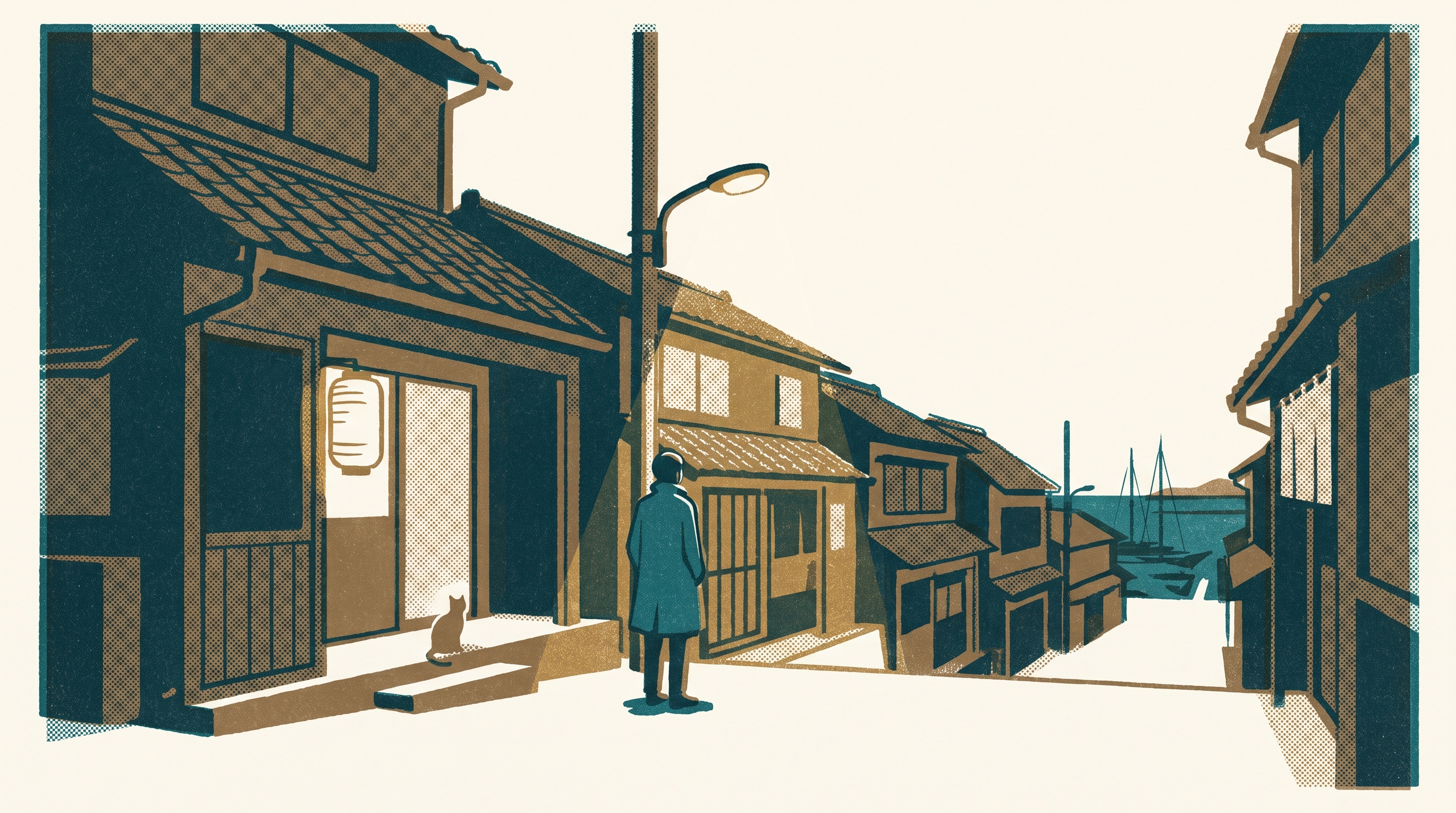
Yu Suzuki was born on June 10, 1958, in Iwate Prefecture, in the north of Japan. He studied electronic science at Okayama University of Science — an engineer's training, not an artist's. In 1983 he joined Sega. He was, by background and by instinct, a man who thought about how machines worked before he thought about how they felt. That combination would define everything he made.
His first arcade hits were not about graphics. They were about the body. Hang-On (1985) put the player on a full-size motorcycle that leaned into the corners. Out Run (1986) sat them in a car seat that swayed. After Burner (1987) strapped them into a cockpit that rolled upside down on hydraulics. Suzuki called these 'taikan' — body-sensation — games. He understood something most designers did not yet: that a game is not what you watch, it is what you feel happening to you.
Then he turned to polygons. Virtua Racing (1992) and Virtua Fighter (1993) were among the first arcade games built entirely from 3D polygons, and Virtua Fighter became a social phenomenon in Japan — lines around the arcades, players studying frame data like a martial art. There is a story from its development that says everything about him: to test whether the controls were truly simple enough for anyone, Suzuki had the office cleaning lady sit down and play it. If she could not understand it in a few minutes, it was not finished.
His next idea was larger than anything the medium had attempted. It began as a role-playing game built on the Virtua Fighter engine — 'Akira's story' — and grew into something he named with an acronym, FREE: Full Reactive Eyes Entertainment. He wanted to build not a level, but a place. A real town, where the sun rose and set, where it rained on schedule, where every shopkeeper had a home to walk back to at night, where you could open a drawer just to see what was inside. He was describing the open-world game roughly a decade before the rest of the industry had the word for it.
It cost a fortune. Suzuki has said development and marketing together came to around forty-seven million US dollars — at the time, the most expensive video game ever made, a figure that would later be entered into the Guinness records. And he was building it on the Dreamcast: a console Sega would lose the hardware war with, and stop making within a few years. The arithmetic was impossible from the start. There were not enough Dreamcasts on Earth for the game to ever earn back what it cost.
Shenmue released in Japan in December 1999. Critics did not quite have the vocabulary for it — a game where you could spend an afternoon working a forklift, feeding a cat, or asking strangers if they had seen a man with a black car. It was reviewed with a kind of awe and sold to a console that was already dying. Shenmue II followed in 2001. Suzuki had planned the story to run at least five chapters. Sega left the hardware business, and the chapters stopped. The grand arc was left hanging, mid-sentence, for almost two decades.
And yet. The living town that lost money on the Dreamcast became the blueprint for an entire genre. The day-night cycles, the weather, the townspeople with their own daily routines, the freedom to ignore the plot and simply exist in a place — this is now the standard grammar of the biggest games in the world. Suzuki even gave a name to a mechanic he invented for it: the Quick Time Event. The bet did not close on a balance sheet. It closed across the whole medium, which slowly, game by game, grew up into the shape he had drawn first.

He left Sega and, in 2008, founded his own small studio, Ys Net. In 2015 — sixteen years after the first game — the unfinished story refused to die: fans funded Shenmue III directly through Kickstarter, setting a crowdfunding record for a video game, and it finally arrived in 2019, two decades after he began. The vision had outlived the console, the company, and the math that said it could never work. Some bets, it turns out, are not meant to be won in their own time. They are meant to show everyone else what is possible, and to wait.