Buying a Famicom — A Practical Guide
What to think about before you click. Questions worth asking — and what the answers tell you.
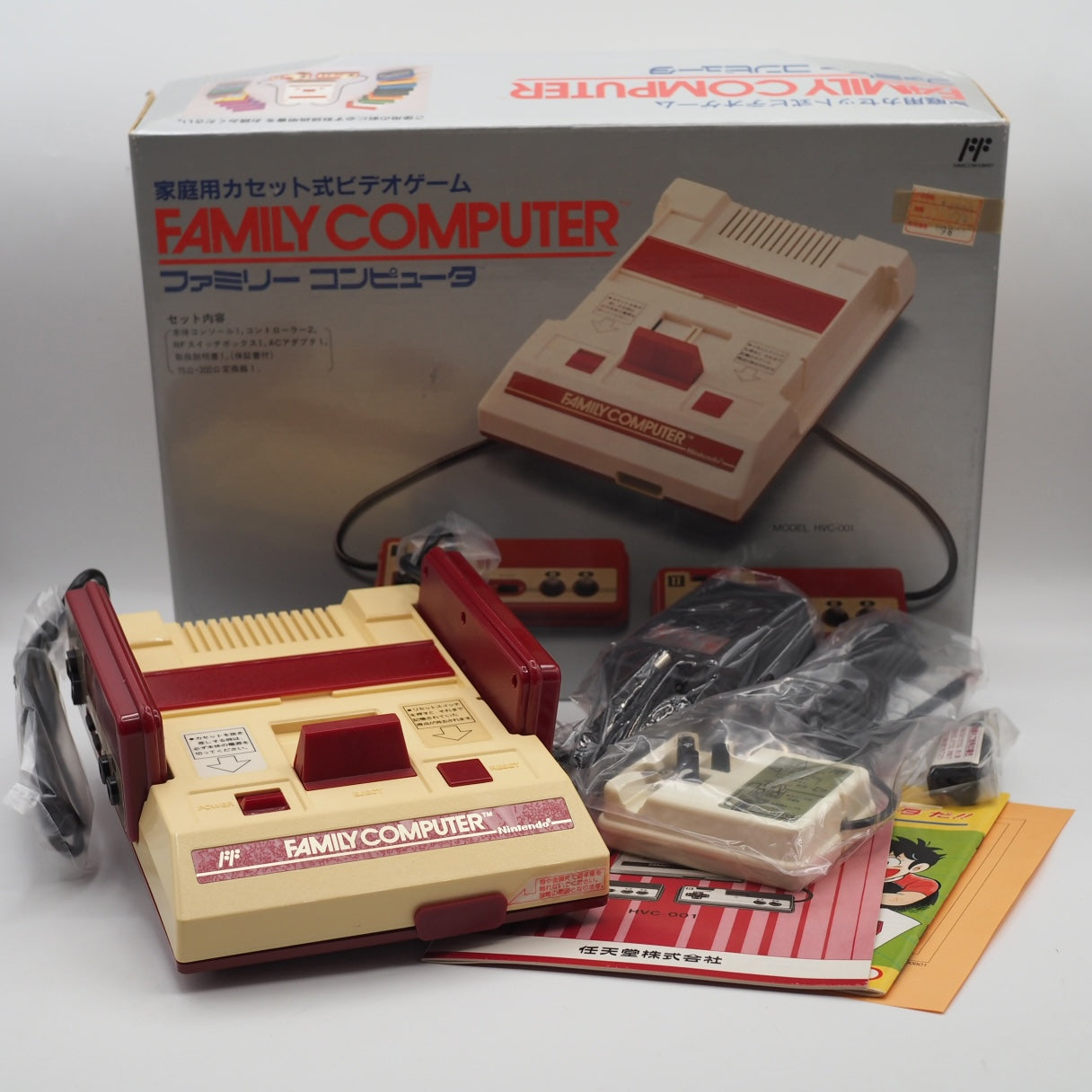 Nintendo Famicom HVC-001 — hand-tested, from our shop
 Things to watch out for when buying
Buying a Famicom: what to think about before you click
Somewhere out there, the right machine is waiting for you. But between you and that machine are a few questions worth asking — not because things go wrong all the time, but because when they do, you wish you'd asked.
This isn't a repair manual. It isn't a spec sheet. Think of it as notes from someone who's been through the same decisions, trying to save you the detours they had to learn the hard way.
And here's the thing: most of these questions already have answers — if the person selling it actually knows their machine.
The variations of the Famicom
The Famicom family spans three decades and four distinct hardware releases. They share software compatibility but differ in output, connectivity, and practical usability outside Japan.
Original Family Computer (HVC-001)
Launched in Japan on July 15, 1983, designed by Nintendo engineer Masayuki Uemura. A red-and-white unit with a top-loading 60-pin cartridge slot and RF-only video. Both controllers are hardwired; the Player 2 controller has a built-in microphone and no Start/Select. The HVC-002 adapter is rated for Japan's 100V only.
- RF output only
- Hardwired controllers
- 60-pin cartridge slot
- Japan 100V adapter
Two sub-variants exist: the earliest 'square button' units (a known graphics chip issue led to a Nintendo replacement program — prized by collectors, less suited to regular play) and the later, common 'round button' run. RF output and 100V power make this Japan-only hardware overseas.
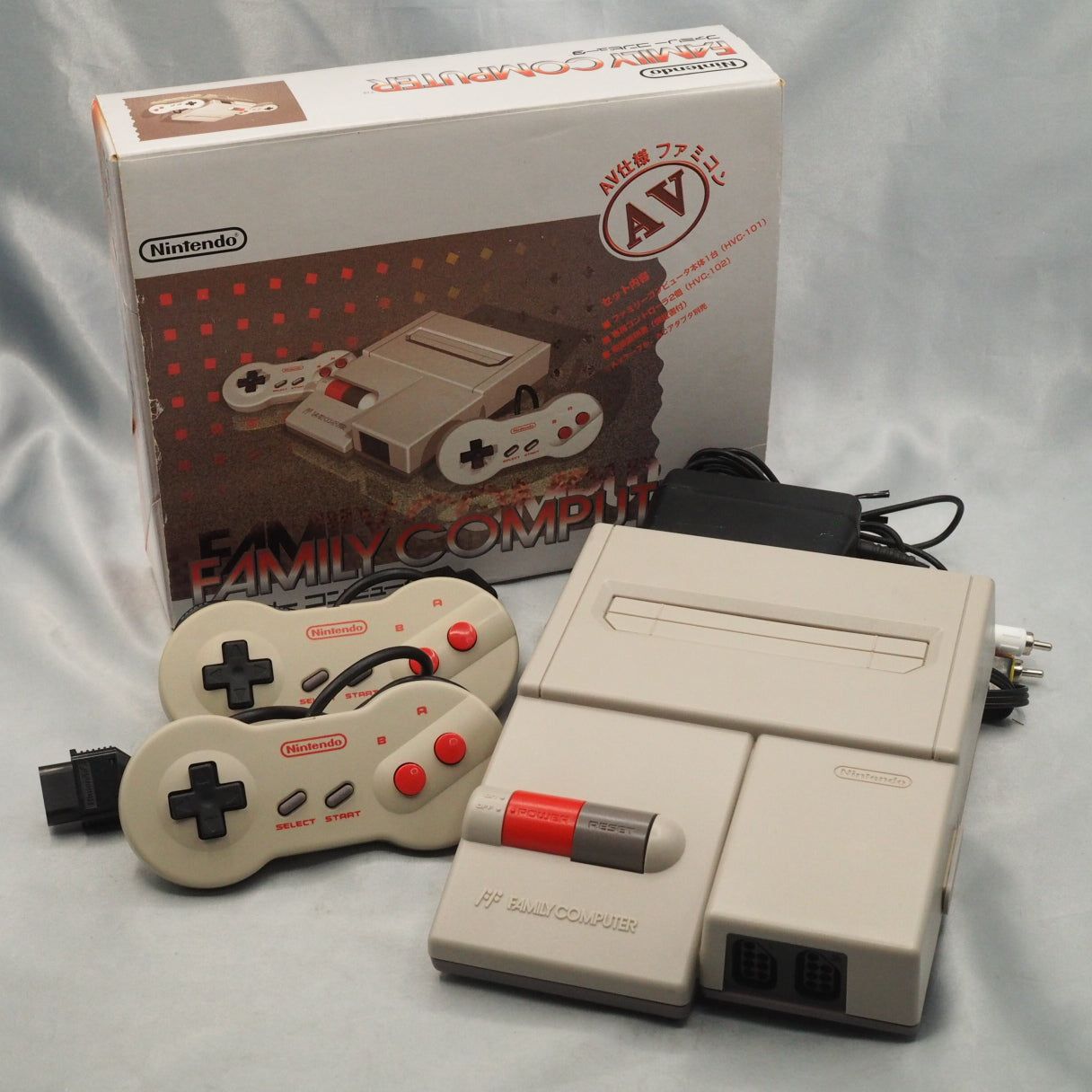
AV Famicom / New Famicom (HVC-101)
Released December 1, 1993 as a cost-reduced revision, just as the Super Famicom dominated. Adds composite AV output via the same multi-out connector as the Super Famicom, and detachable 'dogbone' controllers using NES-style ports. RF output was removed. It keeps the side expansion port and works with the Disk System RAM Adapter.
- Composite AV output
- Detachable controllers
- Super Famicom multi-out
- No RF
The preferred choice for overseas buyers who want to play without modification — composite works with most modern TVs via AV-to-HDMI. Detachable controllers also remove the original's cable-damage risk.
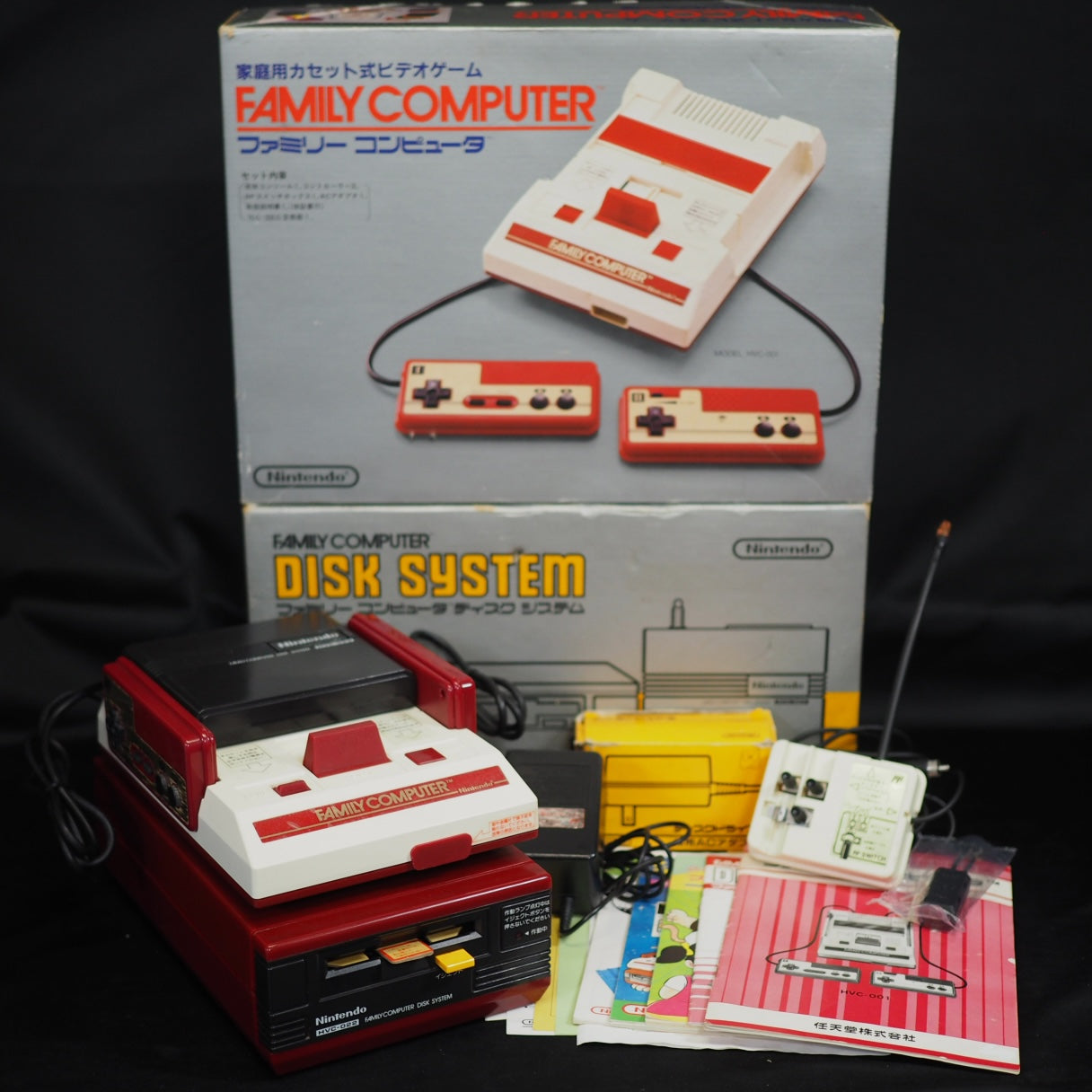
Famicom Disk System (HVC-022)
Released February 21, 1986. A floppy-disk drive add-on, not a standalone console. It connects through a RAM Adapter inserted into the Famicom's cartridge port and needs its own power supply. It used proprietary 2.8-inch Quick Disk media (up to 112 KB per side), added a sound channel, and enabled battery-free saves. About 4.4 million units sold, Japan only; hardware sales ended in 1993.
- Peripheral, not a console
- RAM Adapter required
- Quick Disk media
- Japan only
Requires a working Famicom and an undamaged RAM Adapter. The magnetic disks degrade and many no longer read reliably — confirm disks have been tested. Home to the original Famicom releases of The Legend of Zelda and Metroid.
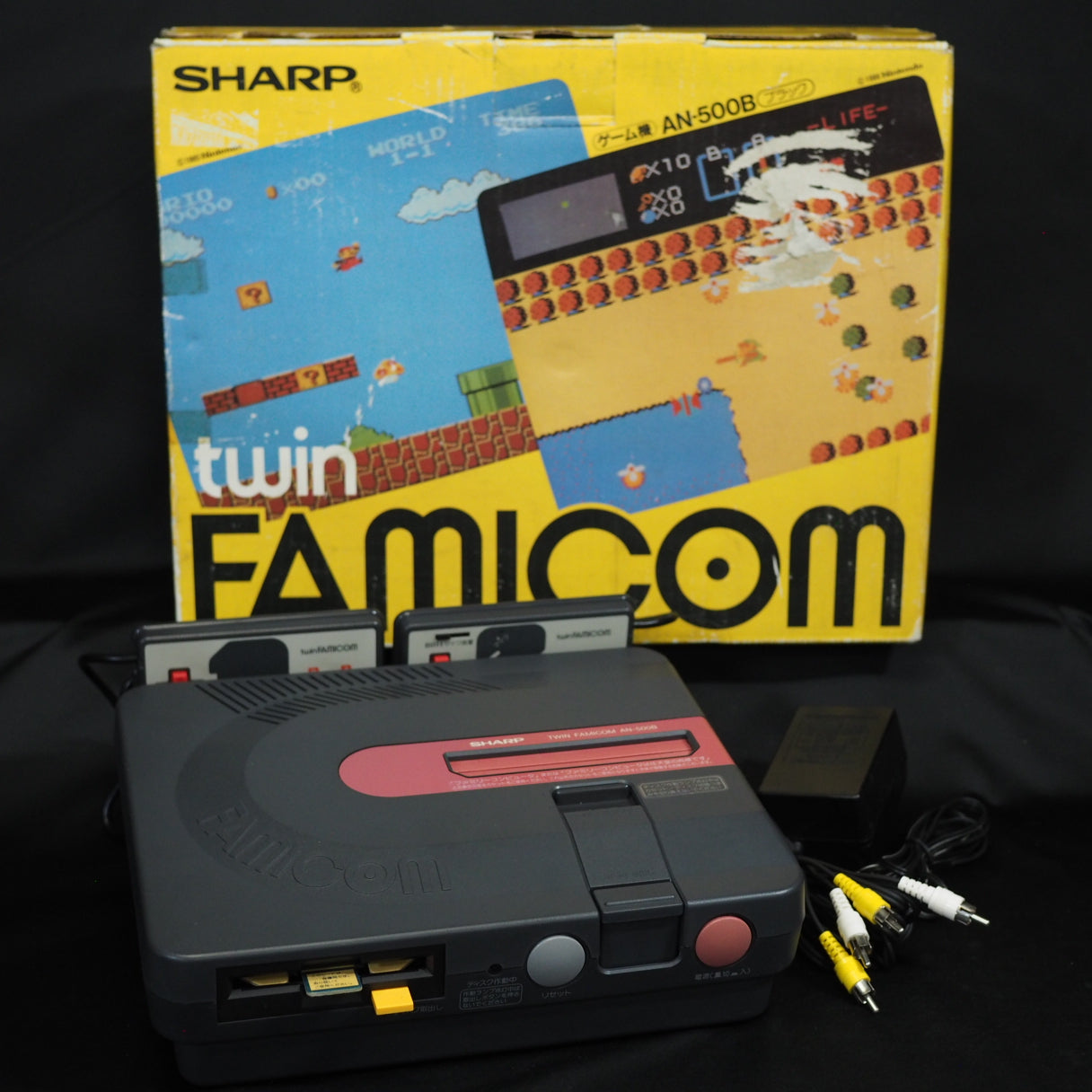
Sharp Twin Famicom (AN-500 / AN-505)
A Nintendo-licensed product made by Sharp, released July 1, 1986, integrating the Famicom and the Disk System into one unit. Unlike the original Famicom it outputs composite video via RCA connectors. The 1987 revision (AN-505) added turbo-fire controllers and longer cables. It launched at 32,000 yen, roughly four times the original Famicom's price.
- Famicom + Disk System in one
- Composite RCA output
- Sharp-made, Nintendo-licensed
- No RF needed
Valued by collectors for its all-in-one integration and composite output on Famicom hardware. The built-in Disk drive carries the same disk-degradation risk — test with both cartridge and disk software before buying.
And then — what do you put in it?
A working console is only half the purchase. The reason to own a Famicom rather than an NES is the shelf behind it: some of these carts never left Japan, and a few of them are the best argument the machine ever made for itself.
Want to know the going rate?
Prices for original Famicom hardware vary — condition, model revision, and whether the unit has been recapped or modified all affect the figure. Our shop lists hand-tested units with pricing that reflects what each machine is actually worth.
Already own one? How to care for a Famicom →
Now in the shop
These are the individual pages for units we currently have in stock.
- 1943: The Battle of Midway
- Argus no Senshi (Rygar)
- City Connection
- Clu Clu Land
- Dokuganryu Masamune
- Donkey Kong
- Donkey Kong 3
- Donkey Kong Jr.
- Double Dragon
- Double Dragon II: The Revenge
- Downtown Nekketsu Koushinkyoku: Soreyuke Daiundoukai
- Dr. Mario
- Dragon Ball 3: Gokuden
- Dragon Buster
- Dragon Quest II: Luminaries of the Legendary Line
- Dragon Quest III: The Seeds of Salvation
- Final Fantasy
- Mega Man 2
- Mobile Suit Z Gundam: Hot Scramble
- Ninja Gaiden III: The Ancient Ship of Doom
- Ninja-kun: Majou no Bouken
- Yoshi's Cookie