In 1985, two brothers walked into a music shop in Leicester. They were looking at a Yamaha CX5 Music Computer, and David Wise, who worked there, offered to demonstrate it. He played them the music he had programmed for the demonstration. They did not buy the computer. They offered him a job instead.
Tim and Chris Stamper ran a small game development company called Rare. Wise joined them and became their sole musician. For nearly a decade, every sound in every Rare game came from his hands. He composed for the NES, the Game Boy, the arcade boards. He was used to working with almost nothing — the NES gave him five sound channels, each one fragile and hard to control.
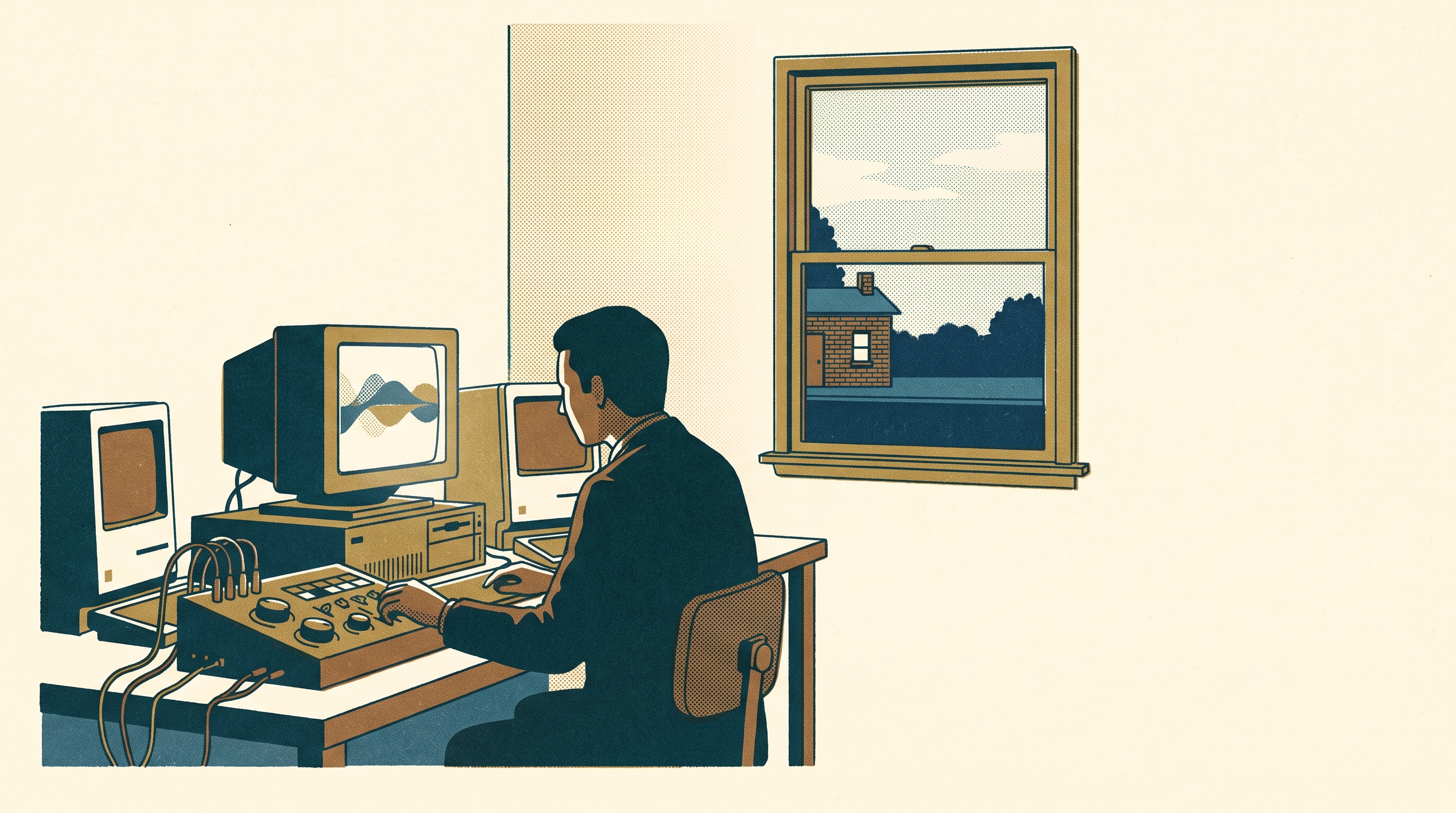
When Rare began working on Donkey Kong Country for the Super Nintendo in the early 1990s, the system had eight channels. It also had 64 kilobytes of sample memory. That is not much. Most composers at the time used standardized MIDI instruments — plug-and-play sounds that filled the space quickly and left little room for anything else. Wise did not do that. He coded his own instruments from scratch, sampling waveforms from a Korg Wavestation and a Roland U-110, breaking them into tiny pieces, and reassembling them in a text editor as HEX subroutines. He did not use Nintendo's Sound Tools. He typed everything by hand.
The choice was slower. Each track took at least three weeks to complete. The track called 'Aquatic Ambience' took five weeks, most of that time spent on the technical side — stitching hundreds of tiny waveform fragments together so they would loop seamlessly and emulate the Wavestation's vector synthesis. The result was a piece of music that sounded like it belonged to hardware that did not exist yet. Players heard it in 1994 and thought the Super Nintendo had been hiding something all along.
What Wise understood — what he built his method around — was that constraint does not kill creativity. Constraint reveals where the work is. You cannot avoid the technical problem. You can only decide whether to let it dictate your sound or whether to rebuild the tool so the sound dictates itself. He chose the latter. Every track on Donkey Kong Country was composed not just with notes but with code, written in an editor meant for programming, not music. The line between the two had dissolved.
Rare became known for the sound of its games. The underwater levels, the forests, the factories — each had a mood so specific that players could recognize a Rare game by ear. Wise stayed with the company for twenty-four years. In 2009, he resigned. In his own words, the company had 'changed a great deal,' and there was no longer the opportunity to create the music Rare had once been known for. He left quietly and set up a freelance studio. He has worked on games since, including Donkey Kong Country: Tropical Freeze, but always as an outsider now, hired by contract rather than in-house.
The choice he made in 1994 — to code rather than compose, or to compose by coding — was not about what was easier. It was about what the constraint allowed. If the system only gives you 64 kilobytes, you do not ask for more. You learn how to say what you need within 64 kilobytes. That is not limitation. That is craft.
The question it leaves is not whether constraints help or harm. The question is: when the tool does not fit the sound you hear, do you change the sound, or do you rebuild the tool?