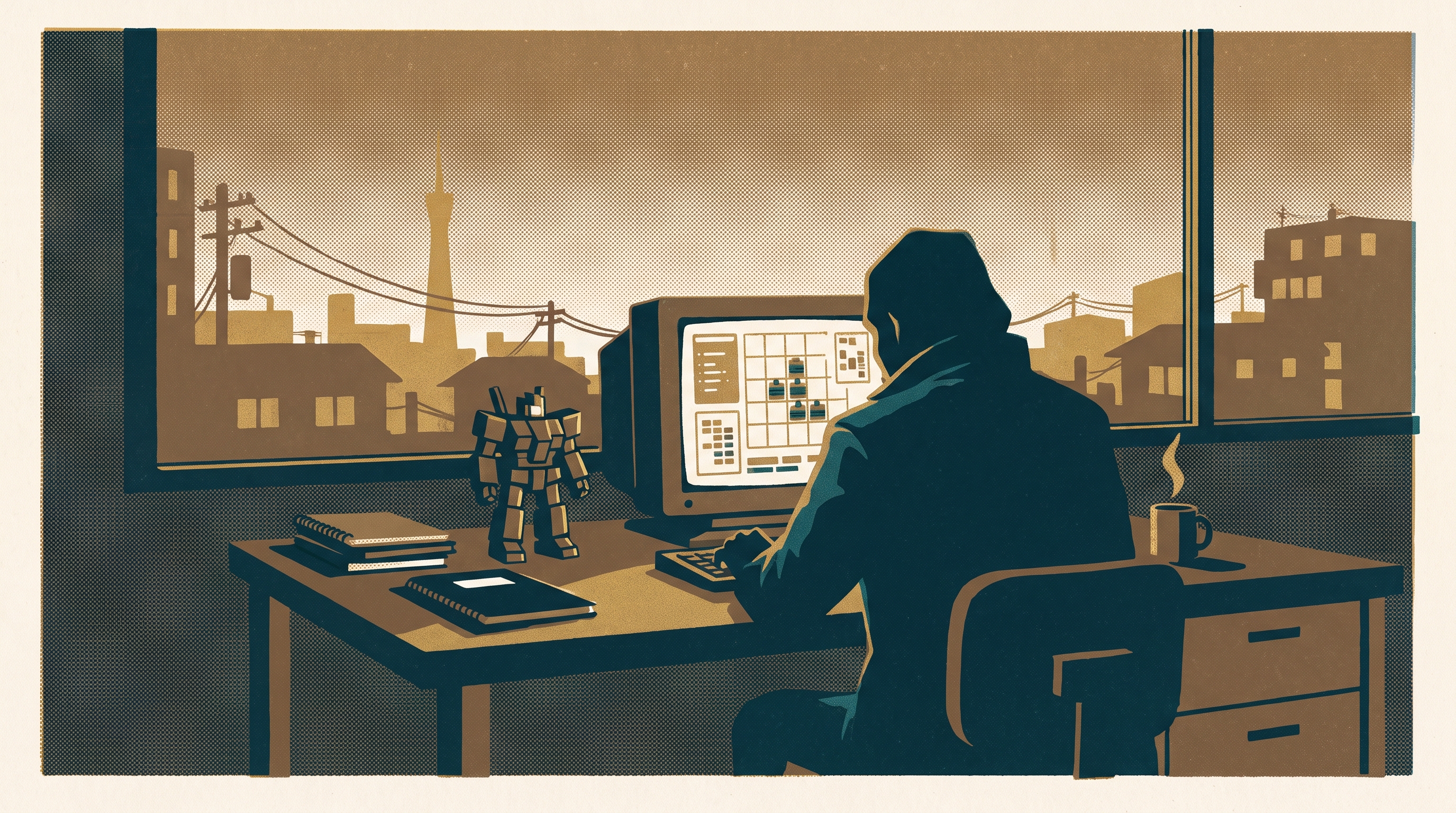
In the fall of 1993, Toshiro Tsuchida walked into Square's Tokyo headquarters to pitch a tactical RPG. He had founded his own studio, G-Craft, earlier that year after leaving Masaya, and the proposal he carried was deliberately unheroic. It was a near-future war story about piloted mechs called wanzers, set against geopolitical conflict — closer to a military drama than a power fantasy. Square, known for epic quests and fantasy worlds, found the concept too radical. They said no.
Tsuchida did not revise his pitch. Instead, he built a working prototype. The prototype answered the question Square had not yet asked: could a game about war feel like war? Not glorious conquest, but limited resources, moral ambiguity, and consequences that could not be undone. The prototype showed Square what the pitch could not. Negotiations proceeded slowly — Square had never outsourced development to another company before — but by the end of 1993, an agreement was reached.
Front Mission released on February 24, 1995, for the Super Famicom. It sold over five hundred thousand copies in Japan — a success large enough to launch a franchise. But the game's greatest achievement was not in sales. It had proven that tactics games could carry the weight of adult storytelling, and that turn-based strategy could feel as tense as real-time action when designed with care.
In 1997, during the development of Front Mission 2, Square approached Tsuchida with an offer: they wanted to buy G-Craft outright and incorporate it as Square's Development Division 6. Tsuchida accepted. Front Mission 2, released in September 1997, became the last game credited to G-Craft. The studio that Tsuchida had founded to maintain creative independence now belonged to the publisher he had once needed to convince.
Inside Square, Tsuchida turned to a very different problem. As battle director of Final Fantasy X, he faced a system that had defined the series for a decade: the Active Time Battle, introduced by Hiroyuki Ito in 1991. ATB rewarded speed and reflex — bars filled in real time, and hesitation was punished. Tsuchida believed the system no longer served the kind of strategy Final Fantasy could carry. So he replaced it.
The Conditional Turn-Based Battle system that shipped with Final Fantasy X in 2001 was deliberate where ATB had been frantic. Turns did not operate in equal rounds. Speed determined frequency — faster units acted more often — and every action had a visible cost in time. Players could see exactly when each character would move next, and plan accordingly. Weaker spells resolved faster than powerful ones, introducing a trade-off between patience and power. Tsuchida had Final Fantasy IV in mind when designing the system — he wanted to preserve what made turn-based combat thoughtful, and strip away what made it feel like waiting.
The system divided opinion. Some longtime fans saw it as a betrayal of the series' identity. Others found it more engaging than anything Final Fantasy had done before. Tsuchida returned to the role of battle planning director on Final Fantasy XIII in 2009, refining the ideas he had introduced eight years earlier. He led Development Division 6 until February 28, 2011, when he left Square Enix to join the mobile developer GREE.
After leaving GREE in 2014, Tsuchida restarted G-Craft — the studio he had sold to Square seventeen years earlier. The company that had once needed Square's approval to exist now stood on its own again. In 2022, Tsuchida returned to the Front Mission series, contributing to the world-building of Front Mission: Borderscape, a multiplayer entry announced for international release.
Toshiro Tsuchida never argued with the rules of battle. He simply rebuilt them — whether that meant replacing dragons and swords with geopolitical wanzers, or trading a decade-old combat system for one that asked the player to think three moves ahead. The question his career poses is quiet but persistent: when you inherit a system everyone recognizes, do you preserve it out of reverence, or do you trust that the best way to honor it is to build something better?