composer
Akito Nakatsuka
中塚章人
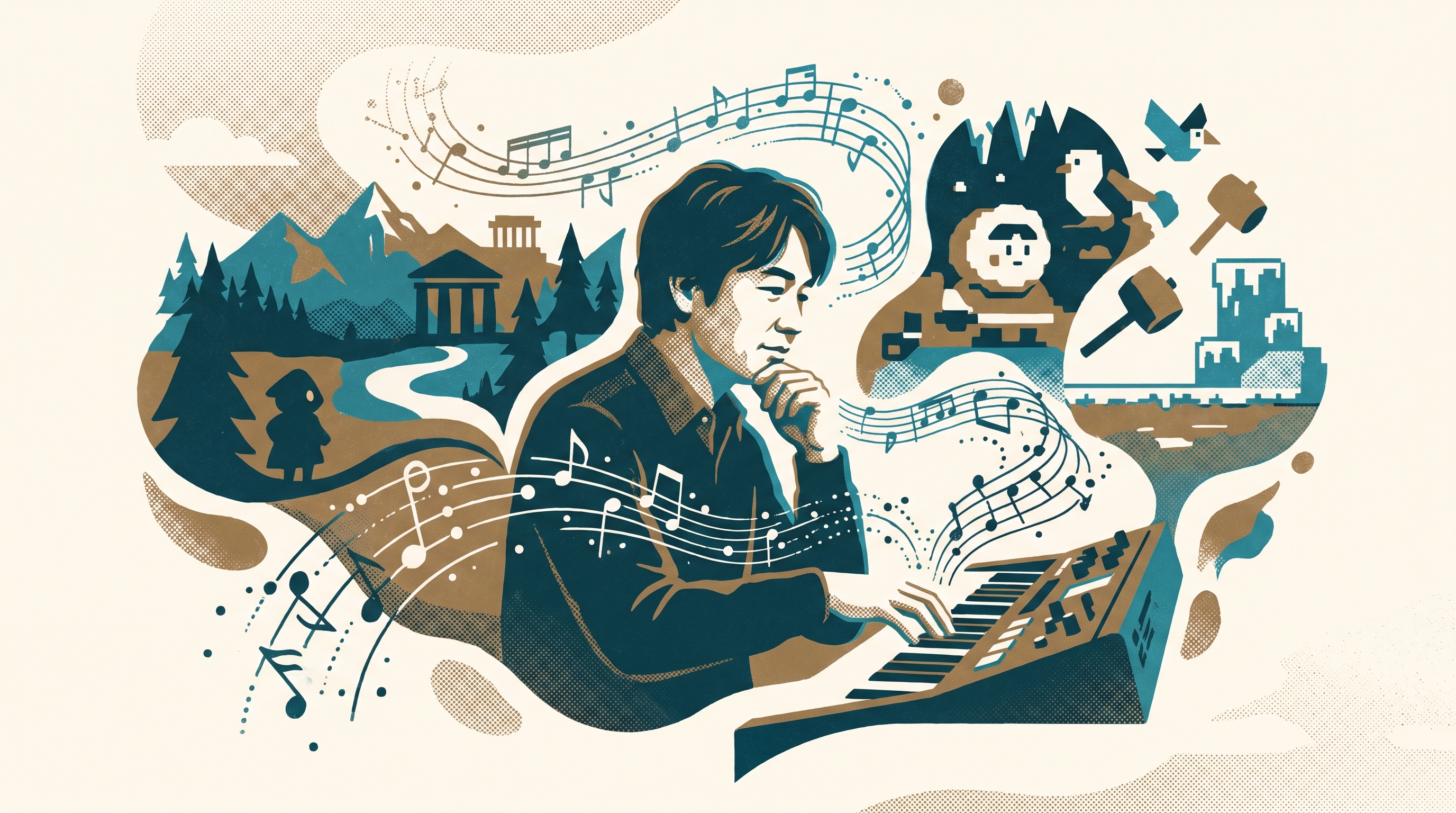
When the tools weren't enough, he built his own engine. The craft of making music and the craft of making tools — both, at once.
About
Akito Nakatsuka is a Japanese video game composer and sound director at Nintendo. He joined the company in 1984, the same year as Koji Kondo, and became one of Nintendo's earliest in-house composers during the Famicom era. He composed music for Devil World, Ice Climber, Zelda II: The Adventure of Link, and Punch Out!!, and programmed his own sound engine around 1986. In later years, he transitioned to a managerial role within Nintendo's sound division, providing supervision and support for other composers.
History
Akito Nakatsuka entered Nintendo in 1984, during the same hiring wave that brought Koji Kondo into the company. It was a time when video game music as a discipline barely existed in Japan, and the people being hired to compose for the Famicom were, in most cases, making it up as they went. Nintendo's Research & Development 2 division had no established compositional training program, no formal process for creating game audio, and no clear expectations about what a composer's job would look like five years down the line. Nakatsuka and Kondo were among the first people the company hired specifically to make music for games, and together with Hirokazu Tanaka and Yukio Kaneoka — who had already been at the company — they formed the nucleus of Nintendo's early sound culture.
Nakatsuka's first credited work was Devil World, released in October 1984 for the Famicom. The game was a Pac-Man-style maze title designed by Shigeru Miyamoto, and Nakatsuka shared the music composition duties with Kondo. The following year he composed the full soundtrack for Ice Climber, a vertically scrolling platformer about two climbers ascending a mountain while avoiding wildlife and breaking ice. The music was short, looping, and constrained by the severe hardware limits of the Famicom's sound chip — which offered just five channels of monophonic audio. Every note had to justify its existence; there was no room for filler. The result was lean, propulsive, and cleanly structured — qualities that would define much of Nakatsuka's early catalog.
By 1986, Nakatsuka had begun programming his own sound engine. The decision was not unusual for the period — composers at Nintendo often had to write or modify the code that drove their music, because off-the-shelf tools either did not exist or did not serve the needs of the games they were making. Nakatsuka's engine gave him more direct control over timing, dynamics, and memory allocation, and it became a tool he would refine and use across multiple projects in the years that followed.
His most recognized work came in 1987 with Zelda II: The Adventure of Link, the side-scrolling action-RPG sequel to The Legend of Zelda. The game represented a sharp departure from the top-down exploration of the original, and Nakatsuka's soundtrack matched that shift in tone. The overworld theme, the palace themes, and the boss battle music were all built from economical melodic motifs that repeated with variation rather than sprawling into longer compositions. The music had to fit into extremely limited cartridge space, and Nakatsuka's response was to design every phrase to carry maximum expressive weight with minimal data. Zelda II has been cited in retrospective analyses of Famicom-era music as an example of constraint used as compositional discipline rather than obstacle.
Nakatsuka continued to compose through the late 1980s and into the 1990s, contributing to titles such as Punch Out!!, NES Open Tournament Golf, and Super Mario Bros. Special. But as Nintendo's scale grew and the company's audio infrastructure matured, Nakatsuka gradually moved away from direct composition. By the 2000s he had taken on a managerial and supervisory role within Nintendo SPD's sound division, where he supported other composers rather than writing music himself. He contributed sound supervision to projects including Brain Age: Train Your Brain in Minutes a Day! and Daigasso! Band Brothers, and his name appeared in credits primarily as a supervisor rather than a composer.
Nakatsuka's career is a reminder of something easy to overlook when video game music is discussed in retrospect: in the beginning, composers were also engineers. To make a sound, you often had to write the system that would play it. To fix a problem, you rewrote the engine. The line between the creative act and the technical act was not a line at all. Nakatsuka stood on both sides of it from the start, and the music he made — short, efficient, expressive — still plays in the memory of anyone who climbed that mountain or walked into that palace with a sword in hand.
Timeline & Works
Career milestones and all 3 games in the museum they worked on — in the order they happened.
- 1984
Joins Nintendo
Joins Nintendo Research & Development 2 division in the same hiring wave as Koji Kondo, becoming one of the first composers hired specifically to make video game music.
people - 1984 10
Devil World (Famicom)
First credited work: co-composes the music for Devil World alongside Koji Kondo. The game is a Pac-Man-style maze title designed by Shigeru Miyamoto.
product - 1985 01
Ice Climber (Famicom)
Composes the full soundtrack for Ice Climber, a vertically scrolling platformer. The music exemplifies the lean, economical style forced by Famicom hardware constraints.
product - 1986
Programs custom sound engine
Develops his own sound engine to gain more direct control over timing, dynamics, and memory allocation — a common necessity for Famicom-era composers.
milestone - 1987
Punch Out!! (NES)
Contributes to the music for Punch Out!!, a boxing game featuring memorable character themes.
product - 1987 01
Zelda II: The Adventure of Link (Famicom)
Composes the soundtrack for Zelda II, a side-scrolling action-RPG sequel to The Legend of Zelda. The economical, expressive themes become some of his most recognized work.
product - 1987
- 1987
- 1992
- 2004
Sound supervision: Daigasso! Band Brothers
Transitions to a supervisory role, providing sound direction and support for other composers rather than composing directly.
leadership - 2005
Sound supervision: Brain Age
Provides sound supervision for Brain Age: Train Your Brain in Minutes a Day!, one of the Nintendo DS's most successful titles.
product
Connections
- employed nintendo (1984–present)
Joined Nintendo R&D2 division in 1984, the same year as Koji Kondo. One of Nintendo's earliest in-house game music composers.
- collaborated with koji-kondo (1984–present)
Co-composed Devil World (1984) with Koji Kondo in their first year at Nintendo.
Also connected to
- Shigeru Miyamoto co-created Zelda II: The Adventure of Link / same employer (Nintendo, since 1984)
Explore the work
Each title has its own page — history, trivia, and collector's notes.
Family Computer Disk System · 1992
Clu Clu Land D
The last game Nintendo published for the Famicom Disk System came without ceremo…
Family Computer Disk System · 1987
Zelda II: The Adventure of Link
The Legend of Zelda defined top-down exploration. The sequel abandoned it entire…
Family Computer (Famicom) / NES · 1987
Zelda II: The Adventure of Link
The sequel that turned the camera sideways and asked you to earn what you used t…
Rooms their games live in
Sources
- Akito Nakatsuka — Wikipedia — accessed 2026-06-20
- 中塚章人 — Wikipedia 日本語版 — accessed 2026-06-20
- Akito Nakatsuka — Video Game Music Preservation Foundation Wiki — accessed 2026-06-20
- The Videogame Scores of Akito Nakatsuka — Steemit — accessed 2026-06-20