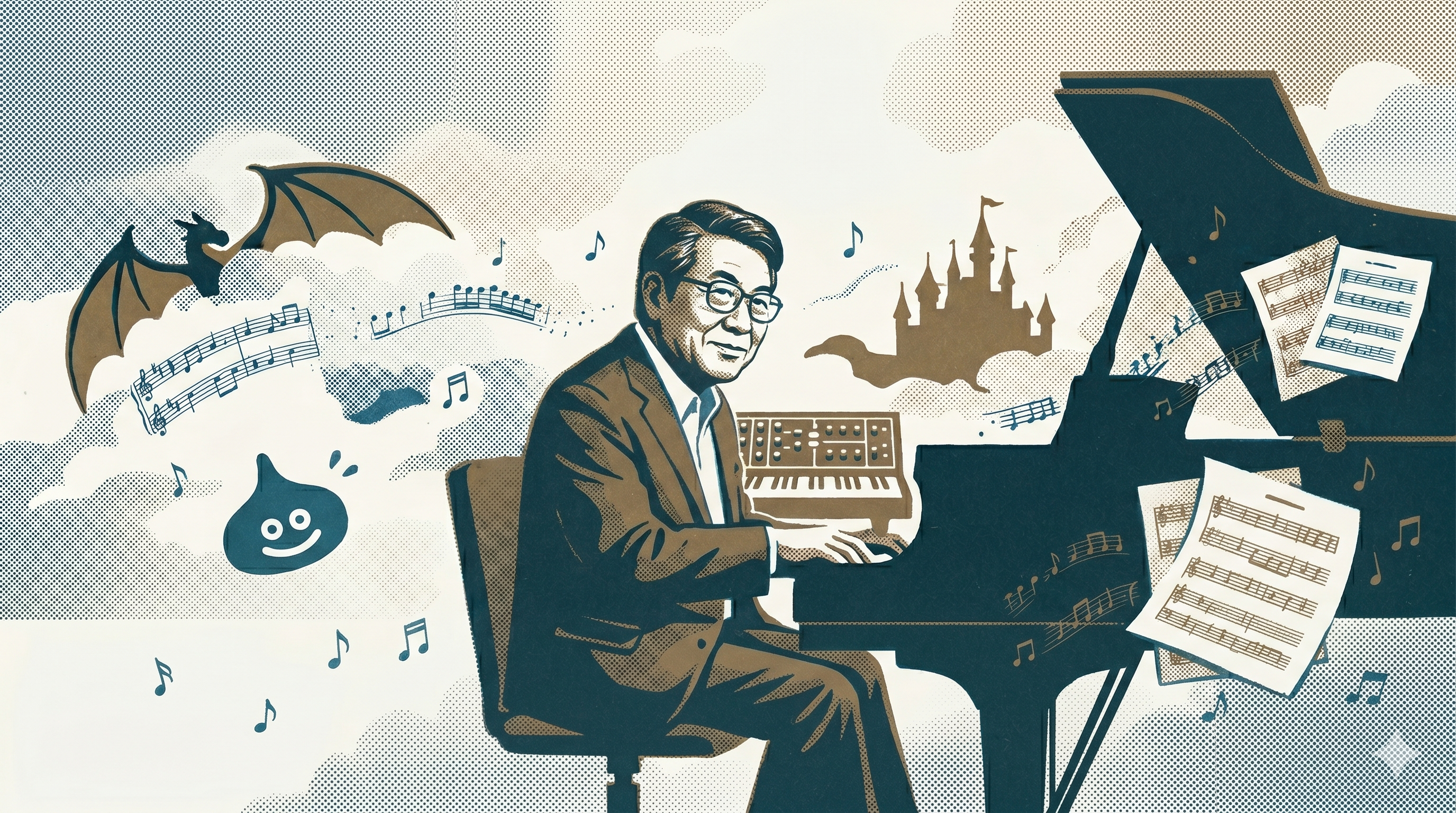
composer
Koichi Sugiyama
椙山浩一
The overture took five minutes — but those minutes held a lifetime.
Watch
About
Koichi Sugiyama (1931–2021) was a Japanese composer and conductor best known for composing the music of the Dragon Quest series beginning in 1986. He was one of the first composers to bring orchestral concert performances of video game music to mainstream audiences. His Dragon Quest overture has been performed by orchestras in Japan and internationally.
History
Koichi Sugiyama was born on April 11, 1931, in Shitaya Ward, Tokyo (present-day Taito City). From childhood he was captivated by music, but without a piano at home he could not pass the practical entrance examinations for music college. He enrolled instead in the Department of Educational Psychology at the University of Tokyo's Faculty of Education, where he attended lectures only rarely, spending nearly every waking hour immersed in musical activities. That paradox — a music lover studying at Japan's most prestigious academic institution — would later define his entire philosophy: depth of passion matters more than the formal path you take to pursue it.
After graduating, Sugiyama joined the cultural broadcaster Bunka Hoso in 1954, then moved to the newly launched Fuji Television in 1958, where he worked as a director overseeing hit-parade programmes and honed his craft composing commercial jingles. In 1965 he left broadcasting entirely to work as an independent composer and arranger. The timing proved perfect: Japan's Group Sounds boom was cresting, and Sugiyama provided two of its defining anthems — 'Hana no Kubikakari' (The Tigers, 1968) and 'Amairo no Kami no Otome' (Village Singers, 1968). By his mid-thirties he was a household name in Japanese popular music, yet his ambitions quietly outpaced the genre.
In the mid-1980s, Sugiyama discovered Enix's chess programme Morita Shogi and became genuinely addicted to it. Finding the software bereft of music, he filled out the enclosed user-feedback postcard with a single suggestion — 'It might be a good idea to add some music' — and left it on his desk. His wife found it and dropped it into the postbox. That small act of domestic serendipity landed the card at Enix headquarters, which promptly contacted Sugiyama. The development team was initially sceptical: could a celebrated fifty-four-year-old composer of pop hits truly understand video games? He answered by arriving at the first meeting already brimming with ideas — and an unmistakable enthusiasm for the medium.
When producers described Dragon Quest's world as a medieval knightly romance, Sugiyama answered without hesitation: classical music was the only fitting foundation. He then did something that stunned the team. Within a single week he delivered the complete score for Dragon Quest I. The overture — the four-note fanfare now known to hundreds of millions of players worldwide — took him approximately five minutes to write. 'But those five minutes contained the fifty-four years I had lived up to that point,' he later explained. The remark became one of gaming's most quoted meditations on creative experience: speed is not the measure of a work; the depth accumulated across an entire life is.
Sugiyama's compositional philosophy for the Dragon Quest series was rooted in a simple but profound question: what makes music that nobody ever tires of? His answer pointed to Beethoven and Mozart. 'All of humanity has been listening to them for more than two hundred years without growing bored,' he observed, 'and that is the very essence of music that does not wear out.' Because game music is heard in loops, sometimes for hours at a sitting, he insisted every theme had to pass the same test. He therefore constructed melodies with the harmonic architecture and motivic development of classical concert music — a radical act in an era when chip-tune composers were still exploring the most basic possibilities of the hardware.
On 20 August 1987, Sugiyama conducted the world premiere of orchestral Dragon Quest music at Suntory Hall in Tokyo — the first time video-game compositions had been performed live by a full symphony orchestra anywhere in the world. The concert, titled 'Family Classic Concert: The World of Dragon Quest,' established a tradition he maintained every August until 2019, personally conducting each programme. The annual concerts transformed public perception of game music from disposable entertainment into a legitimate concert repertoire, and inspired an entire generation of composers, conductors, and game developers to take the art form seriously.
Sugiyama remained creatively active far into old age. In 2016, at the age of eighty-four years and two hundred and ninety-two days, Guinness World Records certified him as the oldest active video-game music composer. The following year, at eighty-six, he completed the full score for Dragon Quest XI: Echoes of an Elusive Age, recording the soundtrack with the Tokyo Metropolitan Symphony Orchestra. When Dragon Quest XII: The Flames of Fate was announced in May 2021, he had already begun composing its music. He died on 30 September 2021 from septic shock, aged ninety. The Dragon Quest XII themes he had been writing at the time of his death stand as his final compositions.
Sugiyama's life offers a lesson that defies the logic of the modern age. The overture that defines a franchise was written in five minutes — but it was possible only because those five minutes were charged with fifty-four years of disciplined listening, composing, and loving music for its own sake. He did not pivot into gaming because it was lucrative or fashionable; a postcard, a wife's quiet kindness, and an honest addiction to a chess programme brought him there. 'I live by eating what I like, playing as I like, working as I like, and living as I like,' he said. The real wisdom in that statement is not permission to be capricious, but permission to go very, very deep into the things that genuinely move you — and then trust that depth to do the work when the moment arrives.
Timeline & Works
Career milestones and all 11 games in the museum they worked on — in the order they happened.
- 1931 04
Born in Tokyo
Born on April 11 in Shitaya Ward, Tokyo (present-day Taito City). Developed a passion for music from early childhood.
people - 1958
Joins Fuji Television
Transferred to the newly launched Fuji Television, where he directed hit-parade programmes and built his reputation composing music for television commercials.
milestone - 1965
Goes independent as a freelance composer
Left Fuji Television to work as an independent composer and arranger, beginning a new chapter at the centre of Japan's popular-music scene.
milestone - 1968
'Hana no Kubikakari' and 'Amairo no Kami no Otome' — Group Sounds era anthems
Composed 'Hana no Kubikakari' (The Tigers) and 'Amairo no Kami no Otome' (Village Singers), two of the defining hits of Japan's Group Sounds boom.
product - 1986
Dragon Quest I released — debut as video-game composer
A user-feedback postcard sent to Enix — posted by his wife — led to his composing the full score for Dragon Quest I at the age of fifty-four. He delivered every theme within a single week.
product - 1986
- 1987 08
First Family Classic Concert at Suntory Hall
On 20 August, Sugiyama conducted the world-premiere live orchestral performance of Dragon Quest music at Suntory Hall — the first time video-game compositions had been presented by a full symphony orchestra anywhere in the world.
milestone - 1987
- 1988
Dragon Quest III released — 'And Into the Legend…'
Dragon Quest III, featuring the celebrated ending theme 'Soshite Densetsu e…' ('And Into the Legend…'), became a cultural milestone and one of the most iconic scores in the series.
product - 1988
- 1988
- 1990
- 1992
- 1995
- 1999
- 2000
- 2000
- 2000
- 2016
Guinness World Records certification — oldest active video-game music composer
At the age of eighty-four years and two hundred and ninety-two days, Guinness World Records officially certified Sugiyama as the world's oldest active video-game music composer.
milestone - 2017
Dragon Quest XI released — composed at age eighty-six
At eighty-six, Sugiyama completed the full score for Dragon Quest XI: Echoes of an Elusive Age, recording with the Tokyo Metropolitan Symphony Orchestra, remaining creatively undiminished.
product - 2021 09
Passed away — died while composing Dragon Quest XII
Sugiyama died on 30 September from septic shock, aged ninety. He had been actively composing music for Dragon Quest XII: The Flames of Fate at the time of his death; those themes constitute his final work.
people
Connections
- collaborated with yuji-horii (1986–present)
Collaborated on all eleven mainline Dragon Quest titles (1986–2017), composing over 500 pieces across a thirty-five-year partnership.
Also connected to
- Akira Toriyama co-created Dragon Quest
Explore the work
Each title has its own page — history, trivia, and collector's notes.
Game Boy Color · 2000
Dragon Quest III
Dragon Quest III on a Game Boy cartridge — with a monster recruitment system add…
PlayStation · 2000
Dragon Quest VII: Fragments of the Forgotten Past
The world did not disappear. It was waiting, beneath the water, for someone to b…
Nintendo 64 · 2000
Shiren the Wanderer 2: Shiren's Castle and the Oni Invasion
The platform changed. The dungeon didn't.…
Game Boy Color · 1999
Dragon Quest I+II
Two foundational JRPGs rebuilt for a portable screen. The originals defined the …
Super Famicom / SNES · 1995
Dragon Quest VI: Realms of Revelation
Two worlds — one waking, one dreaming. Players spent forty hours learning which …
Super Famicom / SNES · 1992
Dragon Quest V: Hand of the Heavenly Bride
The story spans three generations. The hero grows old, marries, and watches his …
Rooms their games live in
Sources
- すぎやまこういち — Wikipedia(日本語) — accessed 2026-05-29
- Koichi Sugiyama — Wikipedia (English) — accessed 2026-05-29
- すぎやまこういち氏ご逝去のお知らせ — スクウェア・エニックス公式 — accessed 2026-05-29
- 「序曲は5分でできました」すぎやまこういちインタビュー — デイリー新潮 — accessed 2026-05-29
- 作家で聴く音楽 vol.5 すぎやまこういち — JASRAC — accessed 2026-05-29
From the Museum's Screening Room
Overture (Dragon Quest) — The Sound of the Machines