developer
Naughty Dog
ノーティードッグ
USA
About
Naughty Dog is an American video game developer based in Santa Monica, California, wholly owned by Sony Interactive Entertainment. Founded as JAM Software by Andy Gavin and Jason Rubin in 1984 — when Rubin was 15 and Gavin was 14 — the studio produced fourteen games before landing Crash Bandicoot (1996) for PlayStation with producer Mark Cerny. Crash became the unofficial mascot of the early PlayStation era and led to a trilogy selling over 26 million units. Sony acquired the studio in 2001. After the Jak and Daxter series (2001–2004), Naughty Dog produced Uncharted (2007) and The Last of Us (2013), establishing itself as one of the most technically and narratively ambitious studios in the industry.
History
Andy Gavin and Jason Rubin met as pre-teens at a weekend Hebrew school in Virginia in 1982, bonding over a shared interest in computers and programming. They began discussing game development during class and, in 1984, formed JAM Software — the name standing for 'Jason, Andy, and Mike' after a third friend who quickly lost interest. When Mike departed, Gavin and Rubin redefined JAM as 'Jason and Andy's Magic.' Rubin was fifteen; Gavin was fourteen. Their first published game, Ski Crazed, appeared in 1986. Over the next decade they produced thirteen more games — including Dream Zone (1987), Keef the Thief (1989), and Rings of Power (1991) — on a series of platforms including the Apple II, Amiga, and 3DO, building skill with each iteration while the company struggled to achieve commercial success.
The studio renamed itself Naughty Dog around 1990. In 1994, with Way of the Warrior, Naughty Dog entered a publishing relationship with Universal Interactive Studios. The game was modest, but the relationship gave Gavin and Rubin access to Universal's resources and, crucially, to PlayStation development hardware. Producer and designer Mark Cerny, who had already worked on Sonic the Hedgehog at Sega and was now acting as a consultant for Universal, saw potential in the team and encouraged them to build a character-based platform game designed around the PlayStation's 3D capabilities — a category that the platform still lacked a defining entry.
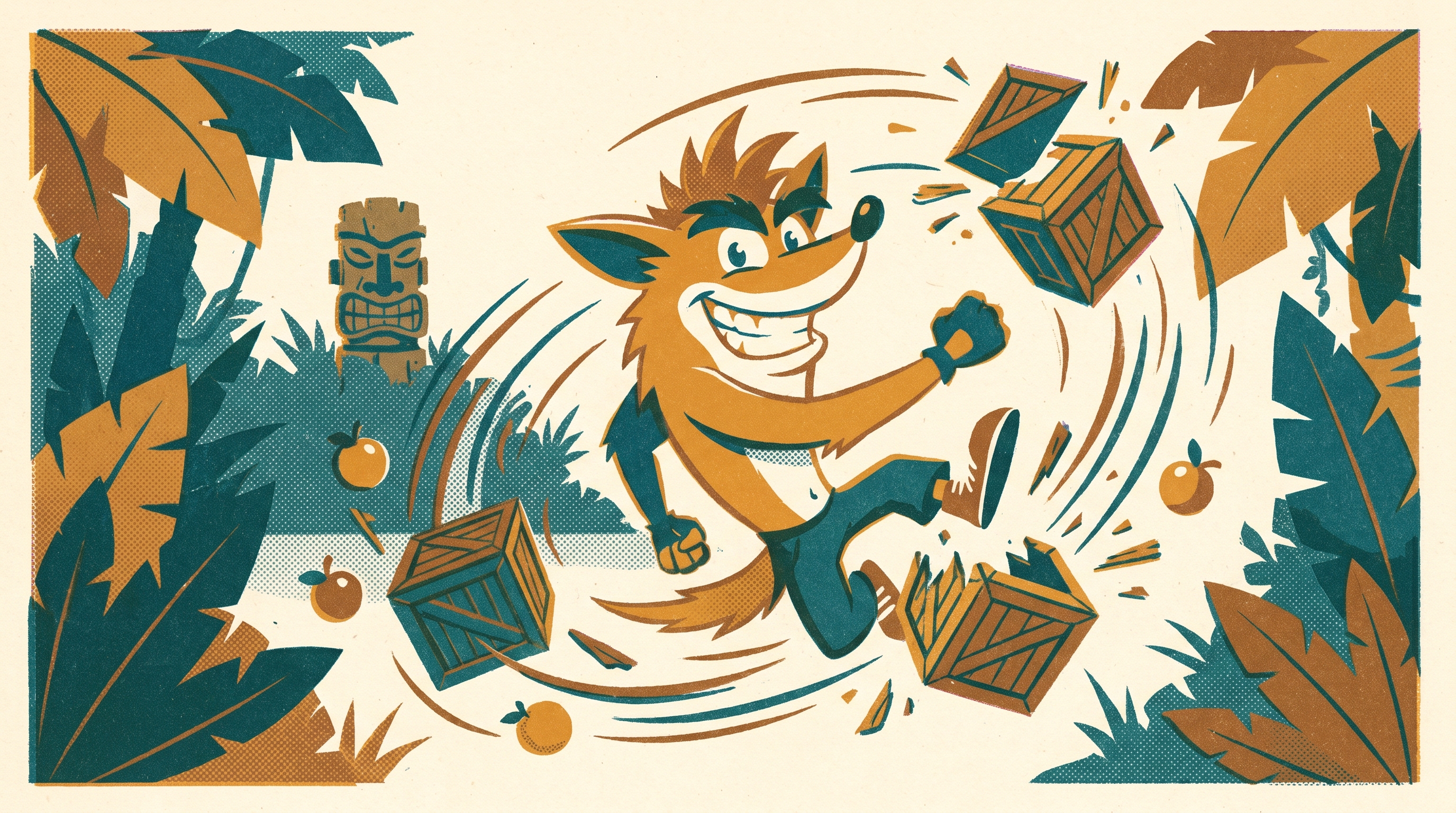
Crash Bandicoot launched in September 1996 as a PlayStation exclusive. Gavin and Rubin, working under immense time and technical pressure, developed new programming techniques — notably an approach that Sony's engineers internally called 'Naughty Dog's black magic' — to achieve visual quality and animation density that the PlayStation's hardware was not formally supposed to support. Crash's angular, expressive design came from character designer Charles Zembillas, while game designer Jason Rubin shaped the physical feel of the platforming. Sony adopted Crash as the unofficial mascot of the PlayStation hardware, running advertising campaigns that positioned Crash as a challenger to Nintendo's Mario. The game sold millions of copies and validated the PlayStation as a platform for character-driven games.
Crash Bandicoot 2: Cortex Strikes Back (1997) and Crash Bandicoot 3: Warped (1998) expanded on the first game's mechanics while refining its visual design. Crash Team Racing (1999) extended the franchise into kart racing. By the end of the PlayStation generation, the Crash trilogy had sold over 26 million units, and Naughty Dog had become one of the most technically accomplished studios on the platform. In 1994, their first games had cost around $50,000 to develop; by the time of Crash Bandicoot, budgets had risen to $1.5 million — and rising costs, according to Gavin in later interviews, were the primary reason they eventually sought a buyer.
Sony Computer Entertainment America acquired Naughty Dog in 2001, the year before Jak and Daxter: The Precursor Legacy launched. Gavin and Rubin, now in their early thirties, completed the transition to first-party developer as the studio began production on a new IP for the PlayStation 2. Jak and Daxter ran from 2001 to 2004 across three main entries and a racing spinoff. Jason Rubin publicly announced his departure from Naughty Dog in 2004; Andy Gavin left shortly after. The studio's founders had built the company from a Hebrew school friendship into a Sony first-party developer over twenty years, then stepped away.
Under new creative leadership, Naughty Dog developed Uncharted: Drake's Fortune (2007) for PlayStation 3 — a cinematic action-adventure game that prioritized narrative presentation and visual spectacle. Uncharted established the studio's reputation for a kind of game that looked and played like a blockbuster film. The Last of Us (2013) carried that production approach into a grimmer emotional register, combining survival horror mechanics with character writing that attracted an audience beyond traditional game players. Both franchises have defined the PlayStation exclusive library across two hardware generations and set benchmarks for production quality that the industry uses as reference points.
Timeline & Works
Corporate milestones and all 4 games in the museum this studio developed — in the order they happened.
- 1984
JAM Software founded by Gavin and Rubin
Andy Gavin (14) and Jason Rubin (15) found JAM Software in 1984, beginning a partnership that will eventually produce Crash Bandicoot.
founding - 1989
Keef the Thief — first commercial success
Keef the Thief for Amiga and DOS marks a step toward commercial viability after several smaller releases.
product - 1994
Way of the Warrior — Universal partnership
Way of the Warrior (3DO) leads to a publishing deal with Universal Interactive Studios, giving Naughty Dog access to PlayStation development hardware.
milestone - 1996
Crash Bandicoot — unofficial PlayStation mascot
Crash Bandicoot launches on PlayStation, becoming the unofficial mascot of the platform. Sony uses the character in advertising against Nintendo's Mario.
product - 1996
- 1997
Crash Bandicoot 2: Cortex Strikes Back
Crash 2 refines and expands the original, further cementing the franchise and PlayStation's identity.
product - 1997
- 1998
Crash Bandicoot 3: Warped
Crash 3: Warped completes the PlayStation trilogy. The series has sold over 26 million copies by the end of the generation.
product - 1998
- 1999
- 2001
Sony acquires Naughty Dog
Sony Computer Entertainment America acquires Naughty Dog, making it a first-party studio as development of Jak and Daxter begins.
acquisition
Also connected to
- Sony Computer Entertainment parent-child company relationship (2001–) (reverse)
Rooms their games live in
Sources
- Naughty Dog — Wikipedia — accessed 2026-06-11
- Andy Gavin — Wikipedia — accessed 2026-06-11
- Jason Rubin — Wikipedia — accessed 2026-06-11
- Making Crash Bandicoot — Naughty Dog official blog — accessed 2026-06-11