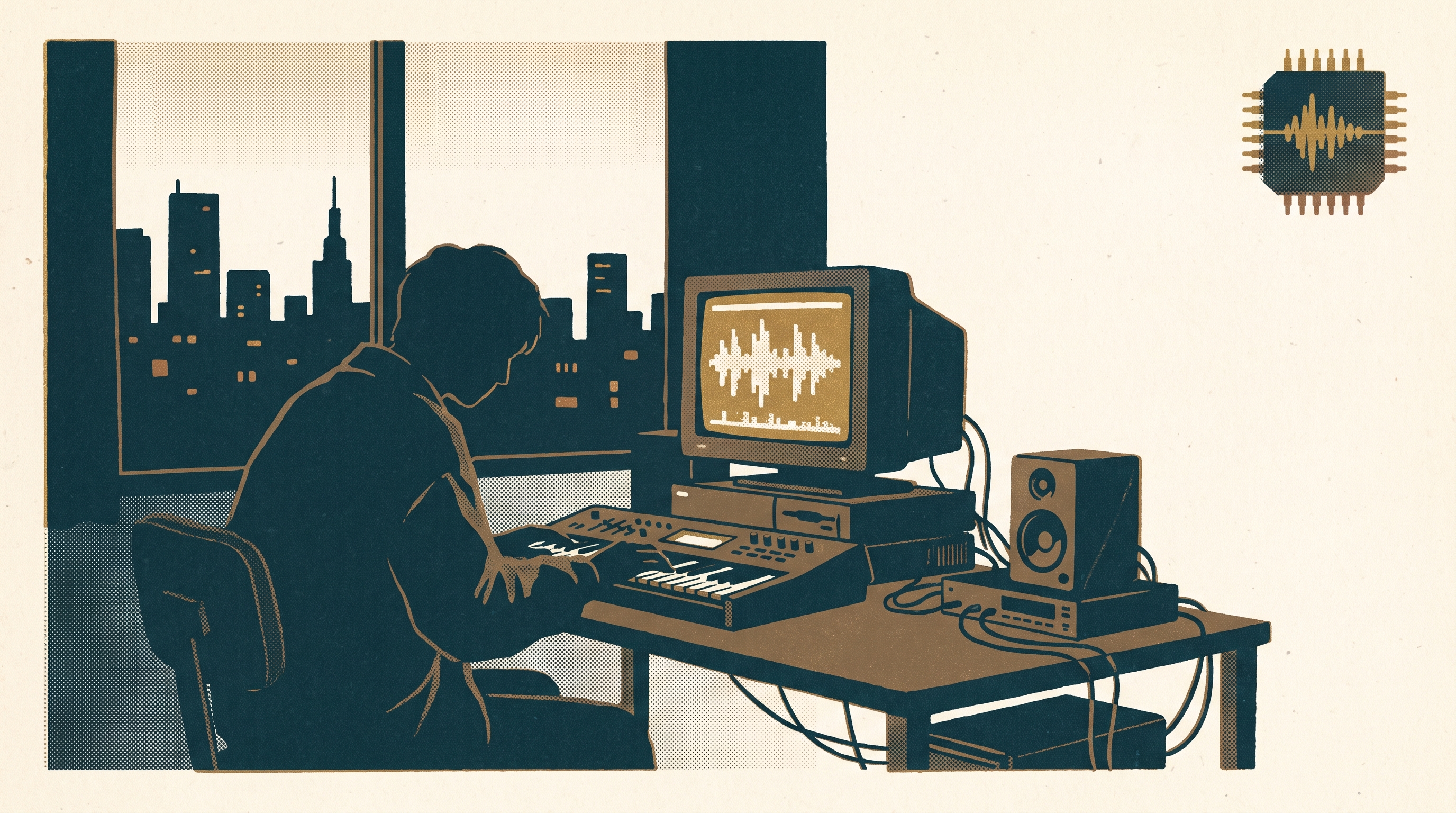
Yuzo Koshiro was born on December 12, 1967, in Hino, Tokyo. His father was a painter. His mother was a classical pianist. At three years old, she sat him in front of a piano and started teaching him. By five he could play. At eight, through a family connection, he began studying under Joe Hisaishi, who would go on to compose the music for films like My Neighbor Totoro and Spirited Away. Koshiro studied improvisation and ear training under Hisaishi from 1974 onward — learning to hear a phrase once and then continue it, to build music on instinct rather than notation.
He did not grow up wanting to compose for video games. He grew up in a house filled with instruments and sheet music and the expectation that he would continue in that direction. But at some point during his school years, he stopped thinking of music as something written down and started thinking of it as something programmed. In 1986, at age eighteen, he sent a demo tape to Nihon Falcom. The tape was made on a PC-8801 home computer. Falcom used over ten of the tracks for Xanadu Scenario II. That was his first job. He never went back to the classical path.
By 1990 he had founded Ancient Corp. with his family. His mother became its first president. He composed for the company's projects and for freelance work. One of his early landmarks was ActRaiser, a 1990 Super Famicom game that required him to write orchestral-sounding music on a chip that was never designed to sound like an orchestra. He succeeded. The brass and woodwinds were convincing enough that the industry took notice.
Then came Streets of Rage 2. It was released in December 1992 in North America, January 1993 in Japan. The console it ran on — the Sega Mega Drive, known in the West as the Genesis — used a sound chip called the Yamaha YM2612. It was an FM synthesis chip. FM synthesis works by modulating one waveform with another to produce complex, metallic, unstable tones — sounds that could approximate bells, electric pianos, certain kinds of bass. It was not designed to reproduce the sounds of club music. It was not designed to reproduce kick drums that punch, hi-hats that sizzle, basslines that slide and distort like a Roland TB-303.

Koshiro reproduced them anyway. He wrote his own audio programming language, called Music Love, and used it to push the YM2612 far beyond what most developers thought it could do. He studied the sounds coming out of Tokyo's late-1980s and early-1990s club scene — house, techno, jungle — and then reverse-engineered them into FM synthesis parameters. The result was a soundtrack that sounded like nothing else on a game console at the time. Tracks like 'Go Straight' and 'Dreamer' had the punch and the pulse of electronic dance music, compressed into a sixteen-bit cartridge.
He described the music as 'hard-core techno.' Most of his peers in the game industry had never heard of the genre. Many players who grew up with Streets of Rage 2 did not realize they were listening to techno until years later, when they encountered the genre outside of games and recognized the structure, the energy, the 808 and 909 drum patterns Koshiro had painstakingly recreated by hand.
The soundtrack has been called revolutionary. It has been cited as an influence on chiptune artists, grime producers, dubstep musicians — people working in genres that did not exist when Koshiro made it. The music was ahead of the hardware, ahead of the audience, ahead of the industry. He did not wait for game consoles to become powerful enough to play recorded music. He worked with the limitations in front of him and made the chip say something it was never supposed to say.
——When the tools you are given cannot do what you need them to do, do you wait for better tools, or do you learn the language the tools already speak and teach them a new word?