composer
Kenji Ito
伊藤賢治
The same melody can mean comfort or danger — context is the composer's second instrument.
About
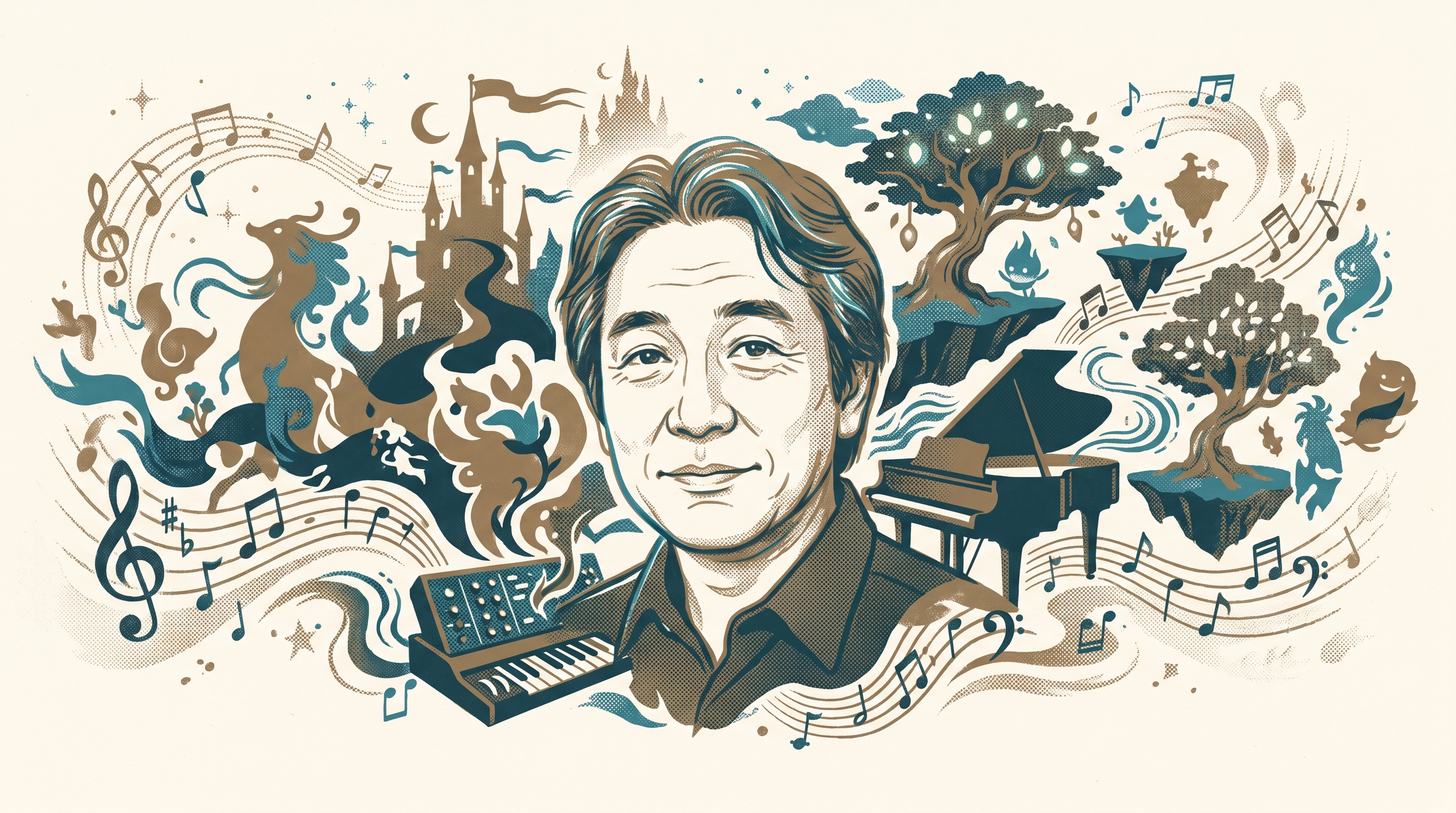
Kenji Ito is a Japanese video game composer known primarily for his work on the SaGa and Mana series at Square. He joined Square directly from college in 1990 and became the exclusive composer for the SaGa series across four consecutive titles. In 2001, he left Square to work as a freelance composer but has continued to collaborate with the company on numerous projects.
History
Kenji Ito was born on July 5, 1968, in Tokyo. He learned to play multiple instruments as a child and pursued music seriously enough to study it formally in college. Upon graduation in 1990, he joined Square as a composer — not through a competitive application process but at the advice of a professor who saw where his abilities might fit. He arrived at a company in the middle of rapid growth, at the beginning of the 16-bit era, when the technical constraints of game music were loosening and composers were beginning to realize what might be possible if they treated the medium seriously.
His first assignment was Final Fantasy Legend II (known in Japan as SaGa 2), on which he worked alongside Nobuo Uematsu. The project introduced him to the SaGa series, a franchise that would define much of his career. Unlike Final Fantasy, which followed a relatively linear narrative structure, the SaGa games were built around non-linear exploration, multiple branching paths, and a sense of geographical and narrative openness. The music needed to serve that structure — it could not rely on the same dramatic arcs that worked in more traditional JRPGs. Ito's scores for the series became known for their use of leitmotifs that recurred in different contexts, shifting in meaning depending on where and when they appeared. The same melody could signal comfort in one scene and danger in another. Context became his second instrument.
With Romancing SaGa (1992), Ito became the sole composer for the series for the first time. The score was entirely his, and over the next several years he composed the music for three more consecutive SaGa titles: Romancing SaGa 2 (1993), Romancing SaGa 3 (1995), and SaGa Frontier (1997). Across those four games, he developed a compositional voice that balanced melodic accessibility with harmonic ambiguity — music that was hummable but never predictable, that could pivot from pastoral calm to battle tension without feeling like two separate scores stitched together. His work on the series demonstrated that a game composer could sustain a recognizable voice across multiple projects without repeating themselves.
Parallel to his SaGa work, Ito also composed for the Mana series, contributing to Seiken Densetsu 3 (1995, known internationally as Trials of Mana). The Mana series required a different tone — lighter, more folkloric, with a stronger emphasis on melody as narrative shorthand. Where SaGa asked for music that could adapt to unpredictable player choices, Mana asked for music that felt like it belonged to a specific place and a specific story. Ito's ability to move between these two franchises without losing the specificity of either became one of the traits his peers noted when discussing his work.
In 2001, after more than a decade at Square, Ito left the company to work as a freelance composer. The decision gave him the freedom to take on projects outside the RPG space and to compose music for media beyond games — plays, albums, concert arrangements. He has since composed soundtracks for over a dozen games as a freelancer, including continued work on SaGa titles through his ongoing collaboration with Square Enix. The shift to freelance work did not represent a departure from the SaGa series but rather an expansion of the contexts in which he could work.
In interviews, Ito has spoken about the difficulty of gaining recognition as the author of his own music early in his career. In an era when game music was often uncredited or attributed generically to the studio, individual composers had to actively advocate for their names to appear on their work. Ito has described that process as requiring persistence — that recognition would not happen simply by waiting for it. That persistence, combined with the consistency and recognizability of his compositional voice across more than three decades, has made him one of the most enduring figures in Japanese game music. The lesson his career offers is not that talent alone is enough, but that the work of being recognized — of insisting that one's contribution be named — is part of the work itself.
Timeline & Works
Career milestones and all 5 games in the museum they worked on — in the order they happened.
- 1968 07
Born in Tokyo
Kenji Ito was born on July 5, 1968. He learned multiple instruments as a child.
people - 1990 03
Joined Square as composer
Ito joined Square directly from college at the advice of a professor. His first project was Final Fantasy Legend II (SaGa 2), working alongside Nobuo Uematsu.
people - 1990
- 1991
- 1992
Romancing SaGa — first solo SaGa score
Ito became the sole composer for Romancing SaGa, beginning a run of four consecutive SaGa titles as exclusive composer.
product - 1992
- 1993
Romancing SaGa 2
Second consecutive SaGa title as sole composer, further developing his use of leitmotifs that shift meaning across contexts.
product - 1993
- 1995
Romancing SaGa 3
Third consecutive SaGa title, continuing to refine his compositional voice for non-linear narrative structures.
product - 1995
Seiken Densetsu 3 (Trials of Mana)
Contributed to the Mana series, demonstrating his ability to balance folkloric melody with narrative specificity.
product - 1997
SaGa Frontier — fourth consecutive SaGa title
Completed his run as exclusive composer for four consecutive SaGa games, establishing a recognizable compositional voice across the series.
product - 1997
- 2001
Left Square to become freelance composer
After over a decade at Square, Ito went freelance, expanding his work to include plays, albums, and concert arrangements while continuing to collaborate with Square Enix.
people
Connections
- employed square (1990–2001)
Joined Square directly from college in 1990 and worked there for over a decade, becoming the exclusive composer for the SaGa series across four consecutive titles.
- collaborated with nobuo-uematsu (1990–present)
Worked alongside Nobuo Uematsu on Final Fantasy Legend II (SaGa 2), his first project at Square.
Also connected to
- Akitoshi Kawazu co-created Romancing SaGa 2 / co-created Romancing SaGa / same employer (Square / Square Enix, 1990–2001)
- Koichi Ishii co-created Final Fantasy Adventure / co-created Seiken Densetsu 3
- Hiroki Kikuta co-created Seiken Densetsu 3 / same employer (Square / Square Enix, 1991–1999)
Explore the work
Each title has its own page — history, trivia, and collector's notes.
PlayStation · 1997
SaGa Frontier
Seven protagonists, seven separate games, one shared world. No two players finis…
Super Famicom / SNES · 1993
Romancing SaGa 2
When the emperor dies in Romancing SaGa 2, the next one inherits his skills, his…
Super Famicom / SNES · 1992
Romancing SaGa
Eight playable characters, no shared story, and a spark system that invented a n…
Game Boy · 1991
Final Fantasy Adventure
He borrowed a famous name to get through the door — and built an entirely differ…
Game Boy · 1990
Final Fantasy Legend II
The master was next door, writing something else — so he found his own voice.…
Rooms their games live in
Sources
- Kenji Ito — Wikipedia — accessed 2026-06-17
- Kenji Ito | Final Fantasy Wiki | Fandom — accessed 2026-06-17
- SaGa series composer Kenji Ito had a difficult time getting recognized as the author of his own work — AUTOMATON WEST — accessed 2026-06-17
- Kenji Ito | SaGa Wiki | Fandom — accessed 2026-06-17