composer
Hiroki Kikuta
菊田裕樹
Don't simulate the sound. Make the sound itself, exactly as it will be heard.
About
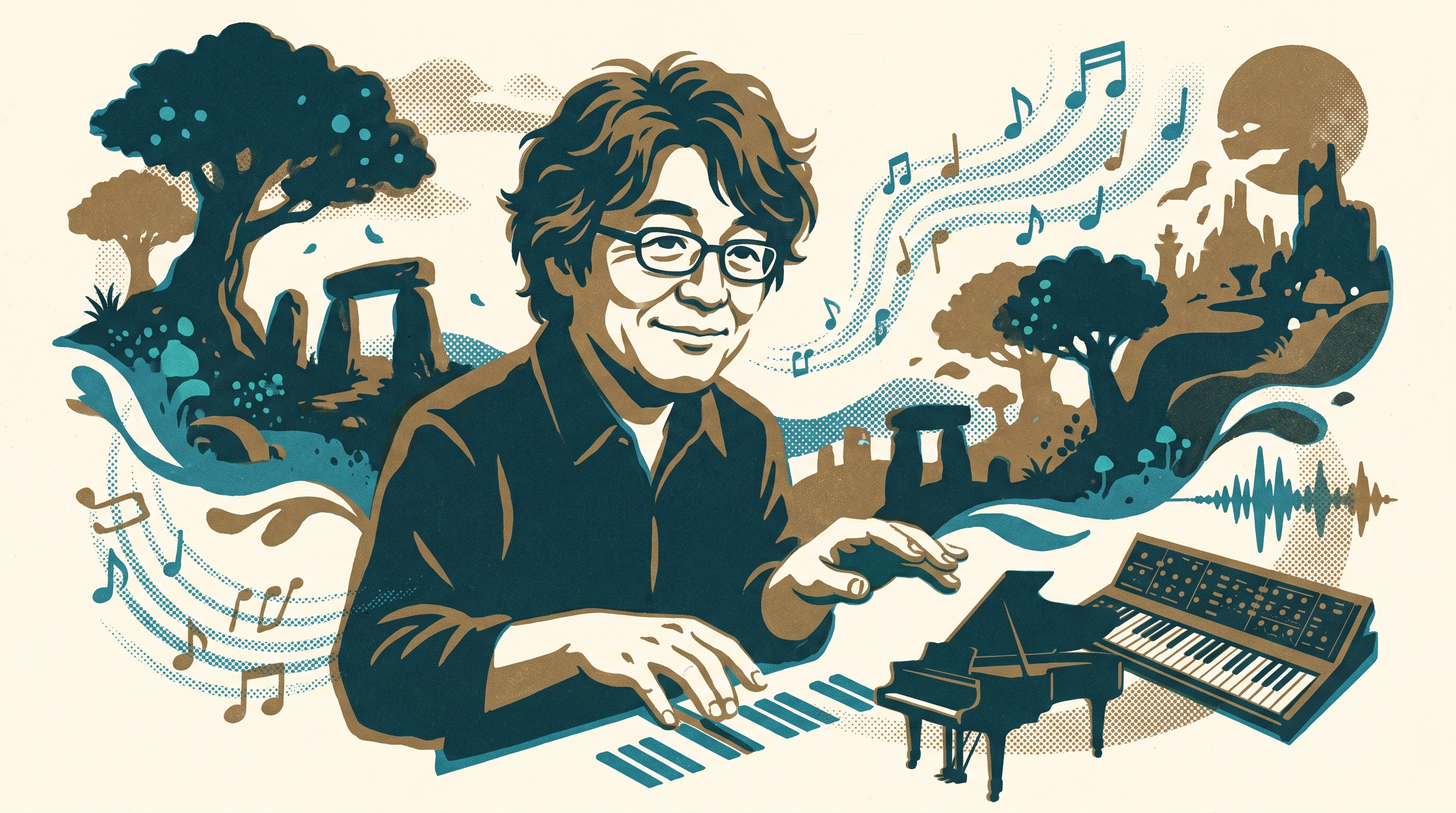
Hiroki Kikuta is a Japanese composer and game designer, born August 29, 1962. He taught himself music theory by reading books and listening to a wide variety of genres, with no formal training. Hired by Square in 1991 after Nobuo Uematsu selected him from over 100 applicants due to their shared love of progressive rock, Kikuta composed the soundtracks for Secret of Mana, Trials of Mana, and Soukaigi during his seven years at Square. Rather than create MIDI versions of his compositions like most game composers of that era, he made his own samples that matched the Super Nintendo's hardware capabilities, knowing exactly how the music would sound on the system. After producing and composing Koudelka in 1999, he left to become a freelance composer and founded his own record label, Norstrilia.
History
Hiroki Kikuta was born on August 29, 1962. He never received formal musical training. Instead, he taught himself by reading music theory books and listening to a wide variety of musical genres — a self-directed education that shaped both his range and his refusal to be bound by genre conventions. Before joining the game industry, he worked first as a manga illustrator, then as a composer for anime series. The route was unconventional, but it prepared him to approach sound from outside the template.
In 1991, Kikuta applied to Square as a composer. Nobuo Uematsu, already well-known for his Final Fantasy soundtracks, was reviewing more than one hundred applicants. He chose Kikuta. The reason, according to Kikuta, was a shared love of progressive rock — a musical vocabulary built on unconventional structures, odd time signatures, and the refusal to repeat what had already been done. It was not incidental. That choice of taste would define how Kikuta worked for the next seven years.
At Square, Kikuta composed soundtracks for three games: Secret of Mana and Trials of Mana for the Super Nintendo, and Soukaigi for the PlayStation. Secret of Mana was his defining work. Kikuta was brought onto the project after Kenji Ito, the composer for the first game in the Mana series, was unable to work on the sequel due to other commitments, including the soundtrack to Romancing SaGa. Kikuta says he was given complete freedom to compose — no direction at all as to how the music should sound. He began working before the design of the game was finalized.
What Kikuta did next was unusual for the time. Rather than create MIDI versions of his compositions and hope the hardware could approximate them, he made his own samples that matched the hardware capabilities of the Super Nintendo, so he would know exactly how the pieces would sound on the system's hardware. It was a choice to work inside the constraint rather than against it, and it gave his music a clarity and presence that felt inseparable from the console itself.
During development, Kikuta practically lived at Square, going home only twice per month. He spent nearly twenty-four hours a day in his office, alternating between composing and editing. His compositions for the game were partly inspired by natural landscapes, as well as music from Bali. The resulting soundtrack became one of the most recognized in the history of game music — not despite the technical limits of the era, but because Kikuta chose to treat those limits as the material itself.
In 1999, after producing and composing Koudelka — a PlayStation survival horror game for which he also served as concept designer — Kikuta left Square. He became a freelance composer and founded his own record label, Norstrilia, through which he produces albums of his own compositions and collaborations with other artists, as well as remastered versions of his previous scores. His career has since spanned over three decades, including work on Soukaigi, Indivisible, and as recently as 2024, Visions of Mana.
Kikuta once said that no matter how wonderful a song is, it is worthless if it doesn't fit closely into the game itself, and that if you can fulfill the role of background music and then add your individuality as a composer, that's the true strength of a game music composer. It is a philosophy built on constraint and service — the belief that music in games is not decoration but architecture, and that the composer's task is to make something that fits so well it becomes invisible, until the player stops and realizes they have been hearing it all along.
Timeline & Works
Career milestones and all 2 games in the museum they worked on — in the order they happened.
- 1962 08
Born in Japan
Hiroki Kikuta is born on August 29, 1962. He will later teach himself music theory by reading books and listening to a wide variety of musical genres, with no formal training.
people - 1991
Hired by Square as a composer
Kikuta is hired by Square in 1991. Nobuo Uematsu selects him from over 100 applicants due to their shared love of progressive rock. This marks the beginning of his seven-year tenure at Square.
people - 1993 08
Secret of Mana released
Secret of Mana is released for the Super Nintendo on August 6, 1993 in Japan. Kikuta composes the entire soundtrack, creating his own samples to match the hardware rather than using MIDI approximations. The soundtrack becomes one of the most recognized in game music history.
product - 1993
- 1995 09
Trials of Mana released
Trials of Mana (Seiken Densetsu 3) is released for the Super Nintendo on September 30, 1995 in Japan. Kikuta composes the soundtrack, continuing his approach of creating samples tailored to the hardware.
product - 1995
- 1998
Soukaigi released
Soukaigi is released for the PlayStation in 1998. Kikuta composes the soundtrack during his final years at Square.
product - 1999
Founds record label Norstrilia
Kikuta founds his own record label, Norstrilia, through which he produces albums of his own compositions, collaborations with other artists, and remastered versions of his previous game scores.
milestone - 1999
Produces and composes Koudelka; leaves Square
Kikuta produces and composes the soundtrack for Koudelka, a PlayStation survival horror game for which he also serves as concept designer. After its release, he leaves Square to become a freelance composer.
milestone - 2019
Composes for Indivisible
Kikuta contributes to the soundtrack for Indivisible, an action role-playing game developed by Lab Zero Games, continuing his freelance work in game music.
product - 2024
Returns to the Mana series with Visions of Mana
Kikuta returns to the Mana series, contributing to Visions of Mana — more than three decades after his work on Secret of Mana.
product
Connections
- employed square (1991–1999)
Kikuta was hired by Square in 1991 and composed soundtracks for Secret of Mana, Trials of Mana, and Soukaigi during his seven-year tenure.
- collaborated with nobuo-uematsu (1991–present)
Nobuo Uematsu selected Kikuta from over 100 applicants to join Square in 1991, citing their shared love of progressive rock.
Also connected to
- Koichi Ishii co-created Secret of Mana / co-created Seiken Densetsu 3
- Hiromichi Tanaka co-created Secret of Mana / same employer (Square / Square Enix, 1991–1999)
- Kenji Ito co-created Seiken Densetsu 3 / same employer (Square / Square Enix, 1991–1999)
Explore the work
Each title has its own page — history, trivia, and collector's notes.
Rooms their games live in
Sources
- Hiroki Kikuta - Wikipedia — accessed 2026-06-21
- Interview with Secret of Mana composer Hiroki Kikuta | RPGFan — accessed 2026-06-21
- Interview: Secret Of Mana Composer Hiroki Kikuta Reflects On The Timeless SNES Soundtrack | Time Extension — accessed 2026-06-21
- Game Music :: Interview with Hiroki Kikuta (November 2009) | Square Enix Music — accessed 2026-06-21
- Seiken Densetsu 3 – 1995 Developer Interview | shmuplations.com — accessed 2026-06-21
From the Museum's Screening Room
Fear Of The Heavens — The Sound of the Machines
Into The Thick Of It (Secret Of Mana) — The Sound of the Machines