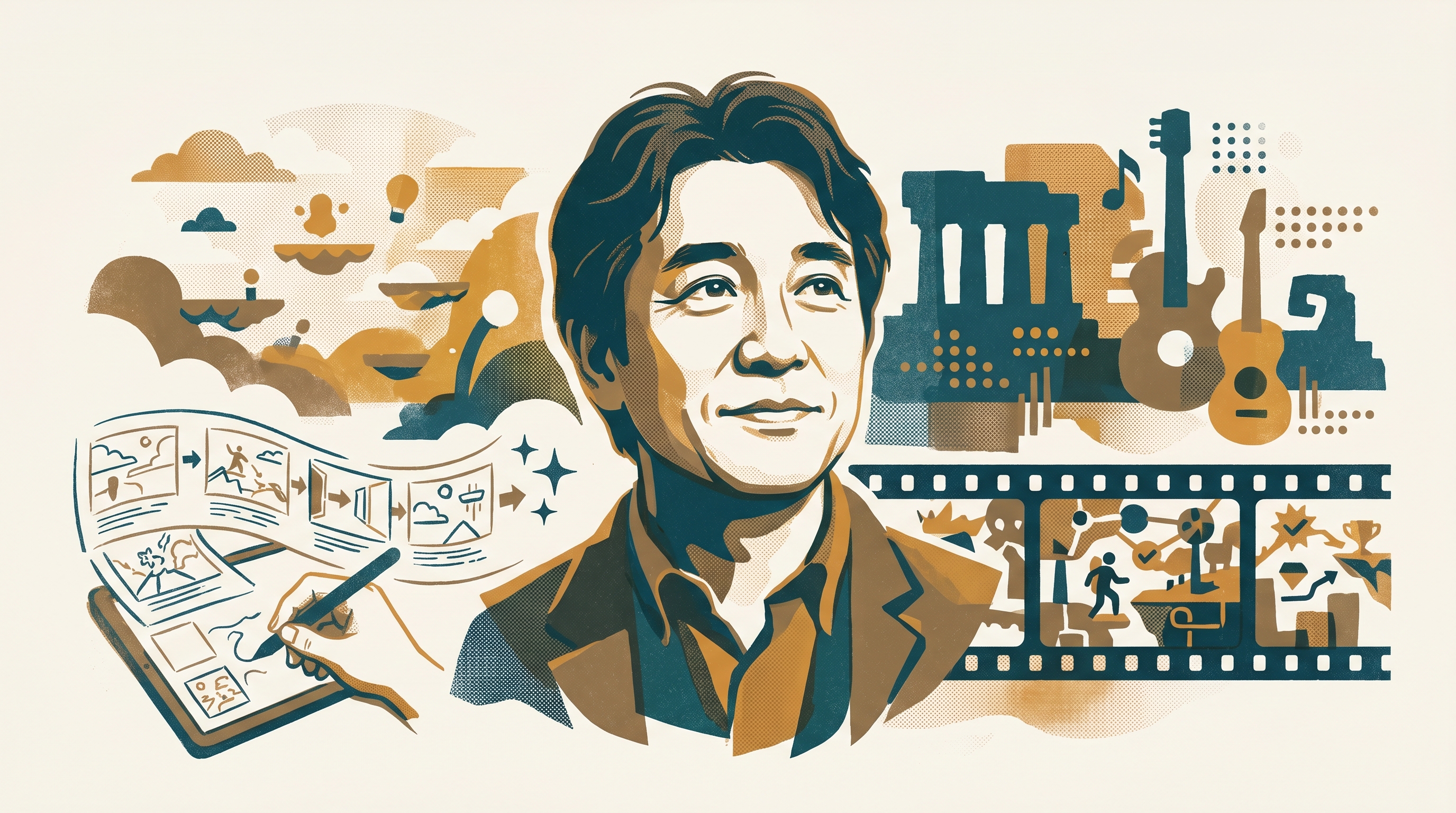
director
Shinichi Shimomura
下村真一
He built three quiet worlds, then walked away without saying where he went. Sometimes finishing the work is enough.
About
Shinichi Shimomura is a Japanese game designer who worked at HAL Laboratory from 1991 to the early 2000s. He directed the 'Dark Matter Trilogy' of Kirby games — Kirby's Dream Land 2, Kirby's Dream Land 3, and Kirby 64: The Crystal Shards — establishing a darker, more melancholic tone within the Kirby series. After his last credited work on Kirby: Nightmare in Dream Land in 2002, Shimomura vanished from the video game industry. His whereabouts remain unknown, making him one of the most elusive figures in game development history.
History
Shinichi Shimomura arrived at HAL Laboratory in 1991, hired to work on Hyper Zone, a rail shooter for the Super Famicom. It was competent work for a young designer finding his footing. The following year he joined the team for Kirby's Adventure, working as a map designer alongside Masahiro Sakurai, who was then establishing the series' visual language and philosophy. Shimomura learned the craft quietly, without drawing attention to himself.
In 1995, he was given his first director credit: Kirby's Dream Land 2 for the Game Boy. The game introduced the Dark Matter, a shadowy antagonist that contrasted sharply with the series' usual bright cheer. Dream Land 2 was quieter than what had come before — slower pacing, colder palettes, a melancholy undertone. It sold well and was praised, but it felt different. Shimomura had found a voice.
He continued with Kirby's Dream Land 3 in 1997 and Kirby 64: The Crystal Shards in 2000. Together with Dream Land 2, these games became known among players as the Dark Matter Trilogy — three works that shared a tonal consistency absent from the rest of the Kirby catalog. The games were not grim, but they carried a weight. Shimomura worked alongside Sakurai during this period, but their approaches diverged: Sakurai built playgrounds; Shimomura built worlds with shadows.
His last credited work was Kirby: Nightmare in Dream Land, a 2002 Game Boy Advance remake of Kirby's Adventure. It was a revisit, not new ground. After that game shipped, Shimomura's name stopped appearing in credits. He did not move to another studio whose work can be traced. He did not surface in interviews or industry events. For over two decades, no public record of him has emerged.
In the years since, fans have searched. A photograph of Shimomura eventually surfaced in a Japanese strategy guide for Kirby's Dream Course, confirming that he existed and that he had worked at HAL. But beyond that, nothing. Whether he left the industry by choice, moved into work under a different name, or simply decided that twelve years at HAL was enough — the record does not say.
What remains is the work: three Kirby games that feel like they were made by someone who understood loneliness, and who knew how to place it inside a world built for children without breaking the world. Shimomura built those games, saw them finished, and then walked away. Some people leave loudly. He left by becoming quiet enough that eventually no one could hear him at all.
Timeline & Works
Career milestones and all 3 games in the museum they worked on — in the order they happened.
- 1991
Joins HAL Laboratory
Begins career at HAL Laboratory, working on Hyper Zone for the Super Famicom.
people - 1992
Map designer on Kirby's Adventure
Works as map designer on Kirby's Adventure alongside Masahiro Sakurai.
product - 1995 03
Directs Kirby's Dream Land 2
First director credit. Introduces Dark Matter to the series, establishing a darker tone.
product - 1995
- 1997 03
Directs Kirby's Dream Land 3
Continues the Dark Matter storyline, deepening the melancholic tone.
product - 1997
- 2000 03
Directs Kirby 64: The Crystal Shards
Completes the Dark Matter Trilogy with the first 3D Kirby platformer for Nintendo 64.
product - 2000
- 2002
Disappears from the industry
After 2002, no further credits or public appearances. Whereabouts remain unknown.
people - 2002 10
Last credited work: Nightmare in Dream Land
Works on Kirby: Nightmare in Dream Land, a GBA remake. After this, Shimomura's name disappears from all game credits.
product
Connections
- employed hal-laboratory (1991–2002)
Worked at HAL Laboratory for approximately 12 years, from Hyper Zone to Kirby: Nightmare in Dream Land.
- collaborated with masahiro-sakurai (1992–2000)
Worked alongside Masahiro Sakurai on multiple Kirby titles, though their directorial approaches diverged — Sakurai built playgrounds, Shimomura built worlds with shadows.
Also connected to
- Hirokazu Ando co-created Kirby 64: The Crystal Shards / co-created Kirby's Dream Land 3 / same employer (HAL Laboratory, 1991–2002)
- Jun Ishikawa co-created Kirby 64: The Crystal Shards / co-created Kirby's Dream Land 3 / same employer (HAL Laboratory, 1991–2002)
Explore the work
Each title has its own page — history, trivia, and collector's notes.
Nintendo 64 · 2000
Kirby 64: The Crystal Shards
Kirby could combine two copy abilities. Fire plus ice made a flamethrower. The c…
Super Famicom / SNES · 1997
Kirby's Dream Land 3
The final Game Boy-style Kirby before the series went 3D. Hand-drawn art, animal…
Game Boy · 1995
Kirby's Dream Land 2
Alone, seven. Together, twenty-one. The ability was always there — it just neede…
Rooms their games live in
Sources
- Shinichi Shimomura - WiKirby — accessed 2026-06-20
- The Lost Kirby Games: Shinichi Shimomura and the Dark Matter Trilogy - Nintendo World Report — accessed 2026-06-20
- The Dark Matter mystery of Shinichi Shimomura – NinFan's Blog — accessed 2026-06-20
- Shinichi Shimomura - Nintendo Wiki — accessed 2026-06-20
- Images of Kirby "Dark Matter Trilogy" Director Shinichi Shimomura Have Finally Been Uncovered - Kirby Informer — accessed 2026-06-20