composer
Shinobu Tanaka
田中忍(永田忍)
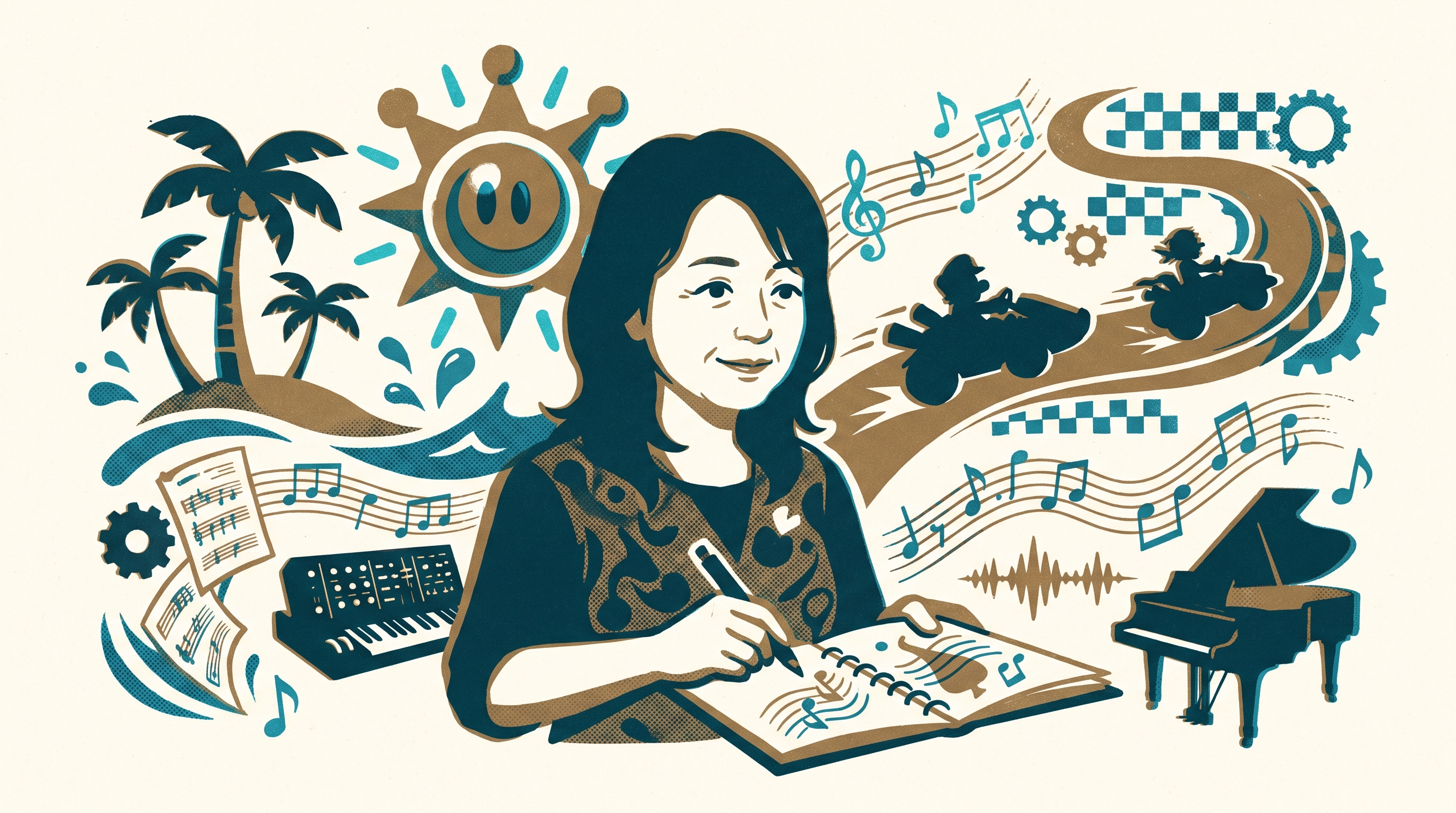
She wrote the music that makes a summer island feel alive — and millions remember that sound as part of childhood.
About
Shinobu Nagata (maiden name Shinobu Tanaka) is a sound composer who joined Nintendo EAD in 2000. Her debut work included event music for Animal Crossing (2001) and boss music for Luigi's Mansion (2001). She is known for her contributions to Super Mario Sunshine (2002), Mario Kart DS (2005), and multiple entries in the Mario Kart and Animal Crossing series. She later transferred to Nintendo SPD Sound Group and continues to contribute to Nintendo titles. Most of her credits continue to appear under the name Shinobu Tanaka.
History
Shinobu Nagata — known professionally as Shinobu Tanaka in most of her game credits — joined Nintendo's Entertainment Analysis and Development (EAD) division in 2000. She began her career at Nintendo at a time when the company was transitioning from the Nintendo 64 era to the GameCube, a hardware shift that opened new creative possibilities in audio design. Her earliest credited work appeared in two Nintendo titles released in 2001: Animal Crossing (Dōbutsu no Mori, originally an N64 title ported and expanded for GameCube) and Luigi's Mansion. In Animal Crossing, she composed event music — the brief melodic moments that punctuate daily routines and seasonal celebrations. In Luigi's Mansion, she wrote boss music — tense, layered compositions designed to escalate the stakes of each encounter. These two projects, released within months of each other, established her range: she could write both gentle, atmospheric soundscapes and high-energy confrontation themes.
Her most prominent early work came with Super Mario Sunshine (2002), a sun-drenched platformer set on the tropical Isle Delfino. Nagata contributed to the game's soundtrack, which combined upbeat, vacation-inspired melodies with the rhythmic precision required for a 3D platforming game. The music needed to convey leisure and warmth while still supporting gameplay that demanded timing and spatial awareness. Super Mario Sunshine's soundtrack became closely associated with childhood memories of summer — not because the game was set in summer (though it was), but because the music itself felt like heat, light, and the temporary freedom of vacation. Nagata was one of several composers on the project, but her contributions helped define the game's sonic identity.
In the mid-2000s, Nagata continued her work on Nintendo franchises, contributing to Mario Kart DS (2005) and Mario Kart Arcade GP (2005). The Mario Kart series required composers to balance excitement, repetition, and clarity — music that could loop for the duration of a race without becoming grating, while still providing enough energy to match the speed and chaos onscreen. Her work on these titles was part of a larger team effort, but her role in shaping the series' sound was consistent. She also composed for Kiki Trick (2006), a lesser-known puzzle game, demonstrating her willingness to work on smaller projects alongside Nintendo's flagship franchises.
Sometime in the mid-2000s, Nagata transferred from Nintendo EAD to Nintendo SPD (Software Planning & Development), a division responsible for coordinating internal and external development. Within SPD, she joined the Sound Group and continued composing for Nintendo titles. Her later work included Brain Age: Concentration Training (2012) and contributions to Animal Crossing: New Horizons (2020). She also took on supervisory roles for the Super Smash Bros. series, overseeing the use of original game music in Super Smash Bros. Brawl (2008), Super Smash Bros. for Nintendo 3DS/Wii U (2014), and Super Smash Bros. Ultimate (2018). These roles placed her in a curatorial position, ensuring that music from decades of Nintendo history was represented faithfully in one of the company's most encyclopedic franchises.
Nagata's career reflects a quiet consistency. She has worked for Nintendo for over two decades, contributing to some of the company's most recognizable franchises without seeking the spotlight. Most of her credits continue to appear under the name Shinobu Tanaka — a professional choice that suggests continuity and recognition within the industry. She is married to Kenta Nagata, also a composer at Nintendo, and the two have occasionally worked on overlapping projects, though they maintain separate professional identities.
Her work is notable not for its volume or for any single defining masterpiece, but for its presence in games that became part of millions of childhoods. The music she wrote for Super Mario Sunshine is now inseparable from the memory of playing that game in the early 2000s. The event music she composed for Animal Crossing has looped in the background of thousands of hours of gameplay. Her career demonstrates what it means to contribute steadily to a creative institution over time — not by dominating its output, but by adding her voice to a collaborative body of work that outlives any individual contribution. The music remains. The games remain. The summers that felt endless, when those songs played, remain too.
Timeline & Works
Career milestones and all 3 games in the museum they worked on — in the order they happened.
- 2000
Joined Nintendo EAD
Joined Nintendo's Entertainment Analysis and Development division as a sound composer during the transition from Nintendo 64 to GameCube.
people - 2001
Debut work: Animal Crossing and Luigi's Mansion
First credited work included event music for Animal Crossing and boss music for Luigi's Mansion, both released in 2001.
product - 2001
- 2002
Super Mario Sunshine released
Contributed to the soundtrack of Super Mario Sunshine, a sun-drenched platformer set on the tropical Isle Delfino.
product - 2003
Mario Kart: Double Dash!! released
Contributed to the soundtrack of Mario Kart: Double Dash!! for GameCube.
product - 2003
- 2003
- 2005
Mario Kart DS and Mario Kart Arcade GP
Contributed to Mario Kart DS for Nintendo DS and Mario Kart Arcade GP.
product - 2006
Kiki Trick released
Composed music for Kiki Trick, a lesser-known puzzle game published by Nintendo.
product - 2008
Super Smash Bros. Brawl — music supervisor
Took on a supervisory role for original game music in Super Smash Bros. Brawl.
product - 2012
Brain Age: Concentration Training
Composed music for Brain Age: Concentration Training after transferring to Nintendo SPD Sound Group.
product - 2018
Super Smash Bros. Ultimate — original game supervisor
Continued supervisory role for original game music in Super Smash Bros. Ultimate.
product - 2020
Animal Crossing: New Horizons
Contributed to the soundtrack of Animal Crossing: New Horizons for Nintendo Switch.
product
Connections
- employed nintendo (2000–present)
Joined Nintendo EAD in 2000, later transferred to Nintendo SPD Sound Group. Continues to contribute to Nintendo titles as of the 2020s.
- collaborated with kenta-nagata
Married to Kenta Nagata, also a composer at Nintendo. The two occasionally work on overlapping projects while maintaining separate professional identities.
Also connected to
- Takashi Tezuka co-created Animal Crossing: Doubutsu no Mori e+ / co-created Luigi's Mansion / co-created Luigi's Mansion / co-created Super Mario Sunshine
- Shigeru Miyamoto co-created Luigi's Mansion / co-created Luigi's Mansion / co-created Super Mario Sunshine / same employer (Nintendo, since 2000)
- Kazumi Totaka co-created Animal Crossing: Doubutsu no Mori e+ / co-created Luigi's Mansion / co-created Luigi's Mansion
- Koji Kondo co-created Super Mario Sunshine / same employer (Nintendo, since 2000)
Explore the work
Each title has its own page — history, trivia, and collector's notes.
Nintendo GameCube · 2003
Animal Crossing: Doubutsu no Mori e+
The GameCube Animal Crossing, Japan's definitive version. E-Reader card support …
Nintendo GameCube · 2003
Mario Kart: Double Dash!!
Two characters per kart. Four-player LAN. The most mechanically distinctive Mari…
Nintendo GameCube · 2001
Luigi's Mansion
For eighteen years, Luigi existed in Mario's shadow. His first starring role was…
Rooms their games live in
Sources
- Shinobu Nagata — Nintendo Fandom Wiki — accessed 2026-06-18
- Shinobu Tanaka — VGMdb — accessed 2026-06-18
- Game Music :: Shinobu Tanaka — Square Enix Music — accessed 2026-06-18
- Shinobu Nagata — Video Game Music Preservation Foundation Wiki — accessed 2026-06-18
- Shinobu Nagata — IMDb — accessed 2026-06-18