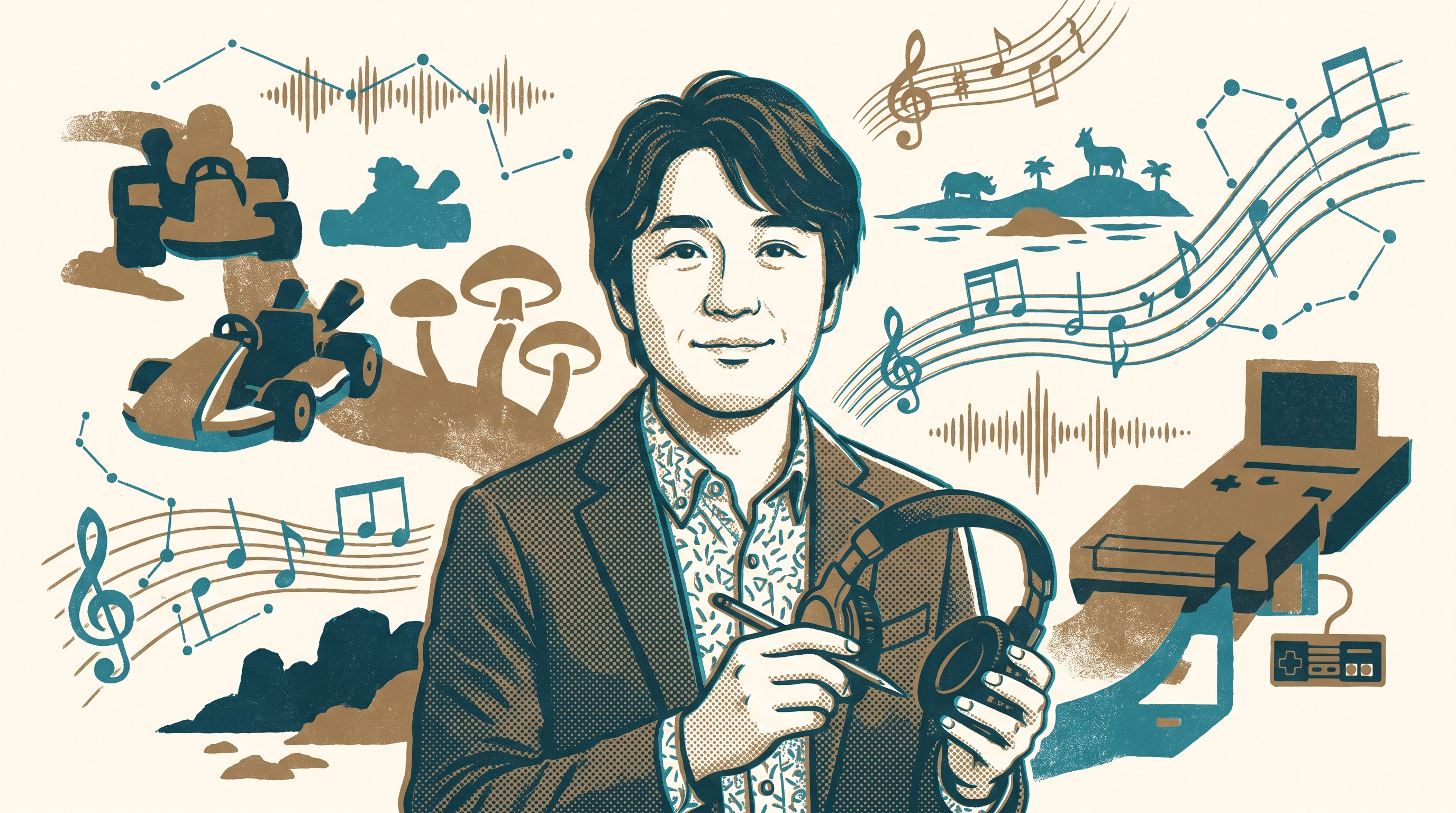
composer
Kenta Nagata
永田権太
He made the sound of speed, the sound of the sea, and the sound of an ordinary Tuesday afternoon.
About
Kenta Nagata wrote the music for 1080° Snowboarding, which Nintendo released in Japan on February 28, 1998. He had been with the company for two years by then: his first job as a new hire, in 1996, was the entire score of Mario Kart 64. He went on to write “The Great Sea” and “Dragon Roost Island” for The Legend of Zelda: The Wind Waker (2002), and has been sound director on the New Super Mario Bros. and Mario Kart series ever since. If you came here about the 2003 GameCube sequel, 1080° Avalanche — that one is not his. Lawrence Schwedler and James Phillipsen wrote it.
History
They handed the new hire all of Mario Kart 64. Not a few tracks of it — the whole score. Kenta Nagata had joined the sound team at Nintendo's Entertainment Analysis and Development division that same year, in 1996. “Mario Kart 64 was my first job as a new guy,” he said years later, sitting across from Satoru Iwata. He was born on July 7, 1970; he had learned piano and bass as a child and picked up guitar somewhere along the way; and none of that told him what a racing game was supposed to sound like. The Nintendo 64 was still new. So was he.
So he decided it himself. “I pay attention to the sound of the engines every time,” he told Iwata. “I also try to make sure the background music doesn’t simply sound like racing-game music. It’s like Mario’s blood runs through Mario Kart.” Iwata asked whether that was a tradition of the series, something handed down to him. Nagata answered: “Well, no one told me to, but…” He made that rule up in his first year at the company, and he was still working to it fifteen years later.
Four people were going to hear the same track on the same circuit for as long as the race lasted, and often for the whole evening. It had to loop without a seam, stay bright without turning shrill, and still give every course a face of its own. What came out was “Moo Moo Farm”, and “Bowser’s Castle”, and “Rainbow Road” — a farm, a fortress and a strip of light in the sky, written on retro synthesizers and rock organs. Mario Kart 64 went on to be one of the best-selling games on the Nintendo 64, and hardly anyone who played it can hear those tracks now without also seeing the corner they always spun out on.
Two years later they gave him a mountain. 1080° Snowboarding was directed by Masamichi Abe and Mitsuhiro Takano under producer Shigeru Miyamoto; work on it began around April or May of 1997 and it reached Japanese shops on February 28, 1998. The rule Nagata had made for himself started at the sound of an engine, and a snowboard does not have one. What he wrote instead was techno, drum and bass and jungle, with vocal samples over the top. It was an unusual thing to hear coming out of a Nintendo 64 in 1998. The soundtrack was released on CD that year, and it is the one people are still looking for.
On Animal Crossing he wrote the title theme and all twenty-four hourly variations of the field music, under the supervision of Kazumi Totaka. Those pieces play behind fishing, and talking to a neighbor, and moving a chair three inches to the left. They had to hold a mood for an hour at a time without ever asking for attention — and then be noticed, just for a moment, when the hour turned over.
In 2002 he was one of four composers on The Legend of Zelda: The Wind Waker, with Hajime Wakai, Toru Minegishi and Koji Kondo. The game was almost all ocean. Nagata wrote “The Great Sea”, the piece that plays while Link is between islands, and “Dragon Roost Island” — woodwinds and drums for a place of heat and stone where the Rito live. He also worked Koji Kondo's older Zelda melodies into the new score.
He was sound director for New Super Mario Bros. Wii (2009), New Super Mario Bros. 2 (2012) and Mario Kart 8 (2014), which meant leading other composers and signing off on work he had not written himself. He came back as lead composer for Mario Kart 7 in 2011, writing the new courses and going back over the classic tracks — “Memory revision,” as he put it to Iwata.
Almost everything Nagata has written has to survive being heard again. A kart track loops until the race ends. An hour of field music loops until the hour does. The open water of The Wind Waker plays for as long as it takes to get somewhere. Music like that fails in a way most music never has to worry about — not by being bad on the first listen, but by becoming unbearable on the fortieth. Thirty years in, he is still writing music a person can hear a hundred times and still not want turned off.
Timeline & Works
Career milestones and all 4 games in the museum they worked on — in the order they happened.
- 1970 07
Born
Kenta Nagata was born on July 7, 1970. From a young age he was drawn to music and learned to play piano and bass.
people - 1996
Joined Nintendo EAD
Joined Nintendo's Entertainment Analysis and Development division as a composer. Immediately assigned as sole composer for Mario Kart 64.
people - 1996
Mario Kart 64 released
Composed the entire soundtrack for Mario Kart 64, one of the Nintendo 64's best-selling titles. The music ranged from humorous to haunting and became inseparable from the game.
product - 1998
1080° Snowboarding released
1080° Snowboarding reached Japanese shops on February 28, 1998. Nagata scored it with techno, drum and bass and jungle. He did not work on the 2003 GameCube sequel, 1080° Avalanche.
product - 1998
- 1998
- 2001
Animal Crossing released
Composed the title theme and all 24-hour field music variations for Animal Crossing. The music needed to accompany daily routines without ever becoming intrusive.
productanimal-crossing - 2002
The Legend of Zelda: The Wind Waker released
Served as lead composer, creating iconic themes including "The Great Sea" and "Dragon Roost Island." Incorporated Koji Kondo's classic melodies into the new score.
product - 2002
- 2003
- 2009
New Super Mario Bros. Wii released
Served as sound director, leading a team of composers and signing off on work he had not written himself.
product - 2011
Mario Kart 7 released
Returned as lead composer for Mario Kart 7. Composed new course music and remastered classic tracks from earlier games in the series.
product - 2012
New Super Mario Bros. 2 released
Served as sound director for New Super Mario Bros. 2, continuing his supervisory work on the New Super Mario Bros. series.
product - 2014
Mario Kart 8 released
Served as sound director for Mario Kart 8, balancing nostalgia with the technical improvements that newer hardware allowed.
product
Connections
- employed nintendo-ead (1996–present)
Joined Nintendo's Entertainment Analysis and Development division in 1996 as a composer. Given sole composer duties for Mario Kart 64 as his first assignment.
- employed nintendo (1996–present)
Has worked at Nintendo for over two decades, serving as composer and sound director for multiple Mario Kart, Zelda, and Mario titles.
- collaborated with koji-kondo
Worked Koji Kondo's older Zelda melodies into The Wind Waker soundtrack.
Also connected to
- Shigeru Miyamoto co-created 1080° Snowboarding / co-created The Legend of Zelda: The Wind Waker / same employer (Nintendo, since 1996) / same employer (Nintendo EAD, 1996–2015)
- Hajime Wakai co-created The Legend of Zelda: The Wind Waker / same employer (Nintendo, since 1996)
- Shinobu Tanaka co-created Mario Kart: Double Dash!! / same employer (Nintendo, since 2000)
- Toru Minegishi co-created The Legend of Zelda: The Wind Waker / same employer (Nintendo, since 1999)
Explore the work
Each title has its own page — history, trivia, and collector's notes.
Nintendo GameCube · 2003
Mario Kart: Double Dash!!
Two characters per kart. Four-player LAN. The most mechanically distinctive Mari…
Nintendo GameCube · 2002
The Legend of Zelda: The Wind Waker
They drew instead of rendered, and the drawing outlasted everything that tried t…
Nintendo 64 · 1998
1080° Snowboarding
Nintendo's snowboarding game. A physics model that felt different from every oth…
Nintendo 64 · 1998
Mario Party
Four players, one board, dice no one controlled. It ended friendships. You playe…
Rooms their games live in
Sources
- Iwata Asks: Mario Kart 7, Vol. 2 In-house Staff — Nagata in his own words (Nintendo, official) — accessed 2026-08-30
- Iwata Asks: Mario Kart 7, Vol. 2 In-house Staff, part 1 (Nintendo, official) — accessed 2026-08-30
- 1080° Snowboarding — development, staff and release (producer Miyamoto; directors Abe and Takano) — accessed 2026-08-30
- Kenta Nagata — NintendoWiki — accessed 2026-06-19
- Kenta Nagata — Super Mario Wiki — accessed 2026-06-19
- Kenta Nagata — Nintendo Fandom Wiki — accessed 2026-06-19
- Kenta Nagata — Video Game Music Preservation Foundation Wiki — accessed 2026-06-19
- Kenta Nagata Profile — VGMO — accessed 2026-06-19