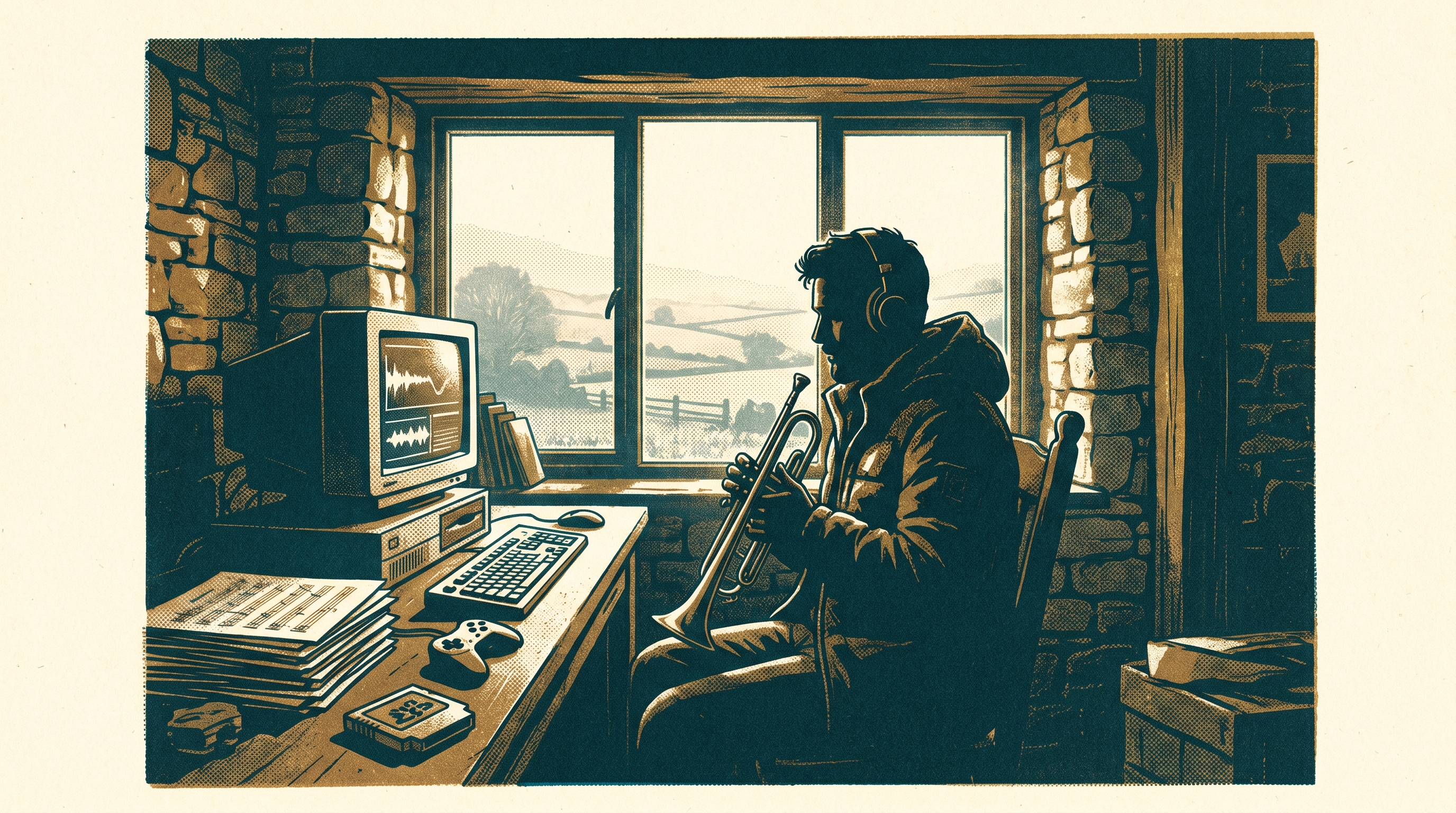
In 1997, at Rare Ltd's studio in Twycross, England, Grant Kirkhope played a rough mix of a track he had recorded with director George Andreas and programmer Chris Sutherland. It was a rap — for monkeys. They had started it as a lunchtime joke. Kirkhope thought everyone would get it. They did not. It was the first time anyone had written something negative about his music. The track became the DK Rap, the opening sequence of Donkey Kong 64, and one of the most polarizing pieces of music in video game history.
Kirkhope was born in Edinburgh on July 10, 1962. When he was five, his family moved to Knaresborough, North Yorkshire. He started playing the trumpet at six. He studied at the Royal Northern College of Music in Manchester and graduated in 1984 with a G.R.N.C.M and P.P.R.N.C.M. For years he played in bands — Zoot and the Roots, then Little Angels, which opened for Bon Jovi, ZZ Top, Van Halen, and Bryan Adams. Little Angels had a number one album in the UK. It was not stable work. When the bands split, Kirkhope turned to composing.
In October 1995, he was hired by Rare Ltd, a small studio in the English countryside that was about to become one of the most prolific developers of the Nintendo 64 era. His first assignment was converting music from Donkey Kong Country 2: Diddy's Kong Quest to the Game Boy version, Donkey Kong Land 2. It was grunt work — technical conversion, not composition. Then composer Graeme Norgate asked him to finish the music for GoldenEye 007. Kirkhope was reassigned to Project Dream, which eventually became Banjo-Kazooie.
Between 1997 and 1999, Kirkhope worked on Donkey Kong 64, Banjo-Tooie, and Perfect Dark at the same time. The Nintendo 64's 4MB of RAM altered the way every track was written. He made each tune from scratch, reusing scrapped bits of music from earlier projects when he could. In his head, he said later, he had to separate Banjo-Tooie from Donkey Kong 64 — he felt DK64 was a darker game. The music had to match that difference, even when he was composing for both on the same day.
He provided the voice of Donkey Kong. He recorded hundreds of instrument samples under extreme memory constraints. He wrote the DK Rap in an afternoon. The joke that no one understood turned into the game's intro, and years later people still argue whether it is brilliant or unbearable. Kirkhope himself has said he thought it was funny. That was enough.
In 2006, he received a BAFTA nomination for his work on Viva Piñata. On July 18, 2008, after nearly thirteen years at Rare, he resigned and moved to the United States. He joined Big Huge Games, which shut down in 2012. He became a freelance composer. He has since worked on projects like the Mario + Rabbids series. He is an Ivor Novello and World Soundtrack Award–winning composer, with nominations from BAFTA, ASCAP, and the IFMCA.
In his twenties, Kirkhope played trumpet in an orchestra pit and opened for some of the biggest rock bands in the world. In his thirties, he made children laugh with a rap about monkeys and composed music for games played by millions. The shift from one to the other was not gradual — it was a door that opened in 1995 and closed in 2008, and during those thirteen years he wrote some of the most recognizable music of the Nintendo 64 generation.
— The stage you are standing on now, does it define what your work is worth? Or is the work the same, no matter where the sound travels?