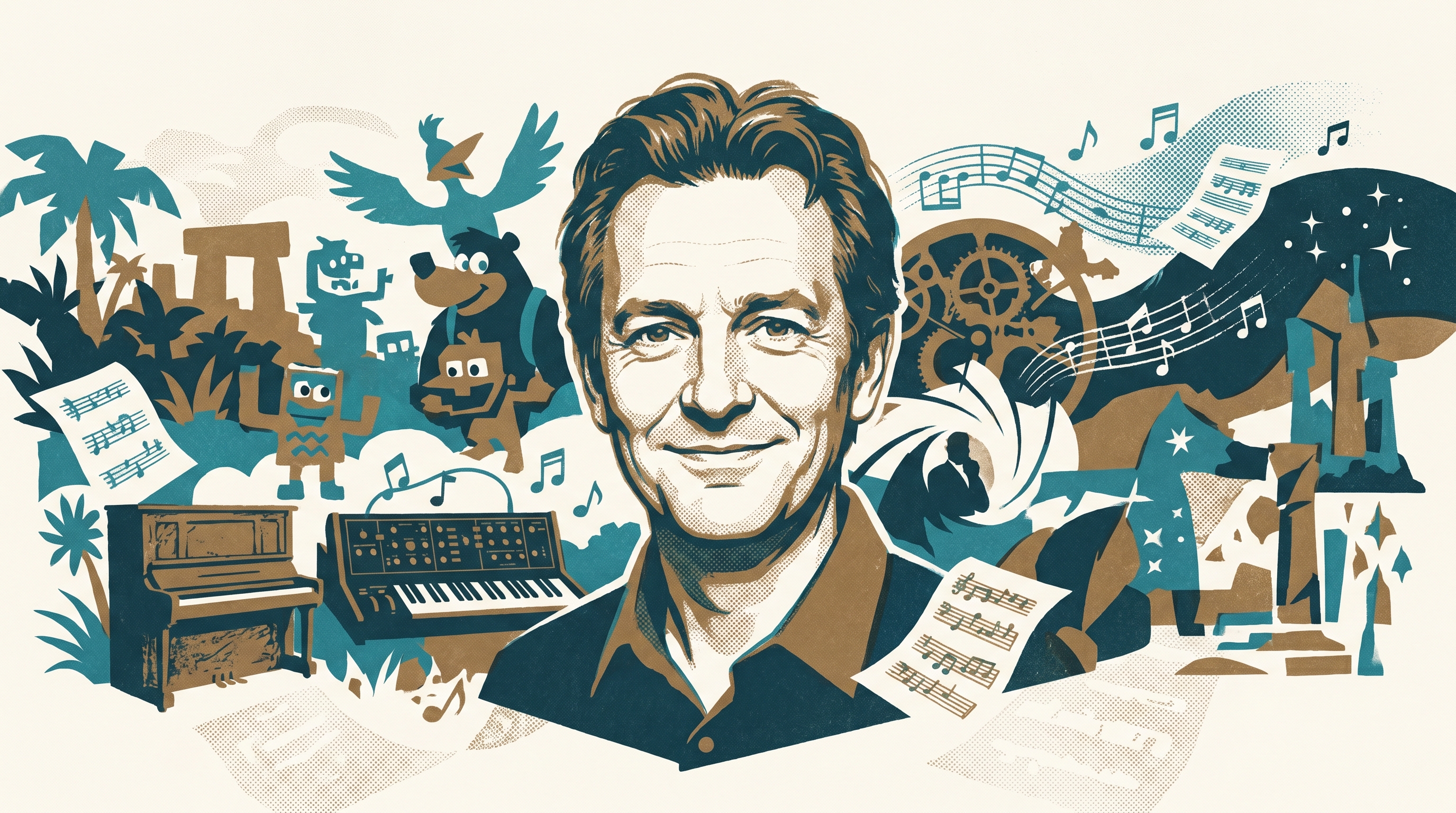
composer
Grant Kirkhope
He spent his twenties in an orchestra pit — then spent his thirties making children laugh on the Nintendo 64.
About
Grant Kirkhope is a British composer born in Edinburgh, Scotland, best known for his work at Rare during the Nintendo 64 era. A classically trained trumpet player who performed in orchestras for years before transitioning to game music, he composed the soundtracks for GoldenEye 007 (1997), Banjo-Kazooie (1998), Donkey Kong 64 (1999), Banjo-Tooie (2000), and Viva Piñata (2006), among others. His music is characterized by its playful melodic invention, rhythmic variety, and the sense of genuine delight that pervades even the most technically straightforward pieces.
History
Grant Kirkhope was born in Edinburgh, Scotland, and received formal classical training as a trumpet player. Before entering the games industry, he worked as a professional trumpet player in orchestras and theater productions — a background that gave him a rigorous technical foundation and an intimate understanding of how brass instruments function in an ensemble context. He spent years in the orchestra pit before he found his way to a keyboard.
In 1995, Kirkhope joined Rare, the UK developer that had become one of Nintendo's closest partners following the success of Donkey Kong Country on the Super Nintendo. Rare was at the beginning of its most productive period, and the Nintendo 64 was the platform on which it would release the work for which the studio is still best remembered. Kirkhope's first major project was an unexpected one: GoldenEye 007 (1997), the first-person shooter based on the James Bond film. GoldenEye became one of the best-selling Nintendo 64 games of all time and defined the console first-person shooter genre for years. Kirkhope composed the game's soundtrack largely by himself, working with the N64's sound hardware to create music that was simultaneously tense, atmospheric, and unmistakably British in its understated sophistication.
The work that defined his identity as a composer came next: Banjo-Kazooie (1998). The game — a platformer following a bear and a bird on a journey through colorful worlds — was designed to be a direct response to Super Mario 64, and the music needed to match the game's sensibility: endlessly inventive, warm, slightly absurd, and immediately endearing. Kirkhope's approach was to write themes that transformed depending on the context — the same melody reappearing in different rhythmic and harmonic guises as the player moved through different areas of the same world. The technique, sometimes called adaptive music, created the impression that the entire game existed in a single coherent musical space, which in turn made the world feel genuinely inhabited. Banjo-Kazooie sold over two million copies and became one of the most beloved platformers of its generation.
Donkey Kong 64 (1999) was a massive project — the biggest platformer on the N64 in terms of sheer content — and Kirkhope composed the entire score, including the Donkey Kong Rap, a brief comedic song that opened the game and became, decades later, a minor internet landmark. The rap was included, Kirkhope has said, partly because Rare's director wanted something to match the energy of a Saturday morning cartoon and partly because Kirkhope found himself in a studio with a microphone. It is not, technically, a high point of his compositional career. It is, however, possibly the most recognized short piece he has ever written.
Banjo-Tooie (2000) extended and deepened the musical language of the first game, with more complex adaptive techniques and a greater orchestral ambition. When Microsoft acquired Rare in 2002, Kirkhope remained with the studio and continued composing, working on Viva Piñata (2006) — a garden simulation game that required a very different voice from the platformer work, one gentler and more pastoral — and the Kingdoms of Amalur (2012) score, which he composed after leaving Rare.
Kirkhope has been notably public about his experience in the games industry and about the craft of game music composition. He has spoken in interviews about the technical constraints of the N64's sound hardware — the tiny ROM allocation for audio, the need to loop music seamlessly, the challenge of writing music that served gameplay rather than overwhelmed it — and about the relationship between classical training and game composition. His view, expressed consistently over many interviews, is that classical technique provides a toolbox, but that game music requires a different sensibility: the ability to write short, self-contained ideas that reward repetition rather than punishing it. The Banjo-Kazooie soundtrack is the most complete expression of that sensibility he has produced.
Timeline & Works
Career milestones and all 5 games in the museum they worked on — in the order they happened.
- 1995
Joined Rare
Kirkhope joined Rare, bringing a classical trumpet background to one of Nintendo's closest development partners at the start of the Nintendo 64 era.
career - 1997
GoldenEye 007 — console FPS landmark
GoldenEye 007 became one of the best-selling N64 games and defined the console first-person shooter genre. Kirkhope composed the tense, atmospheric soundtrack largely alone.
product - 1997
- 1998
Banjo-Kazooie — adaptive music and playful identity
His adaptive music technique, where the same melody transformed contextually as the player moved through worlds, helped make Banjo-Kazooie one of the most beloved platformers of its generation.
milestone - 1998
- 1999
Donkey Kong 64 — including the DK Rap
Kirkhope composed the entire score for the largest N64 platformer, including the Donkey Kong Rap, which became a cultural reference point decades later.
product - 1999
- 2000
- 2000
- 2006
Viva Piñata — a gentler voice
The Viva Piñata score demonstrated his range beyond platformers, writing music of pastoral warmth for a garden simulation aimed at a different audience.
product
Also connected to
- Graeme Norgate co-created GoldenEye 007 / co-created Perfect Dark
- Robin Beanland co-created GoldenEye 007
Explore the work
Each title has its own page — history, trivia, and collector's notes.
Nintendo 64 · 2000
Perfect Dark
GoldenEye's successor, by the same team. More ambition, twice the memory require…
Nintendo 64 · 2000
Banjo-Tooie
Rare made the sequel bigger in every direction. The worlds connected. The music …
Nintendo 64 · 1999
Donkey Kong 64
Grant Kirkhope was asked to make the DK Rap as bad as possible. It became famous…
Nintendo 64 · 1998
Banjo-Kazooie
Grant Kirkhope composed the score in fragments that reassemble themselves as you…
Nintendo 64 · 1997
GoldenEye 007
Nine people made GoldenEye. It sold eight million copies and taught a generation…
Rooms their games live in
Sources
- Grant Kirkhope — various interviews on N64 sound hardware and Rare development