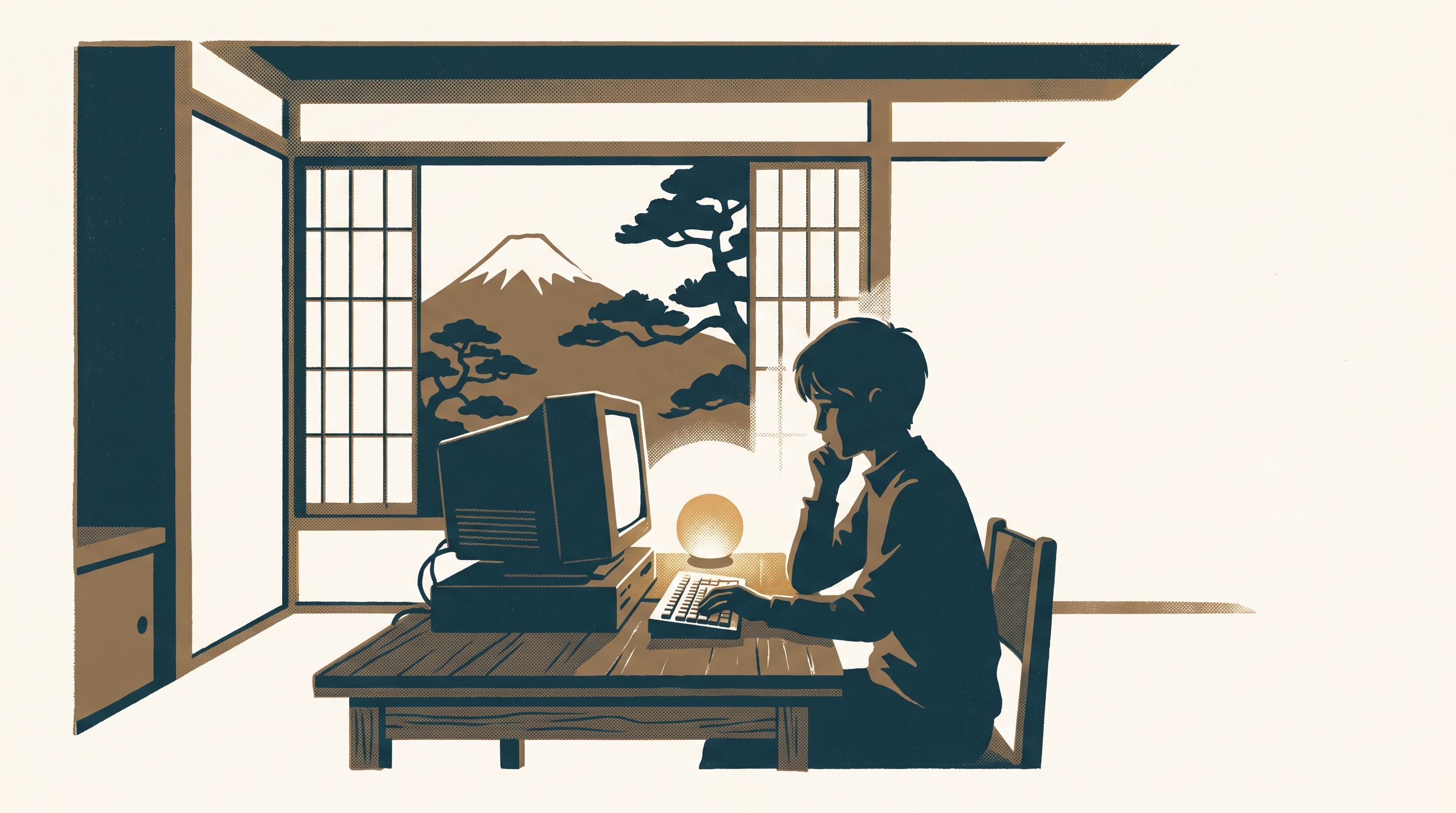
In 1992, HAL Laboratory was in financial trouble. The company had grown quickly during the Famicom boom, but by the early 1990s, accumulated debts had reached dangerous levels. Development costs were rising. Projects were taking longer. The company needed a hit, and it needed it fast.
Masahiro Sakurai had joined HAL Laboratory in 1989, fresh out of high school. He was nineteen years old. He had been programming since he was a teenager, teaching himself on a pocket computer. At HAL, he worked on projects as a junior developer, learning the tools and routines of game production. In 1990, the company asked him to direct a Game Boy title. He was twenty.

The brief was simple: make a game that anyone could finish. Most platformers at the time were built for players who could tolerate repetition and failure. Sakurai was told to make something different — a game for people who had never held a Game Boy before. No steep learning curve. No punishing difficulty. A game that invited you in and let you stay.
He designed the main character as a placeholder — a simple round shape that could move and jump. The character had no arms and no face. It was meant to be temporary. But Sakurai kept it. The simplicity felt right. The character could inhale enemies and spit them out. It could float in the air, giving new players time to correct their mistakes. The game had no complex systems. It had no hidden mechanics. It was built to be gentle.

The team named the character Kirby, after the American lawyer John Kirby, who had defended Nintendo in a lawsuit over the name Donkey Kong. Kirby's Dream Land was released in April 1992 for the Game Boy. It sold well. Not spectacularly, but steadily. Over time, it sold more than five million copies worldwide. For a company teetering on the edge of bankruptcy, it was enough to buy time.
HAL Laboratory survived. The company restructured its debts and continued operating. Kirby became a franchise. Sakurai directed several sequels over the next decade, each one adding new mechanics while preserving the original philosophy: make it so that anyone can finish. He left HAL in 2003, but the character he designed at nineteen remained one of Nintendo's most enduring properties.
Years later, in interviews and columns, Sakurai often returned to the idea of accessibility. He spoke about designing for the weakest player in the room, not the strongest. He spoke about the importance of letting people finish what they start. These were not abstract principles. They were the foundation of the game he made when his company needed saving.
The work Sakurai did at nineteen was not loud. It did not redefine a genre or push hardware to its limits. It did what it needed to do: it reached people who had been left out. It gave them something they could finish. And in doing so, it kept a company alive long enough to make the next thing, and the thing after that. That quiet light, lit in 1992, never went out.