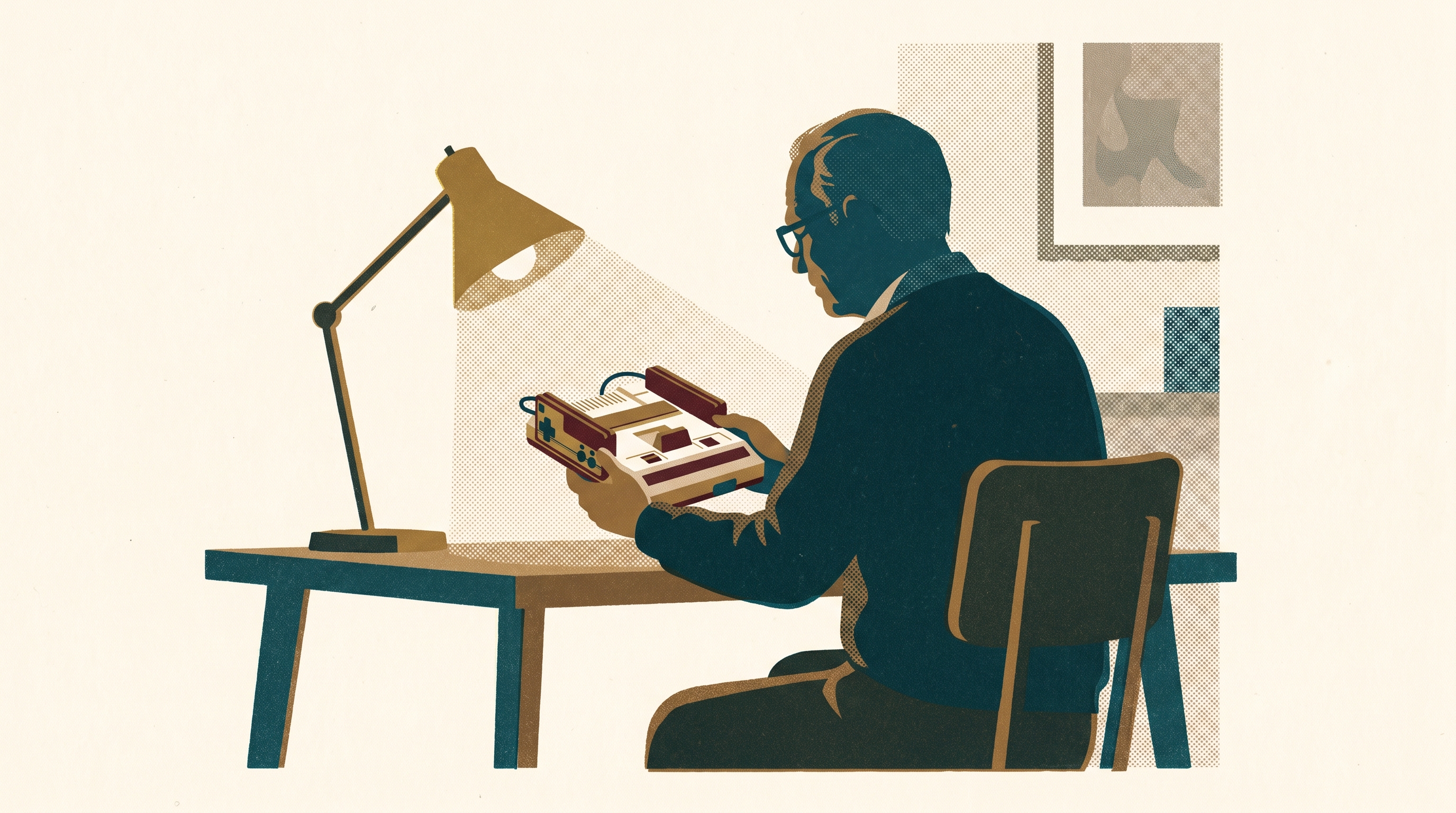
In a university room in Kyoto, an old man in his seventies sat among younger researchers, studying a red-and-white plastic box from 1983. He had designed that box himself. Most engineers who build something the whole world ends up using will, at some point, allow themselves to rest. Masayuki Uemura did close to the opposite. He spent the last decade of his life asking what the thing he had made had actually meant to the people who grew up with it.
He was born in Tokyo in 1943. He graduated from the Chiba Institute of Technology in 1967 with a degree in electronic engineering, and joined Hayakawa Electric — the company that would later become Sharp. There he worked on solar cells. It was ordinary, careful engineering work, the kind that rarely has anyone's name attached to it. One of the things his division did was sell photocell technology to other companies. One of those companies was a small Kyoto firm that had started in playing cards and was now making toys and light-gun games. It was Nintendo, and the man using his photocells was an engineer named Gunpei Yokoi.
In 1971, Yokoi pulled him over to Nintendo. The reasons were not entirely grand. Uemura later said that one thing that decided it for him was simply that Nintendo did not transfer its employees around the country — he would not be uprooted and sent somewhere far away. A small, human reason, for a decision that would sit underneath an entire industry. He went to work alongside Yokoi and a young engineer named Genyo Takeda on Nintendo's Laser Clay Shooting System.
He was a hardware man. Not the games — the machine the games ran on. In the late 1970s he led the development of Nintendo's first home consoles, the Color TV-Game line, simple dedicated machines that played a handful of built-in games. By 1978 he was running a development division. He built the boxes. Other people would fill them.
One evening in November 1981, the phone rang. It was Hiroshi Yamauchi, Nintendo's president, and the request he made sounded almost offhand: build a machine that can play our arcade games at home, let people swap the games in and out on cartridges, and price it so low that no competitor can follow for a year. It was not a description of a product. It was a description of a problem, handed to the man whose job was problems.
The hardest part of the order was the price. To hit it, Uemura's team could not buy ordinary parts; they needed custom chips made cheaply, in volume. They found their partner in Ricoh, whose semiconductor plant in Ikeda had idle capacity and an engineer who had helped Nintendo before. The whole machine was an exercise in doing more with less — a single custom processor, a clever picture chip, no luxury anywhere. The constraint was not the enemy of the design. The constraint was the design.
The Family Computer went on sale on July 15, 1983, for 14,800 yen — well below what its rivals were asking. The first units carried a faulty chip that could freeze the machine, and Nintendo had to deal with the defect after launch; Uemura was the one who saw it through. The machine recovered. It sold two and a half million units in Japan by the end of 1984, and then it kept going, far past Japan, into tens of millions of homes around the world. An industry that had nearly collapsed in America found its floor again on a red-and-white box from Kyoto.
In 1988 he began work on its successor, the Super Famicom, released in 1990. For its sound he worked with a Sony engineer named Ken Kutaragi — a collaboration that would later fracture and, in fracturing, give the world the PlayStation. Uemura did not chase the machines that came after. He did not design the Nintendo 64 or the GameCube. He had laid the foundation; he was content to let others build upward from it.
He retired from Nintendo in 2004. Most men would have stopped there. Instead he became a professor at Ritsumeikan University, and in 2011 he founded and led its Center for Game Studies — a place to study video games as something worth understanding, the way one studies film or music. He spent his final years not defending what he had built, but quietly asking what it had done to people: what play meant, why a generation had loved a red-and-white box. He died on December 6, 2021, at the age of seventy-eight. The machine he designed is the floor a great deal of this still stands on. He spent the first half of his life making sure the floor would hold — and the second half asking what people did once they were able to stand.